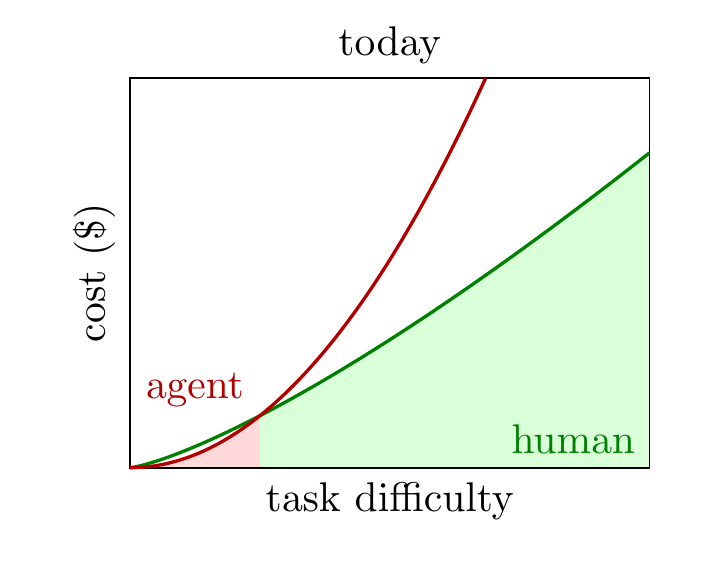
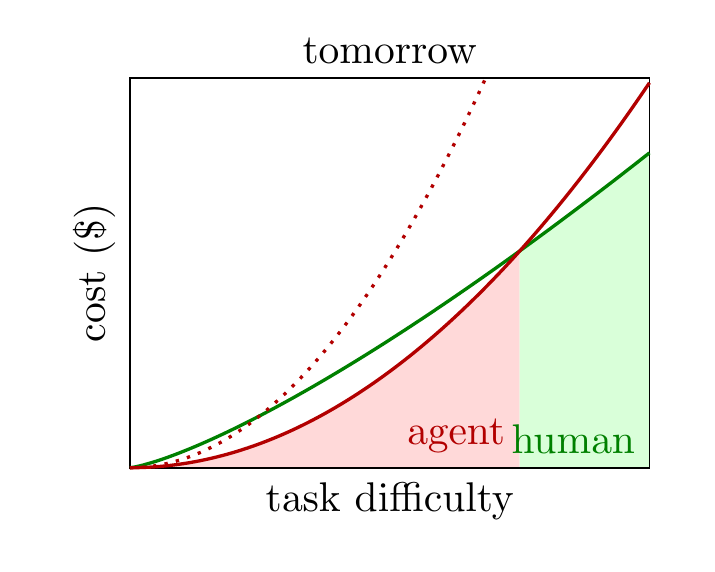
TLDR: even when agent value is high, agent expenditure might be small.
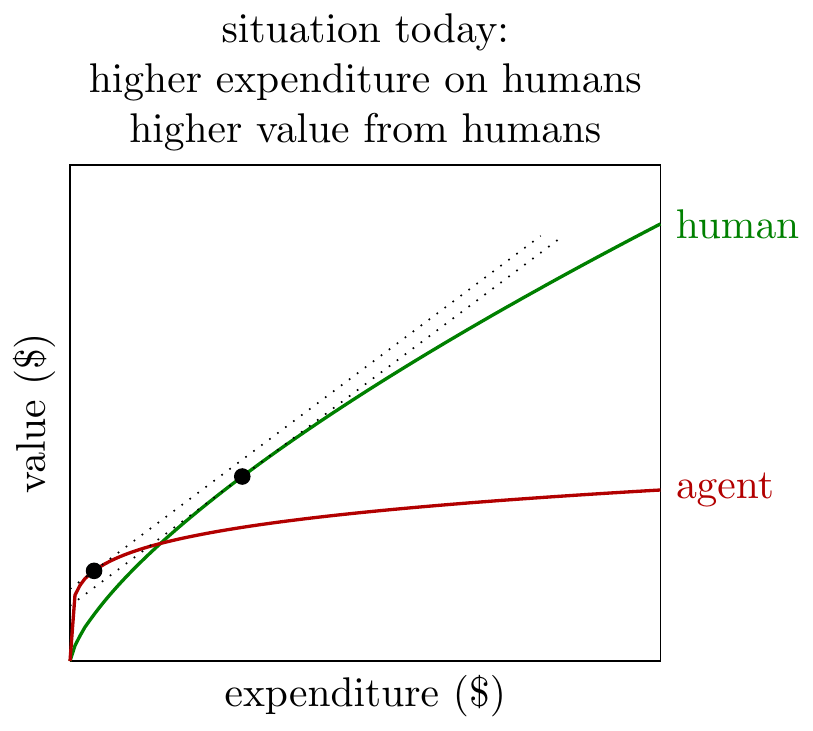
- The returns on agent expenditure diminish more steeply than returns on human expenditure.
-
The current evidence is that (broadly speaking) agents can either (1) do a task more cheaply than humans, or (2) cannot do that task at all. There are relatively few tasks which an agent can perform, but only at a cost higher than the equivalent cost for humans.
This implies the returns on agent expenditure diminish more steeply than the returns on human expenditure: with agents you can solve a lot of problems cheaply, then you quickly hit a wall.
Below I give some evidence for the claim and some theoretical reasons to expect an asymmetry between human and agentic labor.
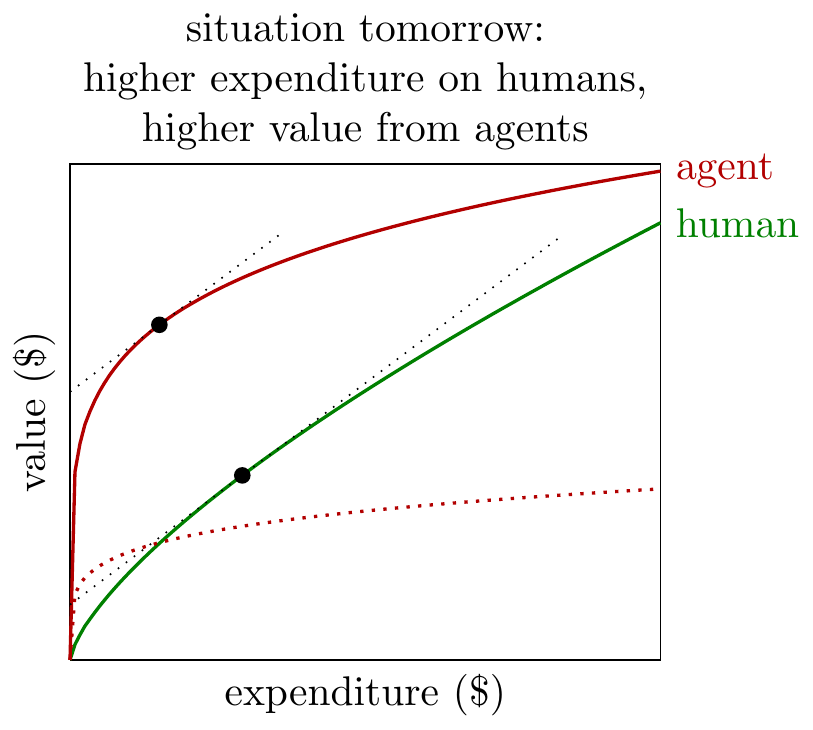
- Implication: the average return on expenditure will be higher for agents than for humans.
- This observation implies that, in equilibrium, the average value per dollar of agent expenditure will be higher. Thus the share of value from agents will generally be higher than the share of expenditure on agents.
- Real world implications.
-
- Expenditure shares will be poor predictors of the value of agentic labor. A very concrete example: suppose we watch the share of AI lab expenditure on .
- Notes:
-
- The optimality conditions are treating returns on expenditure to the two factors as completely additive: \(Y=F(L)+G(A)\) (where \(L\) is human labor and \(A\) is agentic labor).
- Evidence.
-
There are a few interesting related claims:
- Agents have lower elasticity than humans at every level of expenditure.
- Agents have a capability ceiling below human ceiling (if any).
- For each task either (1) agents can do it cheaper than humans, or (2) agents cannot do it at any expenditure level.
I think statement #1 is probably the most useful, both theoretically and empirically. The other two claims involve asymptotic behavior of agents, i.e. whether they could do a task at enormously high levels of expenditure. But the elasticity claim is easier to test and seems sufficient for most practical cases.
A classic piece of evidence:
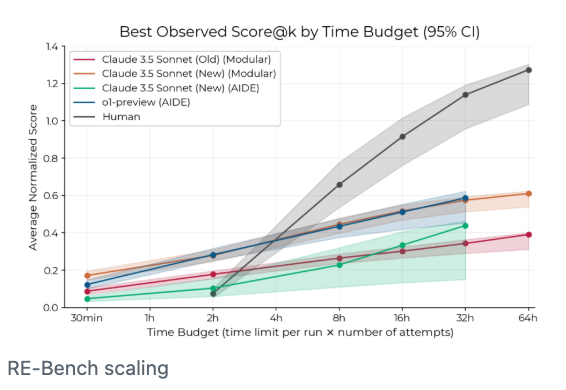 .
. - Derivation of elasticity condition.
-
Claim: the ratio of expenditure to value is equal to the elasticity of the returns-to-expenditure curve at the optimum.
Let \(V = f(E)\) be value as a function of expenditure. The firm picks \(E\) to maximize \(V - E\), so the FOC is \(f'(E^*) = 1\) (marginal $1 input returns \(1 output). The elasticity of the curve is\)\(\varepsilon \;=\; \frac{dV}{dE}\cdot\frac{E}{V} \;=\; f'(E)\cdot\frac{E}{V}.\)$
At the optimum \(f'(E^*)=1\), so \(\varepsilon = E^*/V^*\), i.e. elasticity is the expenditure-to-value ratio. Equivalently \(V^*/E^* = 1/\varepsilon\): a less elastic curve (steeper diminishing returns) yields a higher value-to-expenditure ratio. If agent returns are less elastic than human returns, agents produce more value per dollar spent even though total expenditure on them may be small.
- Related literature