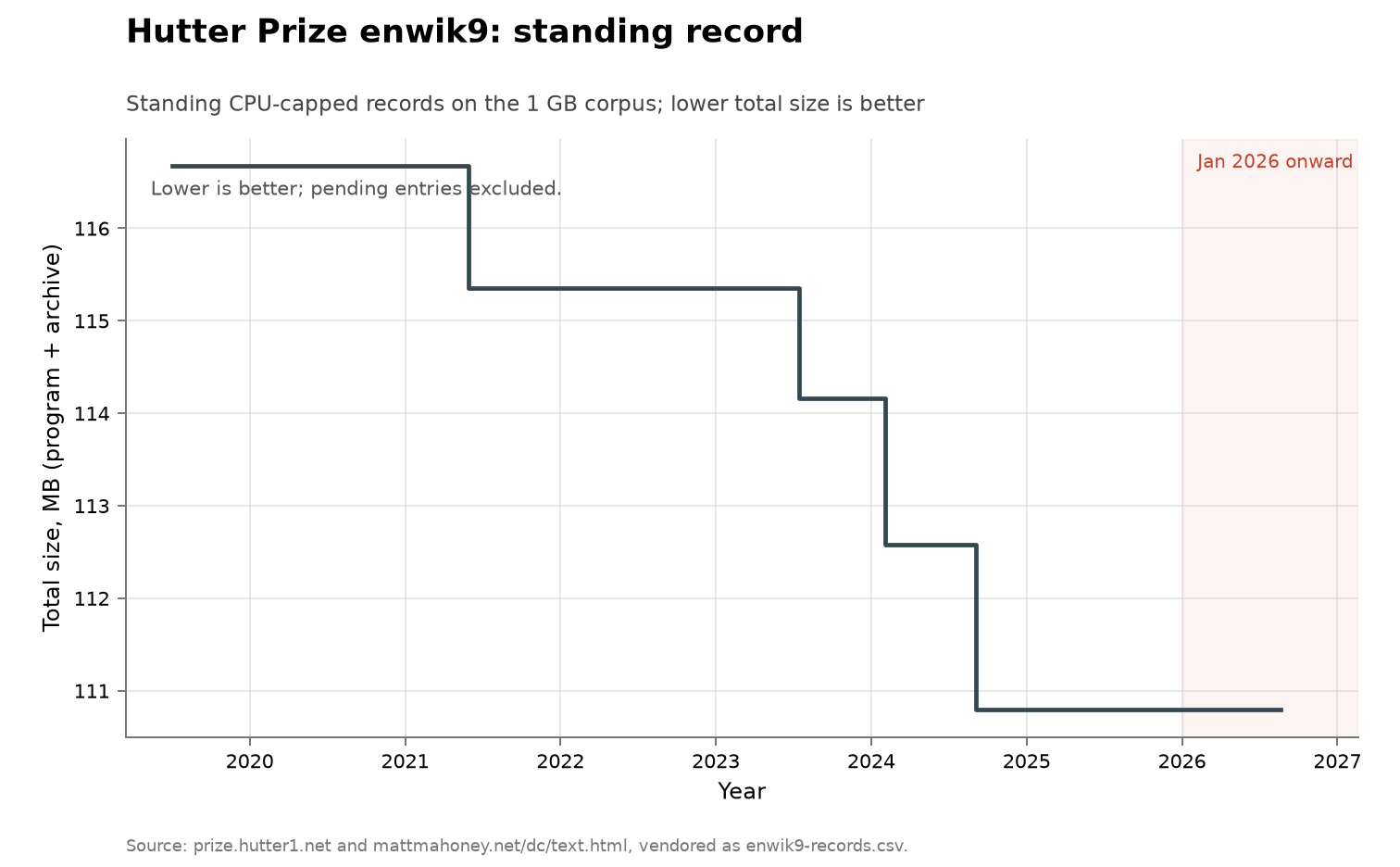
Metric: total size in bytes of decompressor plus archive for a fixed 1 GB
text corpus, under a CPU-time and memory cap, per awarded record
Coverage: 2019 baseline to 2026; the prize moved to enwik9 on 2020-02-21;
prize site read 2026-10-03, benchmark page's own update dated 2026-09-30;
rows through the 2026-09-21 snapshot date
Data:enwik9-records.csv, holding both the
hutter_enwik9 and ltcb_enwik9 series
Verdict: accelerating — 3 awarded records in 2026 against 0 in 2025 and
4 over 2021–2024; the 2026 awards cut the record 9.4% against 5.0% over
2019–2024
Hutter Prize enwik9 record
Definition
The task is to compress the first 10^9 bytes of a fixed XML dump of English
Wikipedia, scored on the compressed size including the size of the
decompression program. The corpus was frozen in 2006, so the task has no
benchmark drift by construction, and counting the decompressor closes the
loophole of hiding the model in the program.
The prize caps resources:
"must run in ≲50 hours using a single CPU core and <10GB RAM and <100GB
HDD on our test machine"
— Hutter Prize rules, prize.hutter1.net, read 2026 [@hutter2026prize]
The cap excludes GPUs at run time, so two series are plotted rather than one:
the prize is the constrained series, and Matt Mahoney's Large Text
Compression Benchmark is the same corpus with no cap, admitting GPU and TPU
compressors [@mahoney2026ltcb].
A "discovery" is an awarded record, dated by the date the prize site's record
table gives it, which is the submission date; the award itself can come
months later. The prize pays only for improvements of at least 1% over the
standing record, so the ledger records steps that cleared a hurdle, not every
improvement made.
Facts
baseline: 116,673,681 bytes at the 2019 phda9v1.8 baseline
awards to 2024: starlit by Artemiy Margaritov on 2021-05-31 · fast cmix
by Saurabh Kumar on 2023-07-16 · fx-cmix by Kaido Orav on 2024-02-02 ·
fx2-cmix by Kaido Orav & Byron Knoll on 2024-09-03 at 110,793,128 bytes
awards of 2026: cmix-lex by Ibrahim Marcouch & Kaido Orav on
2026-06-26 · cmix-obias by David Freelan on 2026-07-19 ·
fx2-cmix-transformer by Vladimir Ivanov on 2026-07-24 at 100,424,672
bytes; all three awarded together on 2026-09-30
steps: measured against the record each displaced, the steps are 1.13%,
1.04%, 1.38%, 1.59%, 1.01%, 1.05% and 7.46%; the four awards of 2021–2024
take the total down 5.0% from the 2019 baseline, the three awards of 2026
take it down a further 9.4%, and the standing record is 13.9% below the
2019 baseline
pending: zmix 1.0 by James Byrne, listed on the benchmark page on
2026-09-14 at 99,312,424 bytes of archive plus compressor, a further 1.11%
and inside the 99,420,425 needed to clear the 1% hurdle; undergoing prize
testing as of the benchmark page's 2026-09-30 update
uncapped: nncp v3.2 reached 107,261,318 bytes on 2023-10-23 and stood
until 2026-07-24; zmix 1.0 reached 96,096,261 bytes on 2026-09-14, the
lowest uncapped entry dated on or before the 2026-09-21 snapshot
The 2026-07-24 step replaced a hand-built model with a small pretrained one:
"It is derived from fx2-cmix by replacing the LSTM model with a transformer
with 6M parameters pre-trained on enwik9 on 8 RTX 5090 GPUs for 26 hours,
adding 2.9 MB to the compressor and decompressor. It does not need a GPU to
run."
— Large Text Compression Benchmark, fx2-cmix-transformer entry, read 2026-10-03 [@mahoney2026ltcb]
The award announcement:
"Ibrahim Marcouch & Kaido Orav are the ninth Winners! David Freelan is the
tenth Winner! Vladimir Ivanov is the eleventh Winner!"
— Hutter Prize, prize.hutter1.net, news banner, read 2026-10-03 [@hutter2026prize]
The retired 100 MB enwik8 prize is a different corpus and is not joined to
the curve. Its complete five-row chronology:
Date
Program
Total bytes
Status
2006-03-24
paq8f -7
18,324,887
pre-prize baseline
2006-09-25
paq8hp5 -7
17,073,018
first award
2007-05-14
paq8hp12 -7
16,481,655
second award
2009-05-23
decomp8
15,949,688
third award
2017-11-04
phda9
15,284,944
fourth award
Alexander Rhatushnyak set all four enwik8 awards; the gap before the last
runs eight and a half years. The prize moved to enwik9 in February 2020.
The collection-wide cumulative index redraws this
series as the standing record's value over time:
Method
The rows are transcribed by hand from the two upstream pages, so there is no
fetcher that rebuilds them. fetch.py is a staleness probe
instead: it reads the prize page's record table and reports if its top
awarded row is smaller than the CSV's standing record, leaving the CSV and
this document to be updated by hand. check.py recomputes the
fact lines above from the CSV.
Prize rows carry the totals the prize site scores, which add the compressor
to the self-extracting archive; the pending row carries the same sum as the
benchmark page lists it. Benchmark rows carry the benchmark's own total and
keep only entries that set a new uncapped low.
figure.py calls the shared compression_chart() in
../../lib/families.py, which reads
enwik9-records.csv, keeps the rows whose series column matches, and plots
total_bytes divided by 10^6 against the year fraction of date as a step
function. Rows whose award column is anything other than pending are
drawn filled and joined by the solid line, which therefore includes the
unawarded 2019 baseline; the pending row is drawn as an open marker labelled
from its program column, "zmix 1.0, pending". When the series is
hutter_enwik9, the function additionally selects the ltcb_enwik9 rows and
draws them in grey dashes, with a corner note reporting the last uncapped
row's size and month. The axis is linear and in megabytes; January 2026
onward is shaded, as in every figure here.
Limitations
a hurdle censors the small steps. The prize pays only above 1%, so
improvements below that threshold are invisible here whether or not they
happened, and the 1.0–1.6% steps before 2026-07 are partly an artefact of
the rule.
neural is not AI-authored. fx2-cmix-transformer and the uncapped
entries below it carry a transformer trained offline, nncp has used a
transformer since 2021, and cmix has carried an LSTM since 2016; a trained
model inside a compressor is not a model-written compressor.
training compute sits outside the cap. The cap binds the run on the
test machine; the 26 GPU-hours on 8 RTX 5090s that trained the
fx2-cmix-transformer weights are not counted, only the weights' bytes.
the snapshot date leaves out a later entry. The benchmark page lists
cmix-lex-transformer lexth11c, dated 2026-09-27, below zmix 1.0 at
95,836,613 bytes; it postdates the 2026-09-21 snapshot and is not in the
CSV.
the two pages do not agree on every byte count. fx2-cmix is
110,793,128 on the prize site and 110,351,665 on the benchmark, because the
prize adds the compressor and the benchmark does not, and the benchmark's
nncp v2 row prints a total equal to its archive-only size, apparently
omitting a 99,671-byte decompressor.
the rows were transcribed by hand from prose pages. Neither upstream
is a feed; both are HTML tables read and typed into the CSV, and the prize
site was read over plain HTTP because its TLS certificate has expired.
the capped and uncapped series are not comparable in level. They are
different rules on the same corpus, which is why they share an axis but
not a line style.
the 2026 awards came out together. The three 2026 records were dated
by submission across four weeks but awarded on one day, 2026-09-30, after
a 2025 with no award; the dating rule spreads one announcement across
three dates.
AI attribution
No record on either the capped or the uncapped series credits a language
model or an agent as the author of a compressor, as of the prize-site read of
2026-10-03 and the benchmark page's update of 2026-09-30; entry write-ups and
source repositories were not read. The nearby AI-credited results in this
domain are not compression records: the 23% GPU kernel speedup reported in
the AlphaEvolve paper [@novikov2025alphaevolve], and GPU kernels found by
test-time training that beat the best human submissions by 15 to 51%
[@yuksekgonul2026learning].
Sources
[@hutter2026prize] — the prize site: the record table and award dates,
the resource cap quoted above, the 1% improvement hurdle, and the award
announcement.
[@mahoney2026ltcb] — the Large Text Compression Benchmark: the uncapped
rows, the pending zmix 1.0 entry and its compressor size, the
fx2-cmix-transformer description, the lexth11c entry named in Limitations,
and the enwik8 chronology.
[@novikov2025alphaevolve] — the AlphaEvolve kernel speedup cited in the
AI-attribution register.
[@yuksekgonul2026learning] — the test-time-training kernel result cited in
the AI-attribution register.
[@sherry2021fast] — the published base rate: about half of algorithm
families show little or no improvement over decades, with improvements
arriving at roughly 1.44 per family since 1940.