Verdict: no acceleration — 91 announced updates across 2 releases in
2026 through 2026-09-24 against 13 in 2025 and a 90.1/year mean over
2019–2025
MIPLIB 2017 solufile releases
Definition
MIPLIB is a standard public library of mixed-integer programs. Its
maintainers accept new solutions to open instances and periodically publish a
new solution file, announcing each release in the site's News Log. This
series treats the 2017 collection as a maintained frontier: a better
incumbent improves a known feasible objective, a first feasible solution
closes an instance with no prior incumbent, and an optimality update proves
or records that the frontier cannot be improved.
The three kinds are counted separately because they record different work. A
"discovery" is one announced update, dated by the release announcement; the
unit is the count stated in each announcement, not a solver run and not the
number of changed lines in a downloaded solution file.
Facts
releases: 29 releases with explicit solution counts, 2019-08-26
through 2026-09-24
totals: 650 better incumbents, 44 optimality updates and 28 first
feasible solutions
2026: 2 releases, solufiles 36 and 37, through 2026-09-24 report 91
better incumbents
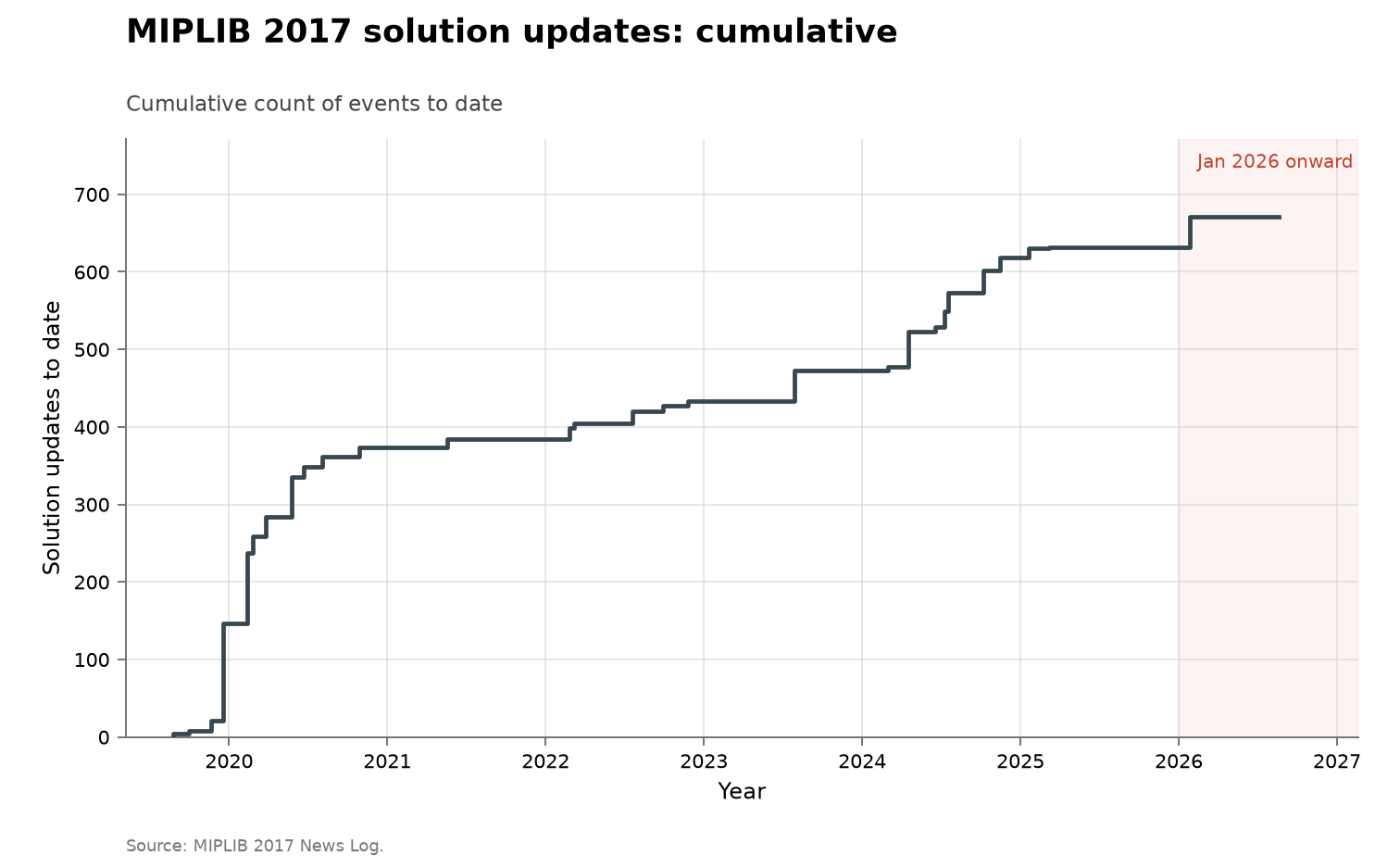
The collection-wide cumulative index redraws this
series as cumulative announced solution updates to date:
Method
The News Log was transcribed by hand into
miplib-solution-releases.csv. For
announcements that give a total and say how many were first-known or optimal,
the categories are made disjoint: the 91 improved incumbents in February 2020
become 86 ordinary improvements, two first feasible solutions and three
optima. Open-to-hard/easy status changes are counted as first feasible;
"marked optimal" entries are kept in optimal_status_only.
figure.py aggregates releases by year and stacks the three
update kinds without treating them as the same event type.
fetch.py is a staleness probe rather than a fetcher, because
the classification depends on prose; it checks whether the live log has
advanced beyond the last vendored solufile. check.py recomputes the fact lines
above from the CSV.
Limitations
publication dates, not discovery dates. A year with one large release
does not mean every improvement was found on that release date; annual
counts are publication cadence as well as discovery cadence.
vocabulary drift. The news prose changes vocabulary across releases, so
category boundaries require the explicit rules stated in Method.
unweighted counts. Counts do not measure objective magnitude or
instance difficulty.
the collection is substantially but not perfectly fixed. Corrected
instances and status tags exist; the library is cleaner than annual
benchmark scores, not immutable.
status changes without an origin are not counted. Solufile 37's
announcement reports "2 instances updated to easy" without saying from
what; its changelog shows one of the two, neos-5045105-creuse, had been
open, which the rules above would count as a first feasible solution. The
CSV keeps the announcement's own count, as for solufile 36's status
changes, so that release carries none.
category overlap. A newly optimal solution can overlap conceptually
with an improved incumbent; the CSV makes categories disjoint to avoid
double-counting.
AI attribution
No AI system or language model is credited in the release-log entries
transcribed here, through the 2026-09-24 release. Submitters and solver
provenance are not recorded consistently enough in these aggregate
announcements to infer whether an AI tool contributed, so the absence of an
AI label is not evidence of absence.
Sources
News Log — the release announcements
every row is transcribed from.
Download page — preserves old
solution files and fixed collection lists, allowing a future
instance-level reconstruction of objective magnitudes.
MIPLIB 2017 paper — documents
collection and benchmark selection for the 2017 edition.
Sibling series: CVRPLIB X instances
counts posted record events for a different fixed instance cohort;
Gurobi MILP speed measures solver
release speedups on the same problem class.