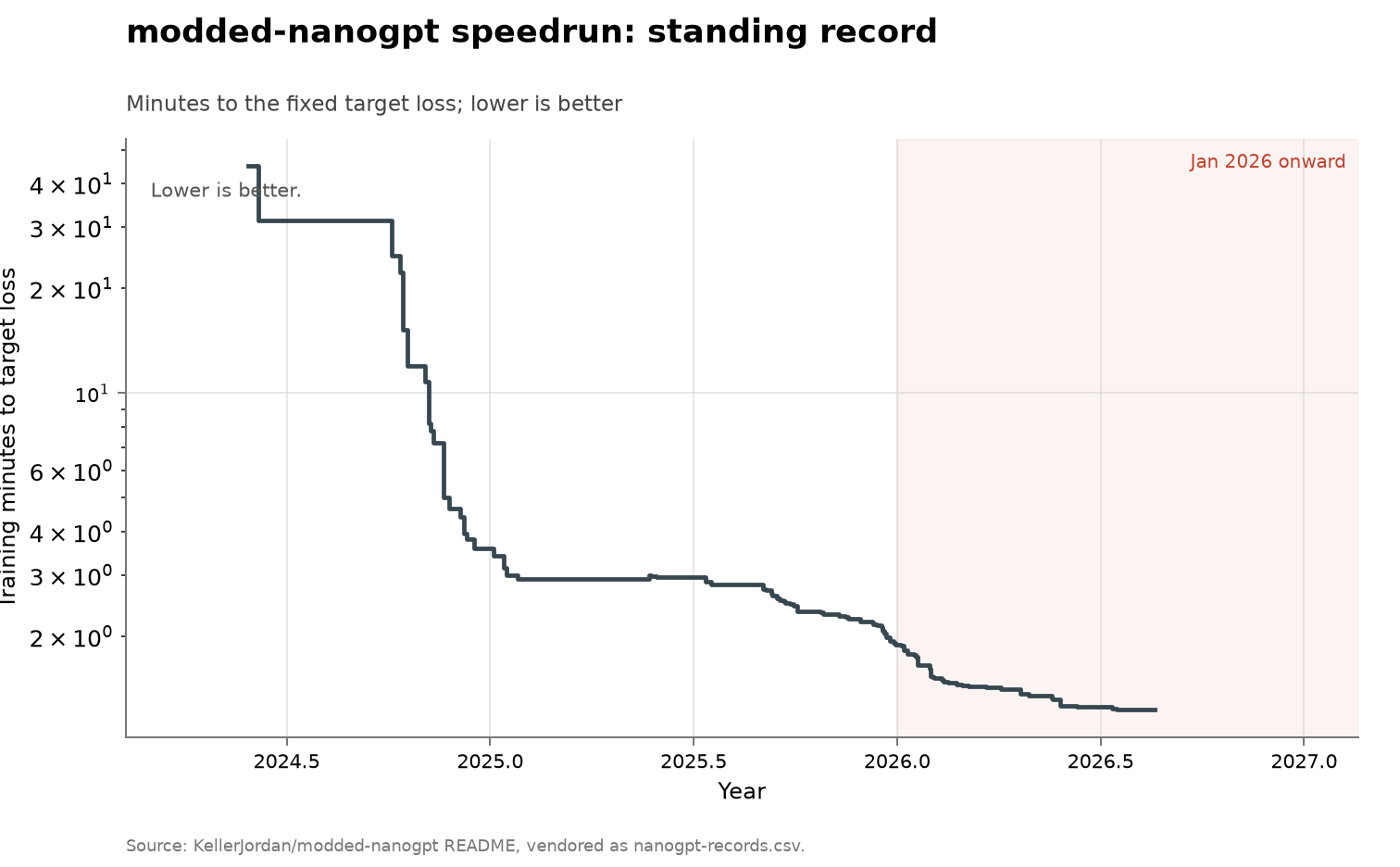
nanogpt-records.csvmodded-nanogpt is a public competition to train a GPT-2-scale language model to a fixed target validation loss in as little wall-clock time as possible. The target is fixed by the rules, so a record is the same capability reached with less compute — an efficiency series rather than a capability series — and an AI-set record is directly comparable with a human one.
A "discovery" is one record accepted into the README's table, dated and credited to a named entrant. Every record carries a day-precise date and an author, which is what allows the AI share to be counted rather than estimated. The fixed-hardware assumption comes from the leaderboard's own rules; the vendored CSV carries only the record number, date, minutes, agent, credited AI system, and a note, so nothing in the data itself pins the machine.
Co-authored-by trailer on the record's merge commit, the
third from its author, none from the README tableThe collection-wide cumulative index redraws this series as the standing record's value over time:
The record rows are transcribed by hand, since attributing a record needs
judgment the README states only in prose. For those, fetch.py
is a staleness probe rather than a fetcher: it reads the upstream README and
reports if a record past the vendored series has been accepted. Open claims
it does write: every open Track 1 pull request whose title claims a time —
in minutes or seconds — below the standing record, opened on or before the
snapshot date, becomes a row whose record is PR<number>, whose date is
the day the request was opened and whose agent and ai_system are empty,
since attribution waits for acceptance. A claim that is merged becomes a
transcribed record row; one that is closed drops out at the next run.
Which kind of row a claim becomes follows the leaderboard's own acceptance
rules, read from the files the pull request adds. It is kind=pending if a
statistics file states p < 0.01 that mean validation loss is at most 3.28,
the runs are on 8xH100, its baseline file names a merged record rather than
another open pull request, and no reviewer's latest review requests changes;
otherwise it is kind=claim, with the tests it failed in note. The size of
the claimed step is deliberately not a test, since record 92 cut the time by
41% and was accepted. Neither kind enters a fact line other than pending
and unvetted claims, or any figure in this folder; the collection's
cumulative comparison page draws the pending rows on request as a tentative
extension of the standing-record line.
check.py recomputes the fact lines above from the CSV.
figure.py reads nanogpt-records.csv, converts each date to
a year fraction, and draws minutes as a step function through all 92 rows
with kind=record. Each record is a point coloured by the agent column,
red where it is ai, pale red where it is ai_assisted and blue where it is
human, with the AI points drawn larger and labelled from the ai_system
column. The y axis is logarithmic, with ticks set explicitly at 0.7, 1, 1.5,
2, 3, 5, 10, 20 and 45; a linear axis would
compress the whole 2025–2026 stretch into the bottom of the frame. January
2026 onward is shaded, as in every figure here.
One discontinuity in the series has a documented cause. Records 22 to 24, in
May 2025, are slower than record 21 of January 2025 as printed in the
README's own table, because the leaderboard changed how it times a run after
record 21: ten formerly untimed warmup steps became timed, worth about 850ms,
and torch._inductor.config.coordinate_descent_tuning was banned, worth
about three seconds. Upstream re-timed record 21 under the new rules at 2.997
minutes and again on the then-current torch at 3.014. Against 3.014, records
22 to 24 at 2.990, 2.979 and 2.966 are improvements rather than a regression.
Both re-timings are vendored as kind=retiming rows and drawn as open
markers. Apart from the two re-timings, nothing is plotted with an open
marker on this series, because every record row carries a firm date and an
acknowledged holder.
agent column reflects the README's own
labels, the co-author trailers on each record's merge commit and, for
record 92, its author's account, so a record set with undisclosed model
assistance counts as human.Five of the 92 records are credited to AI-agent companies: hiverge.ai,
Locus, Aster, Station and Recursive, at the dates and times listed in the
fact lines above, each measuring roughly one percent against the record it
displaced. The README's entry for record 60 (Locus) is an explicit fused
Triton kernel [@kellerjordan2026moddednanogpt], and the CSV note for record
87 records a faster ReLU^2 kernel "credited to @cong_ml and AI System
Recursive". hiverge.ai also holds the first acknowledged AI record on the
CIFAR-10 speedrun, so the AI-set records
on the two ML speedruns partly belong to the same small set of firms. No
other record in the CSV carries an agent value of ai.
Three more are ai_assisted: entries by named people who worked with a
model. Record 82 (learnable XSA gated layers, PR #264) carries
Co-authored-by: Claude Opus 4.7 on its merge commit, and record 91
(canonical token masking, PR #350) carries Co-authored-by: Claude Opus 5.
Record 92 (ANVIL2, PR #360), the largest step of 2026, names no model in its
own commit — the Claude Opus 5 trailer on its merge commit came in with PR
(personal communication to this repository's maintainer, 2026-10-05). It is the one attribution here not readable from the public record.
Two adjacent results are AI-credited off this leaderboard. TTT-Discover's test-time-training harness, running the open gpt-oss-120b model, found TriMul GPU kernels 15 to 51% faster than the best human submission depending on GPU type [@yuksekgonul2026learning]. Karpathy left an agent tuning nanochat for about two days in March 2026; it worked through roughly 700 changes, about 20 of which improved validation loss, after which Karpathy himself tested, transferred and stacked them and measured an 11% cut in time to GPT-2 [@karpathy2026autoresearch].