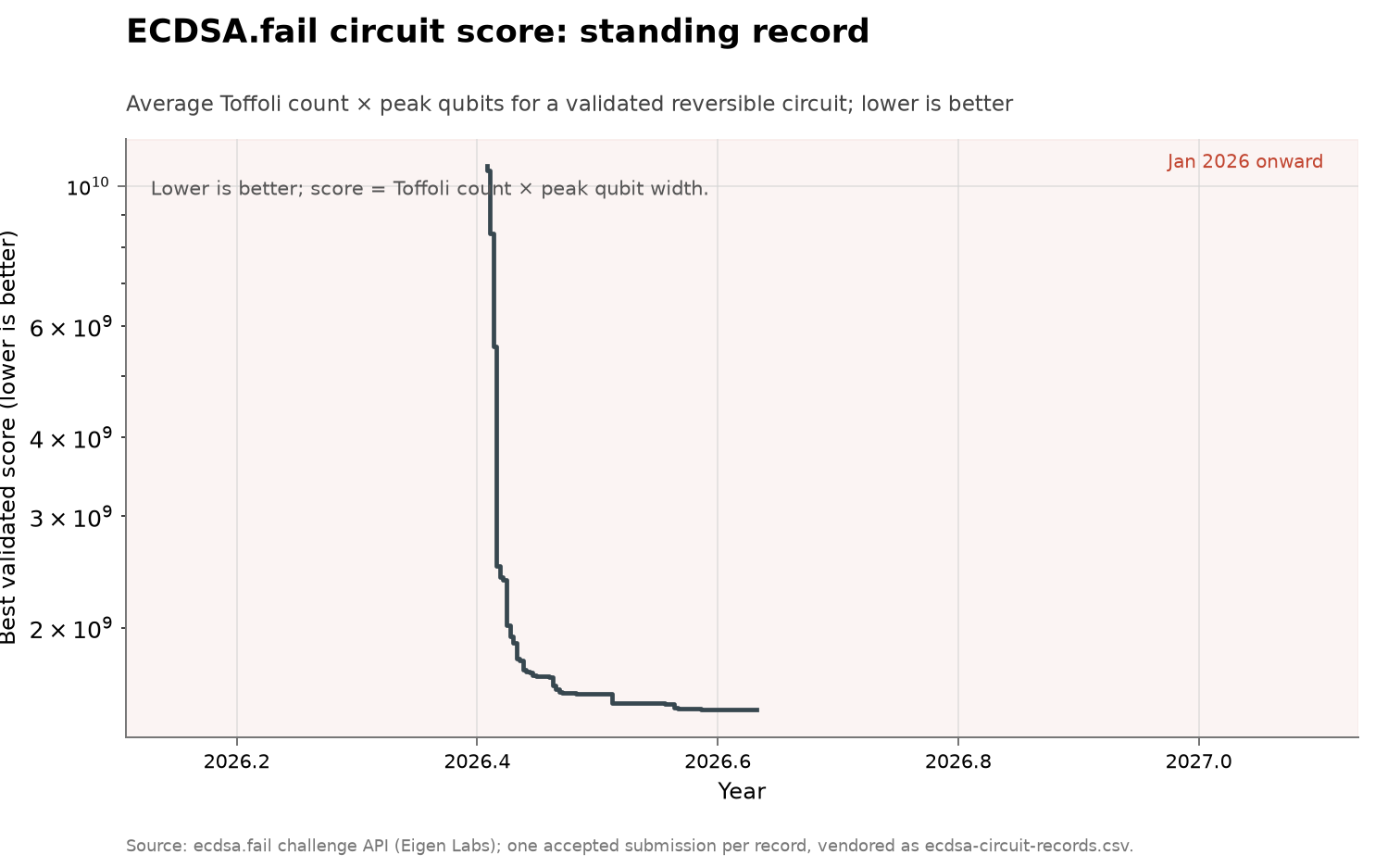
ecdsa-circuit-records.csvEach point is an accepted record; click to open the solver's GitHub profile.
ECDSA.fail is an Eigen Labs challenge to build the leanest reversible quantum circuit that performs one elliptic-curve point addition on secp256k1 — the curve securing Bitcoin and Ethereum. Point addition is the inner primitive Shor's algorithm repeats thousands of times to compute a discrete logarithm, so its cost dominates the quantum resource estimate for breaking the curve [@litinski2023ellipticcurve].
Each submission is scored as the average executed Toffoli count times the peak number of live qubits, and is accepted only after simulating correctly on 9024 test points whose inputs are fixed by a Fiat-Shamir hash of the submitted op stream, so a circuit cannot be tuned against the test set. Lower is better. The API accepts only submissions that beat the standing record, so a "discovery" is one accepted record, dated by its submission timestamp. The challenge opened on 2026-05-30, inside the agent era.
The collection-wide cumulative index redraws this series as the standing record's value over time:
fetch.py reads the challenge API's list of accepted submissions
for the live gpsanant/ecdsafail-challenge benchmark. The API only accepts a
submission that beats the standing record, so the accepted submissions
already are the record ladder — one row per record, carrying its date,
official score, the Toffoli and qubit metrics behind it, the solver's
username, and whether the submission's note names an AI tool. Submissions
dated after lib/dates.py's AS_OF_DATE are dropped so a refetch cannot
push the vendored CSV past the repository's committed snapshot date.
figure.py plots score on a log axis against calendar day; the
whole series sits inside 2026, so month ticks on a day count replace the
usual year axis. The two reference lines — the starting circuit and Google's
published point — are the anchors quoted in the challenge README. Points are
red where the submission's free-text note names an AI tool and grey where it
does not. check.py recomputes the fact lines above from the
CSV.
Of 537 accepted records, 474 carry notes naming an AI tool. Counted from the
free-text notes the challenge API returned at the 2026-08-10 read — the
vendored CSV carries only the per-row yes/no flag — 374 notes include an
explicit Model: line: Claude Opus 4.8 leads at 150, followed by GPT-5 Codex
(77) and GPT-5 (64), with Claude Opus 5, Devin, Gemini, DeepSeek V4 Pro, and
Grok among the rest. Notes describe the agents doing the
cryptographic-engineering work — merging Kaliski binary-GCD inverse steps
across iteration boundaries, tightening Solinas reductions, swapping in
measurement-uncomputed Cuccaro adders — with the human role often described
as running the harness and submitting.