factoring-records.csv (all 23 published RSA factorizations, plus the 795-bit discrete-logarithm record and the first SHA-1 collision for context)Click a point for its source.
The RSA numbers are a published list of hard semiprimes — each the product of two primes of similar size — posed as factoring targets by RSA Laboratories. The upstream record of them is Wikipedia's RSA-numbers page, which lists every published factorization with its date, team and method; the two most recent records are announced in their teams' own texts at caramba.loria.fr. The cash-prize programme attached to the list ended before the last records were set:
"While the RSA challenge officially ended in 2007, people are still attempting to find the factorizations." — en.wikipedia.org, RSA numbers, read 2026-08-14
A "discovery" in this series is a published factorization that raises the running maximum of decimal digits over the 23 vendored RSA factorizations. Rows are dated by announcement date. Two adjacent rows are vendored for context and excluded from the maximum — the 795-bit discrete-logarithm record and the first SHA-1 collision — because they are different quantities. A claimed factorization is verified by multiplying the factors.
no on all 25 rowsThe two most recent record computations state their own cost:
"The total computation time was roughly 2700 core-years, using Intel Xeon Gold 6130 CPUs as a reference (2.1GHz)" — Boudot, Gaudry, Guillevic, Heninger, Thomé and Zimmermann, caramba.loria.fr/rsa250.txt, 2020-02-28
"The CPU time spent on finding these factors by a collection of parallel computers amounted approximately to the equivalent of almost 2000 years of computing on a single-core 2.2 GHz AMD Opteron-based computer." — en.wikipedia.org, RSA numbers, RSA-768 section, read 2026-08-14
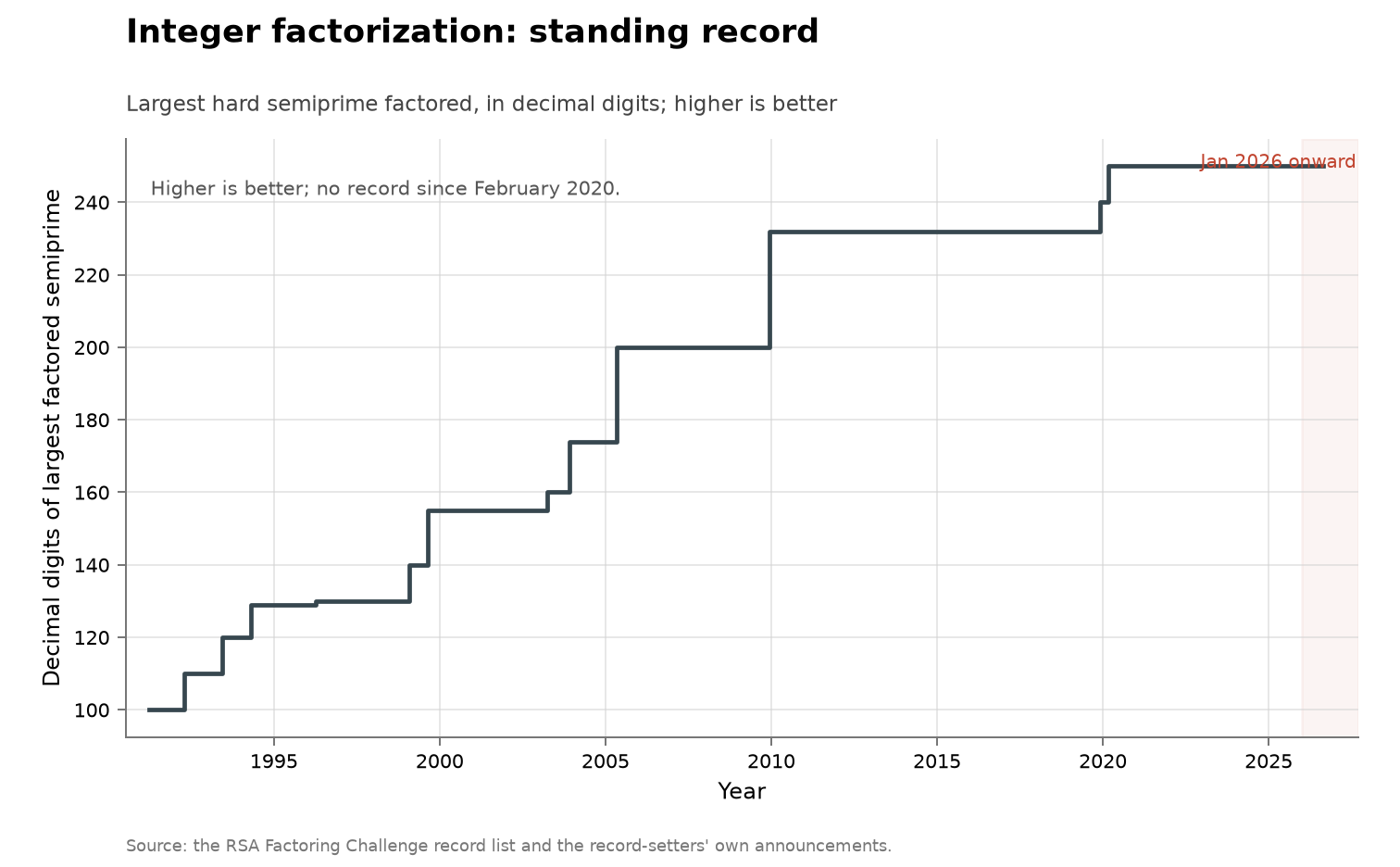
The collection-wide cumulative index redraws this series as the standing record's value over time:
There is no fetcher; the rows are hand-collected from the Wikipedia list and from the two caramba.loria.fr announcements. The record list is a hand-maintained page rather than an API, and the fields scored here — who, which method, whether machine learning was involved — are read from prose rather than parsed.
figure.py filters factoring-records.csv to the
integer_factorization rows, sorts by date, and takes the running maximum
over digits as a step function; the discrete-logarithm and hash-collision
rows are excluded because they are different quantities. The open markers
behind the line are every published RSA factorization, record or not,
including the ten factored while the maximum stood still. Three records are
labelled — RSA-100, RSA-768 and RSA-250 — and the rates in the annotation
are computed at plot time from the running maximum, split at RSA-768, so
they cannot drift from the CSV. January 2026 onward is shaded, as in every
figure here. The same script draws the cumulative view as the standing
record's value over time. check.py recomputes the fact lines
from the CSV.
The ai_involved column is no on all 25 rows of
factoring-records.csv. Every record row's method
is the quadratic sieve or the number field sieve, run as a parallel
computation by a named human team. No AI credit appears on the Wikipedia
list or in the two caramba.loria.fr announcements as of 2026-08-14.
The RSA-240/DLP-240 announcement states its own split between algorithmic gain and hardware:
"Taking this into account, and still using identical hardware, our computation was 3 times faster than the expected time that would have been extrapolated from previous records." — Boudot, Gaudry, Guillevic, Heninger, Thomé and Zimmermann, caramba.loria.fr/dlp240-rsa240.txt, 2019-12-02
"The acceleration can be attributed to various algorithmic improvements that were implemented for these computations. The CADO-NFS implementation was also vastly improved." — Boudot, Gaudry, Guillevic, Heninger, Thomé and Zimmermann, caramba.loria.fr/dlp240-rsa240.txt, 2019-12-02
"Since the 1970s, the numbers that can be factored have apparently increased from around twenty digits to 222 digits, or 5.5 digits per year." — Katja Grace, Algorithmic Progress in Six Domains, p. 33, 2013 [@grace2013algorithmic]