sphere-packing-lower-bound-records.csvsource_url values, chiefly the survey at https://arxiv.org/abs/2606.13313, with the two most recent steps at https://arxiv.org/abs/2312.10026 and the Klartag preprint recorded in the same surveyClick a point for the survey it is documented in.
How densely can equal spheres be packed in dimension $d$ as $d$ grows? The upper bounds and the lower bounds are separate literatures, and this series is the lower bounds: each step exhibits or proves the existence of packings at least as dense as some function of $d$. Saturation gives $2^{-d}$; every recorded step is a factor on top of it.
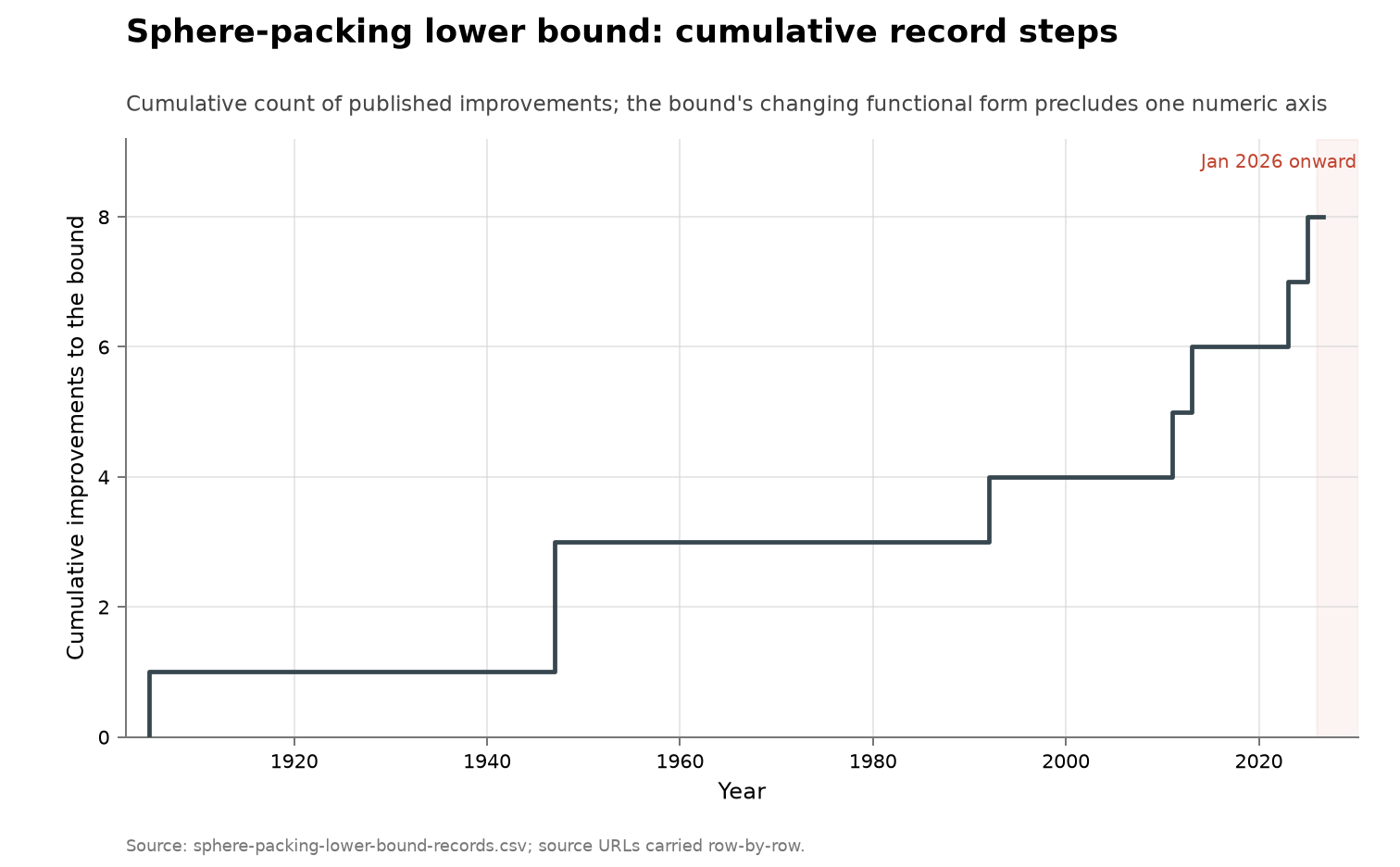
The ladder, with the forms as the vendored rows record them. Minkowski–Hlawka (1905, in Hlawka's general form 1943) gives $\theta(d) \geq 2\zeta(d)\,2^{-d}$, a factor of about 2. Rogers (1947) gives the first asymptotically growing improvement, $\theta(d) \geq c\,d\,2^{-d}$ with $c = 2/e$; Davenport and Rogers raise $c$ to 1.68 the same year, Ball (1992) to 2, and Vance (2011) to $6/e$ for dimensions divisible by four. Venkatesh (2013) gets the first super-linear factor, $d\log\log d$, but only along a sparse sequence of dimensions. Campos, Jenssen, Michelen and Sahasrabudhe (2023) prove $(1-o(1))\,d\log d\,2^{-(d+1)}$, the first asymptotically growing improvement on Rogers valid for all $d$, after seventy-six years. Klartag (2025) gains another whole power, $c\,n^{2}2^{-n}$, by a new probabilistic method.
A "discovery" here is a published improvement to that form or to its constant, one row of the vendored CSV.
The collection-wide cumulative index redraws this series as its cumulative count of record steps over time:
There is no fetch.py. The ladder is transcribed by hand from a survey and
the primary papers it cites, since no upstream publishes it as a
machine-readable series; the CSV is edited directly and every row carries
its own source_url. check.py recomputes the fact lines from
the CSV.
figure.py reads
sphere-packing-lower-bound-records.csv,
plots the cumulative step index against year as a step function, and
annotates the finder for the rows whose year is one of 1905, 1947, 1992,
2013, 2023 or 2025. The bound changes functional form along the ladder —
$c\,d\,2^{-d}$ for the mid-century entries, then $d\log\log d$, then
$d\log d$, then $n^{2}$ — so no single scalar runs the length of the series,
and the figure counts steps rather than plotting a level; the
finite-construction groups are
counted rather than plotted for the same reason. The constant_c column
carries the mid-century constants and the bound_asymptotic column carries
each form in plain text.
Two consequences of the annotation rule are visible: both 1947 rows, Rogers
and Davenport–Rogers, sit at the same x position, so their annotations
overlap; and Vance's 2011 step carries no label because 2011 is not in the
annotation set. The figure records the set of per-row source_url values as
its source rather than naming a single upstream.
No AI credit appears in sphere-packing-lower-bound-records.csv as of
2026-08-14: 0 of 8 steps names an AI system, and the finder column runs
from Minkowski (1905) to Klartag (2025), all named human authors. The 2023
and 2025 rows — the first asymptotically growing improvement on Rogers valid
for all $d$, and the further gain of a whole power of $n$ — are attributed
to named human papers in the rows' source_url values
[@campos2023sphere; @arxiv2026spherepacking].
One AI claim exists on the adjacent quantity. OpenAI's 2026-08-01 Astra release of ten Lean-certified results includes, per the press account cited:
"the first improvement to the general upper bound on high-dimensional sphere-packing density since 1978" — Tech Times on the Astra release, 2026-08-02 [@openai2026astra]
Upper bounds on packing density are a different quantity from the lower-bound ladder this series tracks: no row of the vendored CSV is affected by the claim. Peer review of the release was not complete as of 2026-08-14.
source_url, recording the ladder's dates, finders and bound forms.