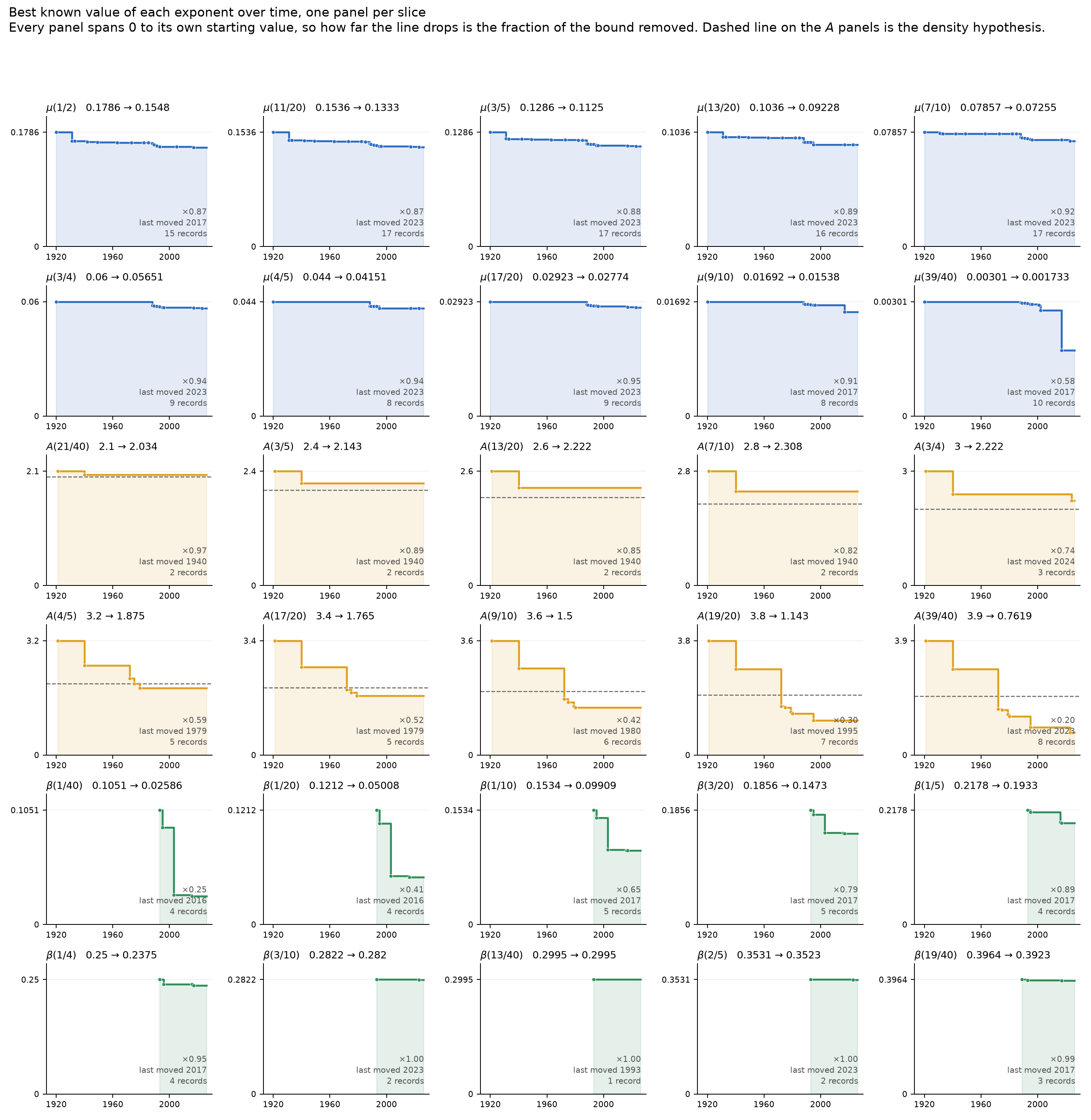
antedb-sweep.csv, with the six named slices and their attributions in antedb-bounds.csvThe Analytic Number Theory Exponent Database records the best known values of the classical exponents of the field, with the theorem and the date behind each [@tao2025antedb]. Three families are extracted here. $\mu(\sigma)$ bounds the growth of the Riemann zeta function, and $\mu(1/2)$ is the Lindelöf exponent, conjectured to be 0. $A(\sigma)$ is a zero-density exponent, with the density hypothesis asserting $A \leq 2$; $A(3/4)$ is the slice Ingham bounded in 1940 and Guth and Maynard improved in 2024. $\beta(\alpha)$ is a third family, whose derivable history in the database begins only around 1989.
A "discovery" in this series is a year in which the best value derivable at some parameter point changes. The year attached to a value is the year in which that bound became derivable from the literature the database records, computed by the database's own solver restricted to results published up to that year — not the year somebody wrote the bound down. Collating relations that were implicit across many papers yields bounds nobody had stated, so the two datings differ, and the curve plotted here is the derivable-year one.
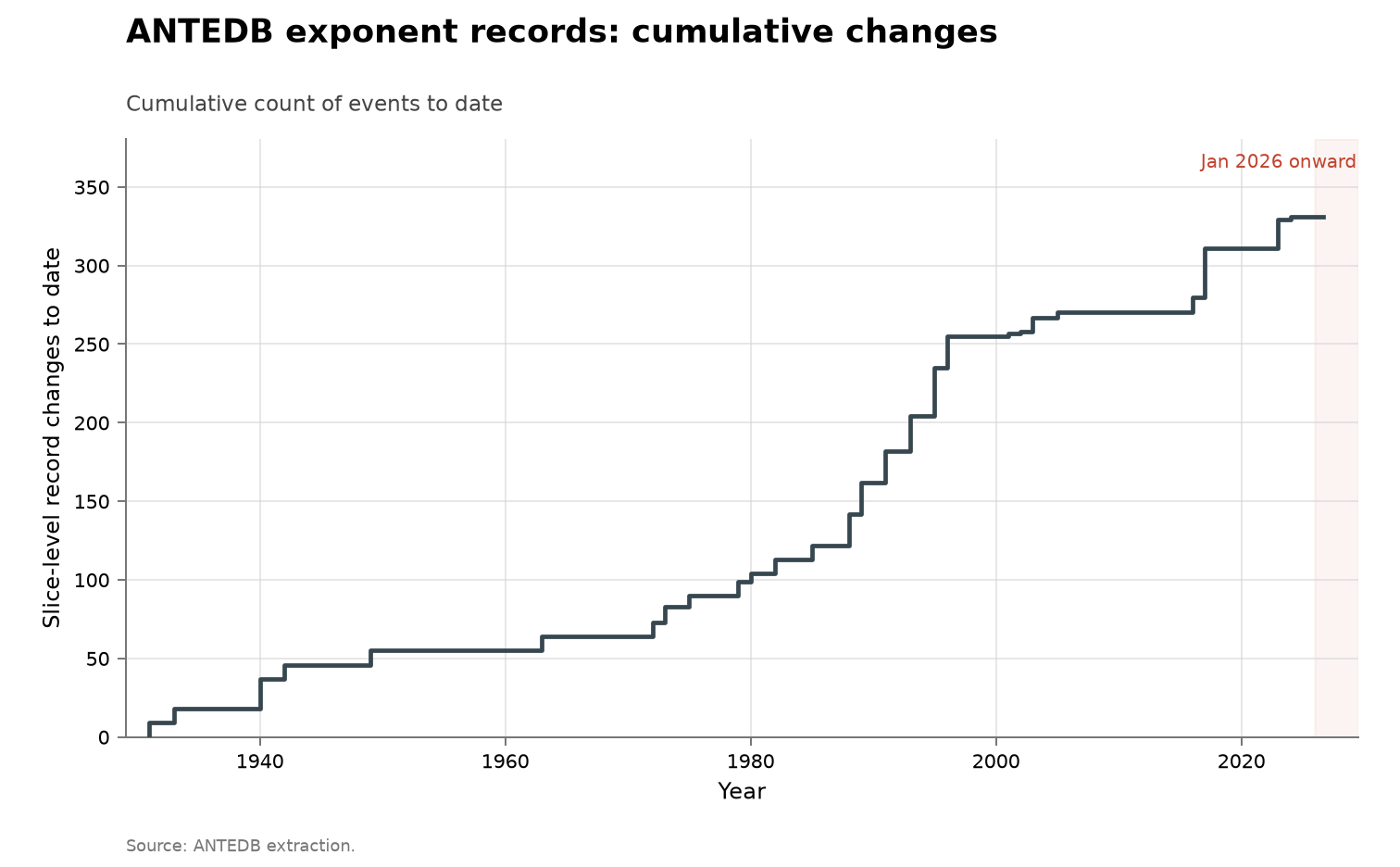
The collection-wide cumulative index redraws this series as cumulative slice-level record changes to date:
Both CSVs are built by fetch.py, which is run by hand: it
needs a checkout of the ANTEDB source tree and a cddlib-backed pycddlib<3,
neither of which belongs in this repository's dependencies.
check.py recomputes the fact lines above from the two CSVs.
figure.py draws all three figures from antedb-sweep.csv.
The first groups the sweep by quantity and point, sorts each slice by
year, and counts an event whenever value_float differs from the previous
year's value for that slice; the per-family cumulative counts are drawn as
step functions, all in blue with three line styles, because no step in the
series is AI-attributed and there is nothing to colour-code.
The small multiples draw the same sweep as thirty panels, one per slice: ten $\mu$ slices, then ten $A$ slices, then ten $\beta$ slices, hand-picked from the grid so that the named points are present. Each panel plots that slice's best known value against the year it became derivable, as a step function extended flat to 2026, with a dot at each recorded change and the area under the line shaded. The y-axis runs from 0 to a little above the slice's own earliest value, and both raw values are printed in the panel title; the corner text gives the ratio of the latest value to the earliest, the year the slice last moved, and how many records it carries. The dashed horizontal line on the $A$ panels marks the density hypothesis, $A \leq 2$, where it falls inside the panel.
antedb-bounds.csv carries the six named slices with exact fractional
value strings and an attribution column naming who set each record; it
is not plotted in the first figure and holds the provenance of particular
records. The attribution stored against a year names that year's dependency
chain, so the last improver of a slice is the last row whose value actually
changed rather than simply the last row.
One gap is deliberate and reported rather than patched: the database's own
$\beta$ solver raises a TypeError for the 1991 restriction of the
literature, so 1991 is missing from the $\beta$ sweep. No other year fails,
and $\mu$ and $A$ are unaffected.
No slice change in the vendored series carries an AI credit: the sweep
carries no attribution field, and the attribution column of
antedb-bounds.csv names human authors only, from van der Corput in 1920 to
Guth and Maynard in 2024, as of the 2026-07-26 extraction.
The automation that did produce new results at the database's launch — four new exponent pairs, several new zero-density estimates, and new additive-energy estimates — was optimization over collated relations rather than a model [@tao2025exponent]; the launch post states the improvements came
"without introducing any substantial new inputs from analytic number theory" — Terence Tao, launch post, terrytao.wordpress.com, 2025-01-28 [@tao2025launch]
When an evolutionary coding agent [@novikov2025alphaevolve] was tested on analytic number theory problems, its co-author's account records:
"it struggled to take advantage of the number theoretic structure in the problem, even when given suitable expert hints" — Terence Tao, terrytao.wordpress.com, 2025-11-05 [@tao2025exploration]
"This could potentially be a prompting issue on our end, or perhaps the landscape of number-theoretic optimization problems is less amenable to this sort of LLM-based evolutionary approach." — Terence Tao, terrytao.wordpress.com, 2025-11-05 [@tao2025exploration]
On formal verification, the database's contributing guide states:
"A formalization effort is underway, but at present it covers only a small portion of the blueprint (the basic notation, $L^2$ integral estimate, and exponential sum growth exponent chapters)" — ANTEDB contributing guide, github.com/teorth/expdb, read 2026-08-14 [@tao2025antedb]
OpenAI's 2026-08-01 Astra release of ten Lean-certified claims spans, per the press account cited, "group theory, von Neumann algebras, high-dimensional geometry, quantum complexity, lattice cryptography, and extremal combinatorics" [@openai2026astra]; none of the ten concerns the exponent families tracked here, as of 2026-08-14.