alphaevolve-records.csv, with the sampling frame in ../math-alphaevolve-inventory/alphaevolve-inventory.csvref and note columnsHover a step for its value and attribution.
Five groups of finite problems from the AlphaEvolve problem set, each with a standing record held by an explicit construction: the Erdős minimum-overlap type constant (6.5), the difference-basis constant (6.7), Heilbronn-style triangle packing (6.48) and convex packing (6.49), and a max-min packing ratio (6.50). In each case the record is a finite object — a step function, a difference set, a packing of $n$ shapes — that can be scored exactly, and the incumbent record often lives on a community page maintained by continuous computer search rather than in a journal. A "discovery" in this series is one such record being improved.
The sampling frame is the inventory folder's 65 numbered problems, of which 31 carry a live numeric record under the companion repository's classification; the five groups are drawn from those 31.
The difference-basis record had stood since Golay in 1972. On that group the paper reports:
"AlphaEvolve by itself, with no expert advice, was not able to beat the 2.6571 upper bound. In order to get a better result we had to show it the correct code for generating Singer difference sets [258]. Using this code AlphaEvolve managed to find a substantial improvement in the upper bound from 2.6571 to 2.6390." — Georgiev, Gómez-Serrano, Tao and Wagner, arXiv 2511.02864, 2025 [@georgiev2025mathexploration]
Both max-min AI records were retaken in 2025 by FICO's Xpress global solver,
run with no custom algorithm and verified with DeepMind's verification tool,
per the FICO blog of 2025-06-13 and arXiv:2601.05943 recorded in the CSV's
ref column. The one 2026 step, on the max-min $(3,14)$ slice, is credited
by the community records page to M. Sun and E. Samanta.
The collection-wide cumulative index redraws this series as cumulative record steps to date:
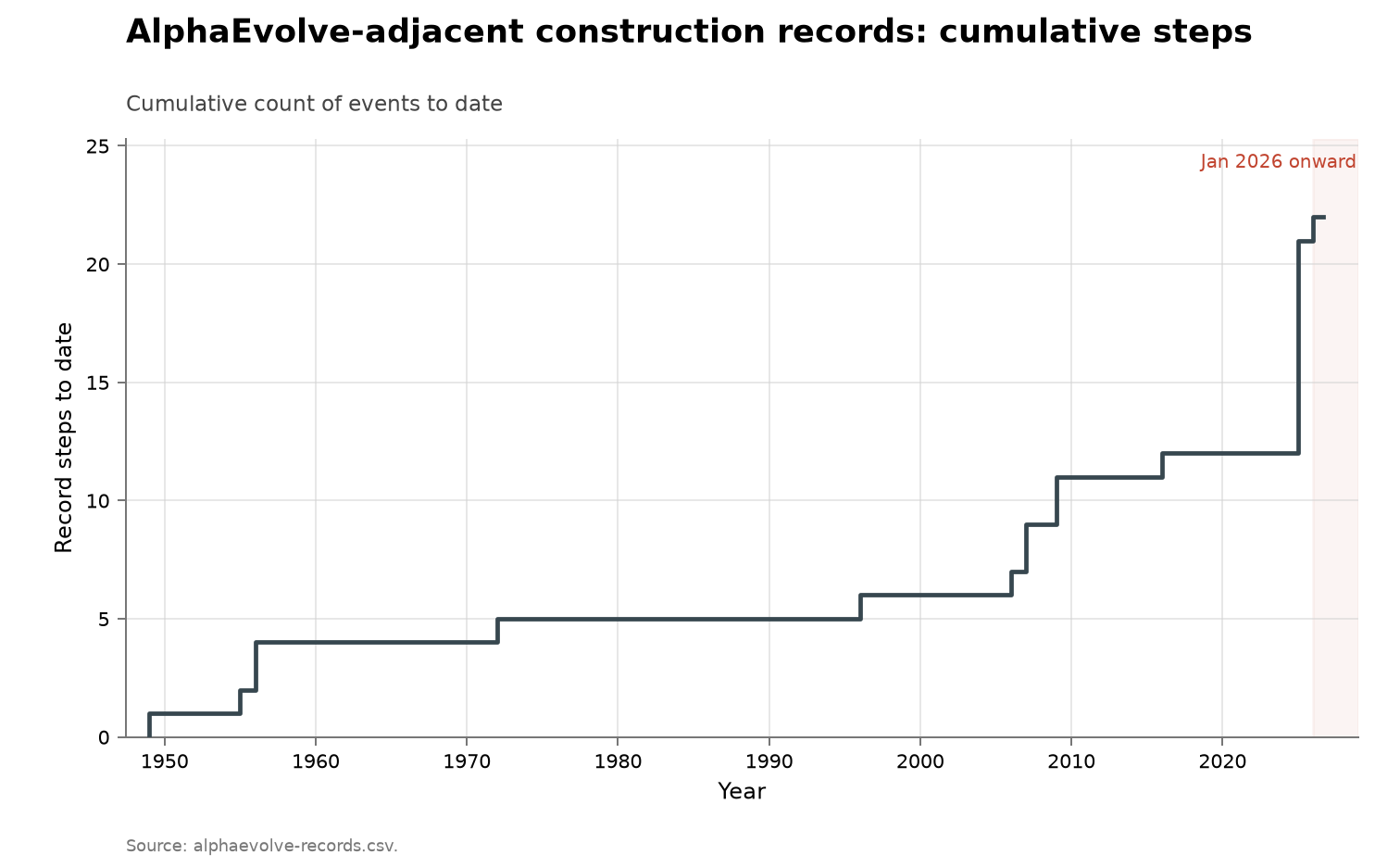
The CSV is built by fetch.py, which carries the hand
transcription itself: the values, the quoted sentence each was read from,
the reference, and the agent coding are all literals in that file, and the
relative gains are computed from consecutive values as it writes. It is the
only place any of these records is maintained, and it also writes the slice
that sums and autoconvolution
plots, so that child dataset cannot drift from the file it is drawn out of.
This folder keeps the full transcription rather than a slice of it because
alphaevolve-record-steps.png pools every record step in the frame, across
all the problems the paper numbers, not only the five plotted in the first
figure. check.py recomputes the fact lines from the CSV.
figure.py draws all three figures from
alphaevolve-records.csv. For the first it holds the five problem ids in a
hardcoded selected set, keeps rows with a non-empty year and is_record
equal to yes, groups by problem, sorts each group by year then
quantity then step, and plots the cumulative step count per group; the
group labels in the legend are hardcoded in the function. The y-axis is a
count because the values are not commensurable: an area, a squared radius,
and two dimensionless constants cannot share a numeric axis, so this figure
plots discoveries rather than levels, as the
sphere-packing ladder does for the same
reason. A callout names the Singer-code hint behind the difference-basis
step.
Step markers are colour-coded by who set them: record_marker() reads
agent, draws red for anything beginning ai_ and blue otherwise, and
draws an unfilled marker where date_certain is no. The FICO solver steps
and the 2026 step are blue: the coding distinguishes AI from non-AI rather
than automated from manual, and much of the blue here is computer search.
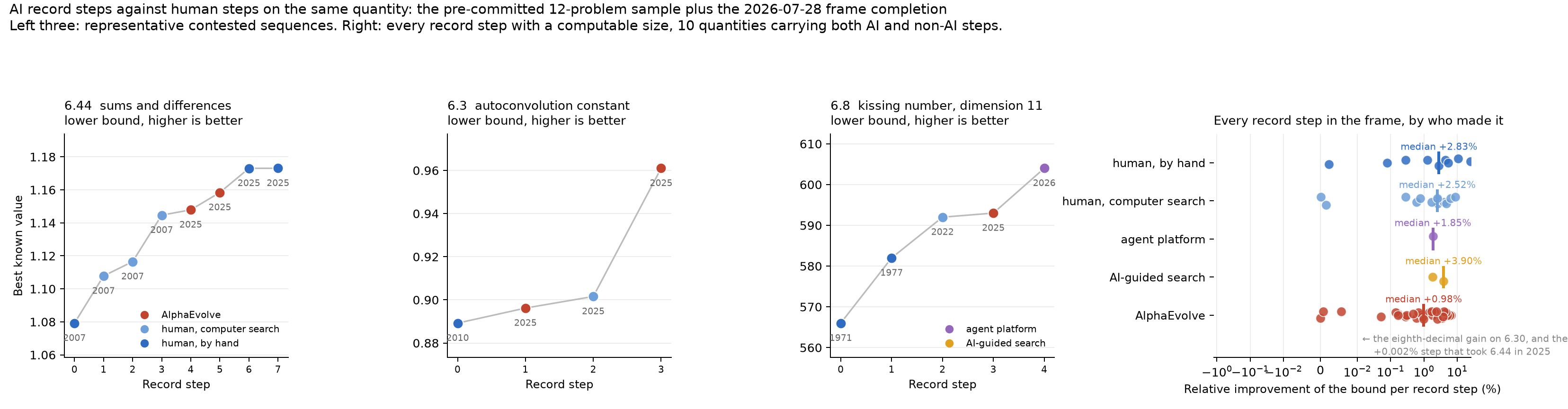
The second figure's left three panels plot the best known value against
record step rather than year, because several steps share a year: problem
6.44's sums-and-differences bound over eight steps, problem 6.3's
autoconvolution constant over four, and problem 6.8's kissing number in
dimension 11 over five. Marker colour is who made the step — AlphaEvolve,
AI-guided search, an agent platform, human computer search, human work by
hand, or a community records page — and each point is annotated with its
year. The right panel pools every record step in the file that has a
computable size and an is_record of yes, one row per kind of agent on a
symmetric log axis, with a vertical bar at each row's median and the median
printed above it.
Two rows in the same CSV are flagged is_record: no and are excluded from
every figure. Both are spherical-design constructions the paper described as
improving on the literature bounds it cited, where a 2016 result the paper
does not cite was already better.
value,
because the community page truncates the figure and the exact number could
not be established; the step is counted, the level is not recorded.Seven of the twenty-two steps in the five groups are AI-set, all AlphaEvolve, all in 2025 [@novikov2025alphaevolve; @deepmind2025problems]. Their sizes run from +1.44% down to +0.00075%; two were retaken in 2025 by FICO's Xpress global solver, and the difference-basis step followed the Singer-code hint quoted above. The paper's own summary of the system's reach:
"We have found that AlphaEvolve excels at discovering constructions that were already within reach of current mathematics, but had not yet been discovered due to the amount of time and effort required to find the right combination of standard ideas that works well for a particular problem." — Georgiev, Gómez-Serrano, Tao and Wagner, arXiv 2511.02864, 2025 [@georgiev2025mathexploration]
Tao's account of the same run, on named conjectures:
"For well-known open conjectures (e.g., Sidorenko’s conjecture, Sendov’s conjecture, Crouzeix’s conjecture, the ovals problem, etc.), AlphaEvolve generally was able to locate the previously known candidates for optimizers (that are conjectured to be optimal), but did not locate any stronger counterexamples" — Terence Tao, terrytao.wordpress.com, 2025-11-05 [@tao2025exploration]
The dated precedent for AI-set records on recognised open mathematical problems is FunSearch's cap-set improvement of December 2023 [@deepmind2023funsearch].