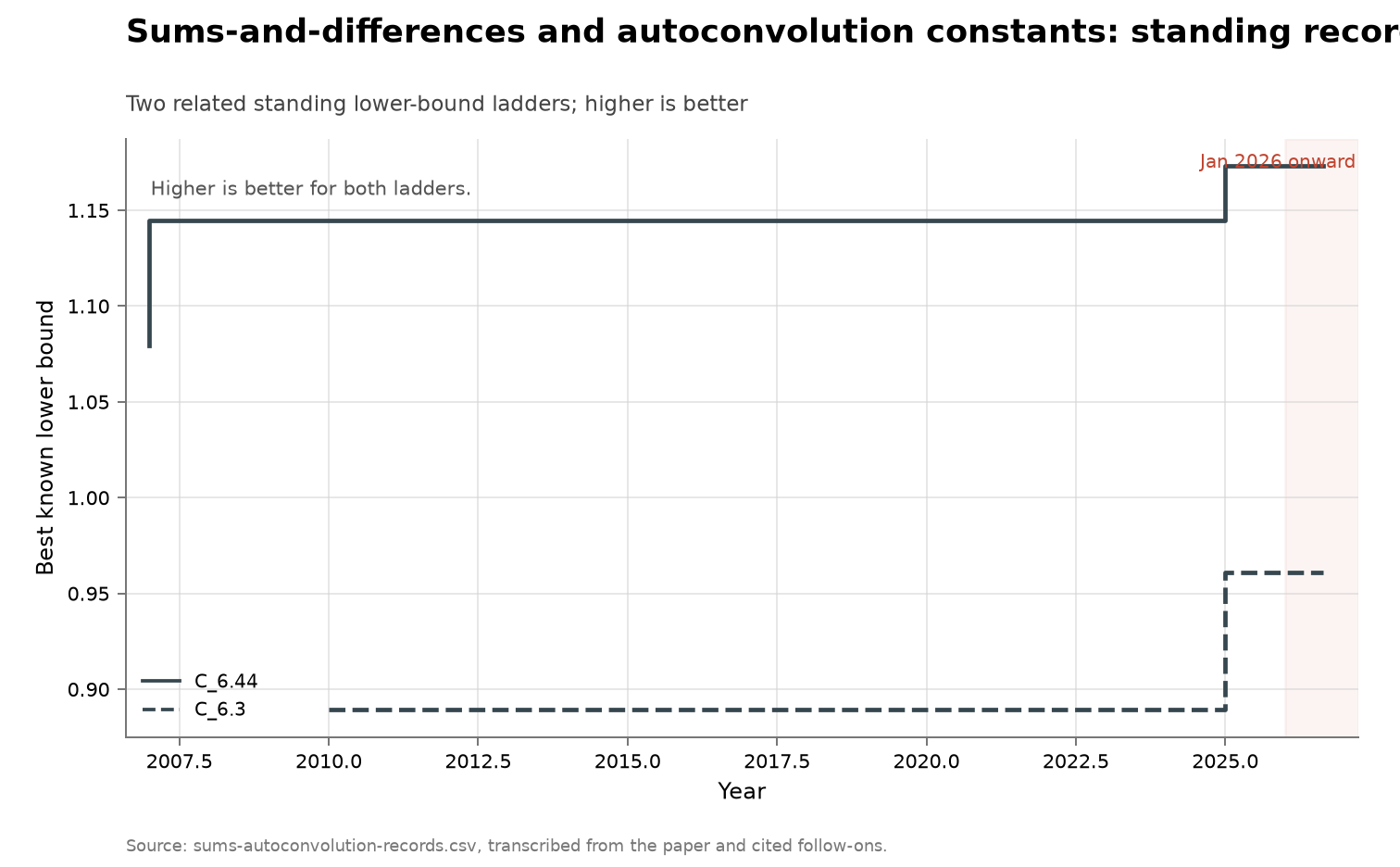
sums-autoconvolution-records.csv, the problem 6.44 and 6.3 rows of the AlphaEvolve record transcriptionref and note columnsHover a step for its value and attribution.
Two constants from the AlphaEvolve problem set, both bounded below by exhibiting a finite object whose score can be computed exactly. For $C_{6.44}$, in sums and differences of sets, the object is a set of integers: taking $U = \{0,1,3\}$ gives $C_{6.44} \geq 1 + \log(7/6) / \log 7 \approx 1.0792$, and later records come from larger sets found by search. For $C_{6.3}$, an autocorrelation inequality, the object is a step function, and the recorded bracket at the start of the series is $0.88922 \leq C_{6.3} \leq 1$.
A "discovery" here is a construction that moves one of those bounds, one row of the vendored CSV. Both quantities carry AI and human record steps in 2025, with each kind overtaking the other at least once.
../math-alphaevolve-records/alphaevolve-records.csvThe largest AI step, $C_{6.3}$'s move to 0.961 from a step function of
50,000 parts, was built after the Boyer–Li result, per the CSV's
attribution column; on that step the paper states:
"We believe that with even more parts, this lower bound can be further improved." — Georgiev, Gómez-Serrano, Tao and Wagner, arXiv 2511.02864, 2025 [@georgiev2025mathexploration]
The 2025 human step to 1.17305 is Gerbicz's, in a paper the arXiv 2511.02864 bibliography lists with the title
"Sums and differences of sets (improvement over AlphaEvolve)" — Robert Gerbicz, arXiv:2505.16105, 2025
and the further step to 1.173077 is cited there as
"Fan Zheng. Sums and differences of sets: a further improvement over AlphaEvolve, 2025. arXiv:2506.01896." — arXiv 2511.02864v1 bibliography, entry [302], read 2026-08-14
The collection-wide cumulative index redraws this series as two standing-record ladders over time:
sums-autoconvolution-records.csv is generated, not separately maintained.
The whole hand transcription lives in
the AlphaEvolve record sequences,
whose fetch.py writes this slice
along with its own file, so the two cannot drift apart.
check.py recomputes the fact lines from this CSV and the
parent transcription.
figure.py calls the shared alphaevolve_value_chart() shape
in ../../lib/families.py, which filters
sums-autoconvolution-records.csv to those two problem values with a
non-empty value and is_record equal to yes, groups by problem, sorts
each group by year then step, and draws each as a grey step function
with markers coloured by author. record_marker() is the scoring rule: red
for any agent beginning ai_, which here means the four ai_evolution
rows, blue for human_analytic and human_search, and an unfilled marker
where date_certain is no — a case that does not arise on these two
ladders, so every marker here is filled. Three annotations are keyed to
step values and read "AlphaEvolve", "human retakes record", and
"AlphaEvolve" again. Legend labels are taken from the quantity column, so
they appear as the bare identifiers C_6.44 and C_6.3. The two ladders
share one linear y-axis.
step column carries that order. The two 2025 human
points at 1.17305 and 1.173077 are indistinguishable at this scale.AlphaEvolve took two record steps on each ladder in 2025 [@novikov2025alphaevolve; @georgiev2025mathexploration]. On $C_{6.44}$ its 1.1479 and 1.1584 were overtaken in the same year by Gerbicz's 1.17305 — in the paper titled as quoted above — and by the further 1.173077, by methods the paper describes as closer to the original 2007 constructions. On $C_{6.3}$ the sequence alternated: AlphaEvolve's 0.8962, Boyer and Li's 0.901564 by gradient methods, then AlphaEvolve's 0.961 from a 50,000-part step function built after the Boyer–Li result. Tao's account of the mathematics paper covers the wider run these two ladders sit in [@tao2025exploration]; the dated precedent for AI-set records on recognised open mathematical problems is FunSearch's cap-set improvement of December 2023 [@deepmind2023funsearch].