elliptic-curve-rank-records.csv,
elliptic-curve-rank-exact.csv,
elliptic-rank-leaderboard.csv,
rank30-timeline.csvrank30-timeline.csvClick a step for the curve and its independent points on Dujella's subpage.
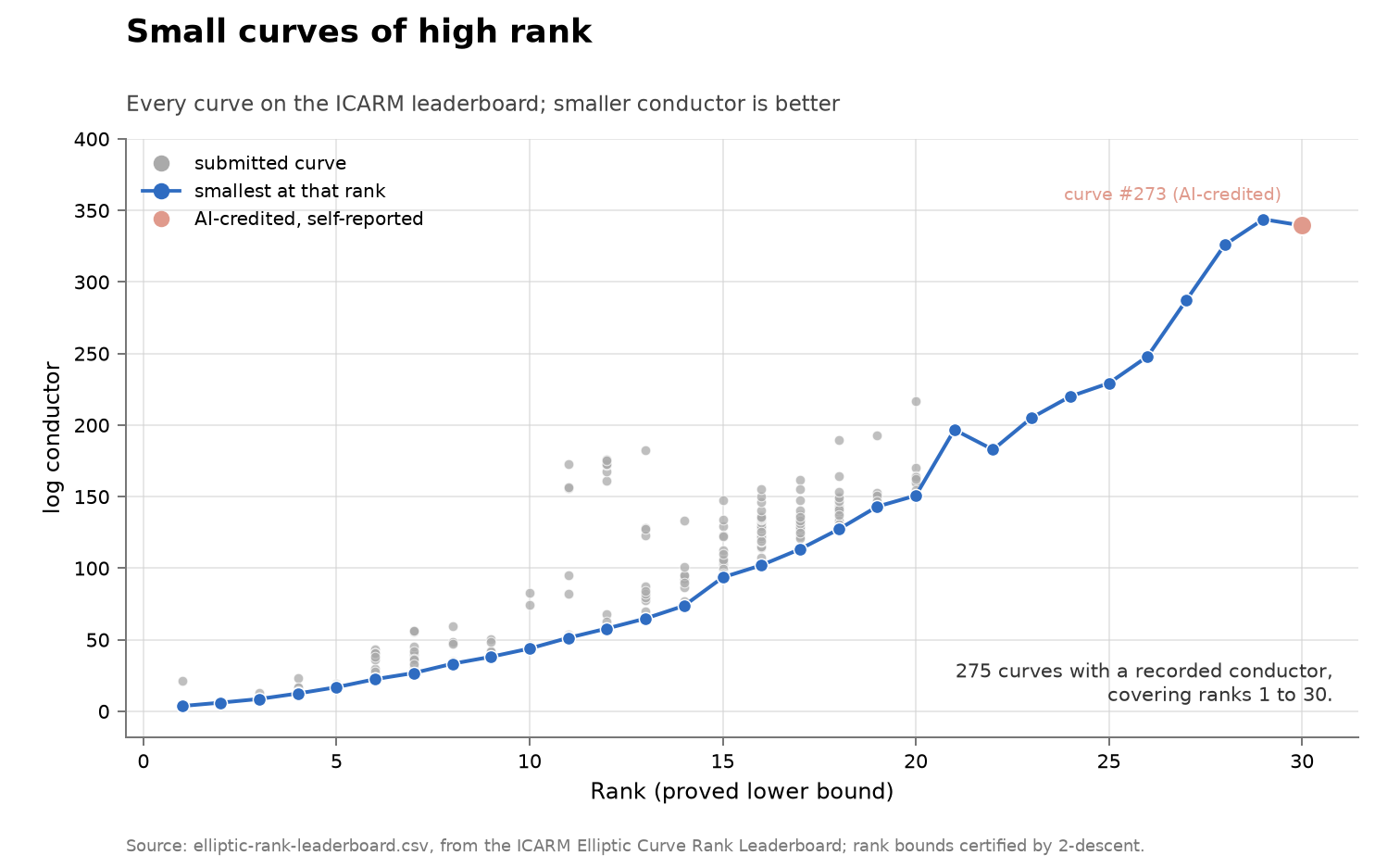
Every curve on the ICARM leaderboard; its rank bound was certified by 2-descent before it was recorded.
For an elliptic curve E over Q, Mordell's theorem makes E(Q) a finitely generated abelian group, so E(Q) is a finite torsion group times Z^r. The integer r is the rank. Which values of r occur is open: the older conjecture is that rank is unbounded, and more recent heuristics point the other way. Nothing in the problem statement has changed since it was posed, so one integer can be tracked across nine decades of methods.
A discovery is an exhibited curve whose rank exceeds every previously exhibited rank, dated by the year in Dujella's table. Exhibiting a curve of rank at least r means giving the curve together with r independent points of infinite order; each of the table's rows links a subpage carrying exactly that. A step is therefore a construction, not a theorem about which ranks are possible.
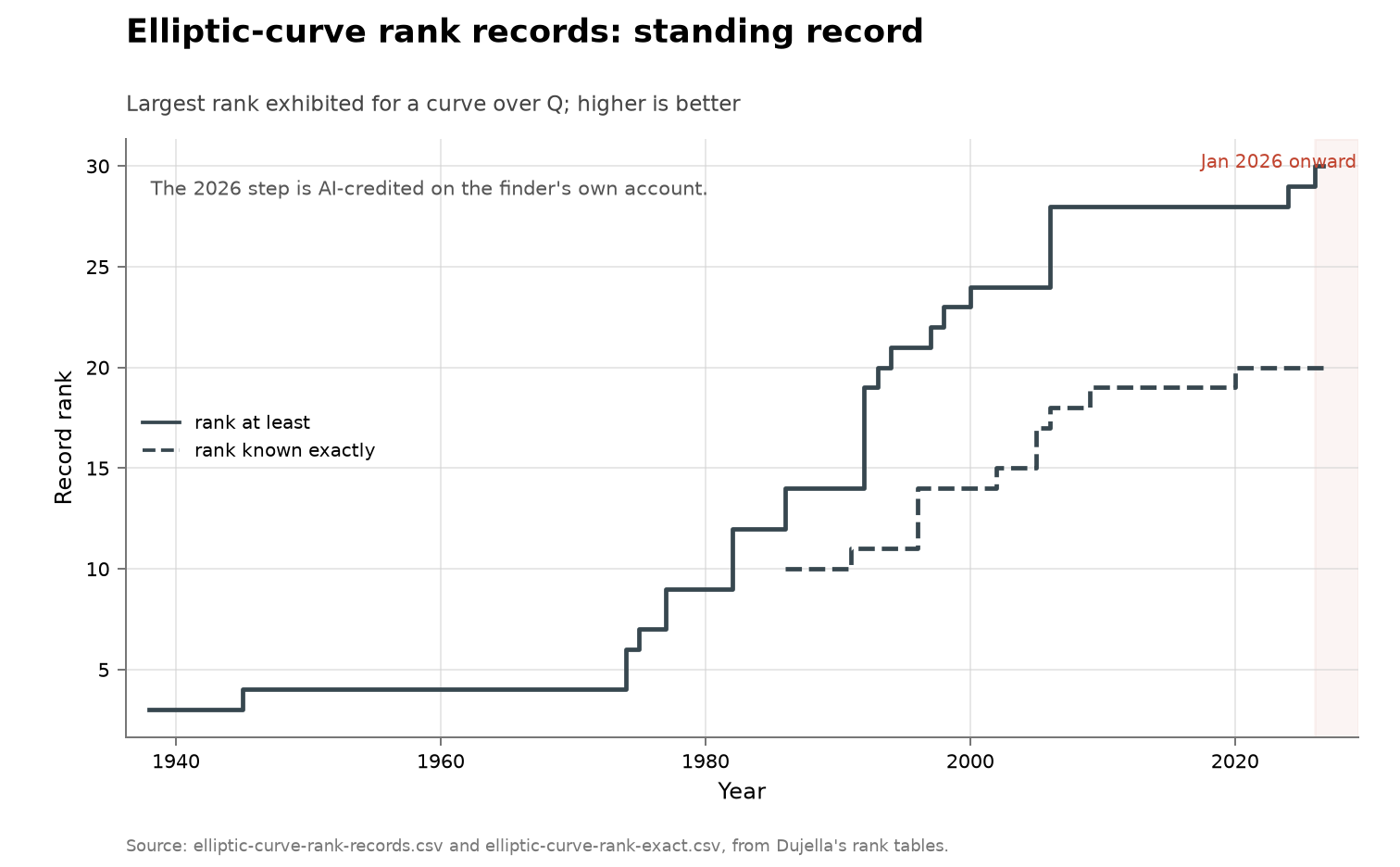
Two frontiers run in parallel and are counted separately. The first is the lower-bound frontier: rank at least r, where the points prove a bound and the true rank may be higher. The second is the exact frontier: curves whose rank is known unconditionally rather than bounded below, which runs behind the first.
The ICARM Elliptic Curve Rank Leaderboard counts a different thing. It fixes the rank and asks how small a curve of that rank can be, ordering submissions by conductor, naive height, Faltings height and discriminant. Its rank bounds are certified before a curve is recorded:
the points are proven independent in E(Q) modulo torsion, so rank ≥ the number of points — elliptic-rank.icarm.cloud, submission form, read 2026-08-20
The collection-wide cumulative index redraws this series as the standing record over time:
The 2026 rank ≥ 30 record answers a dated public challenge. On 2026-08-05, fifteen days before the curve was submitted, Bartosz Naskręcki posed rank 30 as a problem addressed to AI systems as well as to people:
Here is another awesome challenge for your brain and AI. Find an elliptic curve with at least 30 independent points. — Bartosz Naskręcki (@nasqret), X, 2026-08-05 [@naskrecki2026rank30]
The prior record was announced by the maintainer of the tables this series is built from:
New record for the rank of elliptic curves over Q, due to Noam Elkies and Zev Klagsbrun, is 29! — Andrej Dujella (@dujella1), X, 2024-08-29 [@dujella2024rank29]
Daniel Litt plotted the same frontier the next day, and stated what the shape of the series measures:
maybe a reasonable measure of how much effort new records require — Daniel Litt (@littmath), X, 2024-08-30 [@litt2024rankrecords]
The rank ≥ 30 record then stood for three days on the board: curve #302, with 31 independent points, was submitted on 2026-08-23 under Ava Howell's name, and Dujella's table records the rank ≥ 31 record as Alpöge–Howell, 2026, under an ordinary human credit. The standing record is rank ≥ 31.
fetch.py rebuilds all three CSVs. The two record frontiers are
read from Dujella's page: the lower-bound table sits in a fixed-width <pre>
block, one row per record, and each row's rank links a subpage carrying the
curve, its independent points and a centred author-and-year line. The fetcher
parses the table and also reads every subpage, keeping the table's author
string where the two differ and failing if the years disagree. At the
2026-08-20 read the rank ≥ 30 row's author column in the table was empty and
its credit string came from its subpage; the 2026-09-14 read carries
Alpöge–Howell for both 2026 rows. The exact frontier has no table at all: its records are named in the
page's prose, and the fetcher collects the rkeq<r>.html links and reads the
author and year from each subpage.
The leaderboard CSV is the ICARM board's own /database.json, one row per
curve. The conductor and discriminant are integers hundreds of digits long, so
the vendored columns are their natural logarithms — the quantities the board
plots — and the exact integers stay upstream. Submitter and submission date are
recorded as the board gives them.
rank30-timeline.csv is the one table here with no
fetcher: its five rows are transcribed by hand from four public posts and one
HTTP Last-Modified header, each row carrying the URL it came from. It is
maintained by editing the file. The gap the page states is the difference
between its challenge row and its submission row.
Neither upstream records how a record was found, so the credit and
credit_evidence columns are this folder's own and are set in one place, the
CREDITS table in fetch.py. Every row defaults to human / published. The
2026 rank ≥ 30 row is set to ai / self-reported, and the evidence for it
is quoted in the AI-attribution register below.
figure.py draws three PNGs.
discovery-math-elliptic-rank.png steps the lower-bound frontier against year
in human blue, extended flat to the snapshot date, with the exact frontier as a
grey dashed step behind it; each record is a point coloured by the pair
(credit, credit_evidence), so the one AI-credited record takes the
collection's soft red rather than its AI red — the same family, visibly weaker
evidence. Five records are labelled by matching the discoverer column, and
the corner note counts the period splits and the AI-credited steps at plot
time. leaderboard-math-elliptic-rank.png scatters log conductor against rank
for every board curve, joins the smallest curve at each rank, and marks the
board curve at each rank the record CSV credits to an AI.
cumulative-math-elliptic-rank.png is the shared standing-record shape with
both frontiers on one panel.
Last-Modified value at the
2026-08-20 read, which moves whenever the file is edited for any reason.One of the 20 record steps carries an AI credit: the credit column is ai
for the 2026 row and human for the other 19 — the credit sits on the rank
≥ 30 step, and the rank ≥ 31 step that followed it is credited human. No AI
credit appears anywhere in Dujella's tables or subpages as of the 2026-09-14
read.
ranksunbounded, a pseudonymous leaderboard account[edit: Hmm not sure where to put this so editing Drew's comment (sorry Drew!): it was Claude, with Levent Alpöge and Ava Howell!] — elliptic-rank.icarm.cloud, curve #273 commentary, edited by ranksunbounded, read 2026-08-20
The rank bound and the credit rest on different evidence. The bound follows from the 30 witness points by a check that does not depend on who supplied them; the credit is one sentence appended to another contributor's comment, in a field any logged-in user may edit. Andrew Sutherland, commenting on the same curve, adds a conditional statement about the exact rank:
Under GRH+BSD the rank is exactly 30 — Andrew Sutherland, elliptic-rank.icarm.cloud, curve #273 commentary, 2026-08-20
Levent Alpöge is named in one earlier AI-credited resolution recorded in this collection, the 2026 negative resolution of the Jacobian conjecture in dimension 3 credited to Alpöge with Claude Fable 5 (see ../math-smale/README.md).
elliptic-curve-rank-records.csv and elliptic-curve-rank-exact.csv, and
the per-row source_url column points at the subpage a row came from
[@dujella2026rankhist].elliptic-rank-leaderboard.csv, the 2-descent certification
quoted in Definition, and the commentary quoted in the AI-attribution
register. Its source is at https://github.com/icarm/elliptic-rank
[@icarm2026ellipticrank].rank30-timeline.csv.rank30-timeline.csv.