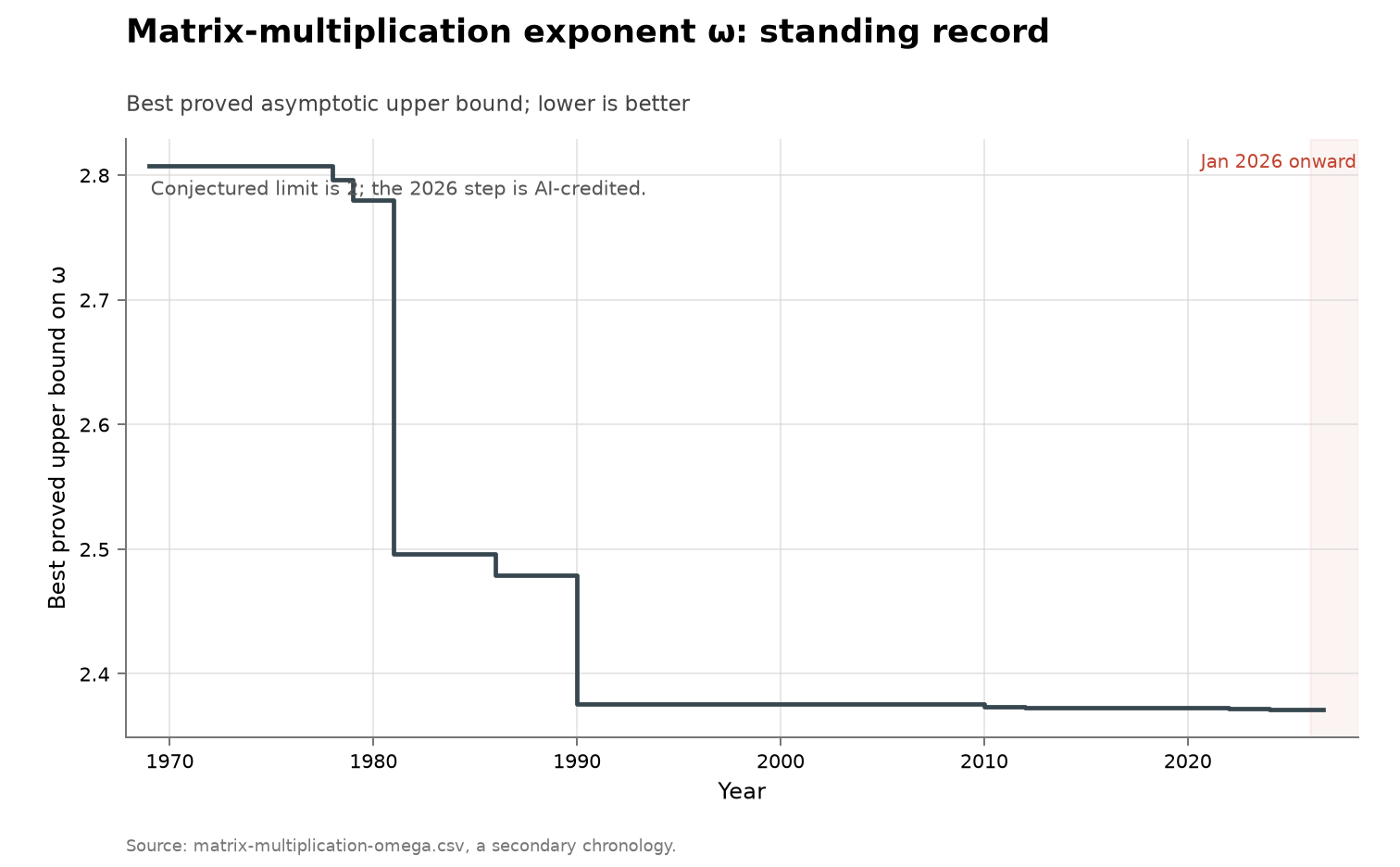
matrix-multiplication-omega.csvω is the smallest exponent such that two n×n matrices can be multiplied in n^(ω+ε) operations for every ε > 0. The naive algorithm gives 3, Strassen's 1969 result was the first to beat it, and the conjectured limit is 2. The problem itself is fixed — one exactly stated asymptotic quantity, unchanged since it was posed — so a single number can be tracked across decades of methods without benchmark drift. Both mathematics and algorithm design keep score on ω: mathematicians prove the bounds and algorithm designers are bounded by them. The page is filed under algorithms because the object being improved is an algorithm's running time.
A "discovery" is a published proof of a smaller upper bound, dated by the year of the proof. The series records what has been proved rather than what is computed in practice, and it is a series of bounds: a step means an analysis improved, not that anyone's matrix multiplication got faster.
The asymptotic exponent and a fast algorithm for one fixed matrix size are different objects. A procedure that multiplies two 4×4 complex-valued matrices in 48 scalar multiplications rather than Strassen's 49 is an improvement on a finite problem; it is not a point on this curve and does not move ω.
The collection-wide cumulative index redraws this series as the standing record's value over time:
There is no fetch.py here. The chronology is transcribed by hand, one
source_url per row, so the CSV is edited directly. The 1969–2024 rows
reproduce a published record list [@wikipedia2026matmul]; the 2026 row is
transcribed from the arXiv abstract that states the new bound
[@dupont2026omega], which that record list does not yet include as of
2026-08-18. check.py recomputes the fact lines above from the
CSV.
figure.py reads matrix-multiplication-omega.csv and plots
the omega column against year as a step function, extended flat to the
present so the standing record is visible as a plateau. Every row is also
drawn as a point, coloured by the credit column: human blue for human
rows and AI red for ai rows. A dotted horizontal line at 2 is labelled
"conjectured limit = 2". Four rows are annotated by matching the
discoverer column against Strassen, Coppersmith–Winograd, Alman et al. and
Dupont et al.; when a name occurs more than once, the latest record is
labelled. The axis is linear and clipped to 1.96 to 2.9, which keeps the
post-1990 stretch readable; January 2026 onward is shaded, and the legend
carries the collection's shared human and AI key. The chart's corner note
takes the 2010 record as its baseline and counts the further improvements
after it and the AI-credited rows, both at plot time.
One step in the series carries an AI credit: the credit column is ai for
the 2026 row and human for the other 15 rows. Before that row was added,
no AI credit appeared in the chronology's source list as of the 2026-08-10
transcription [@wikipedia2026matmul].
"Second, we leverage recent advances in machine learning to design a new optimization algorithm for this problem. Finally, we refine the resulting optimization algorithm with AlphaEvolve. Our combined approach yields an upper bound of ω < 2.371177, improving the previous best bound of 2.371339." — arXiv:2608.16884, abstract, posted 2026-08-17 [@dupont2026omega]
The earlier AI results in this area were on finite matrix sizes and are not points on this curve. AlphaTensor, published in 2022, used reinforcement learning with no language model involved and found faster algorithms for multiplying small matrices, the first improvement in that setting on Strassen-era results [@fawzi2022alphatensor]. AlphaEvolve, in 2025, extended the same line, finding a procedure for two 4×4 complex-valued matrices in 48 scalar multiplications and describing it as "the first improvement, after 56 years, over Strassen's algorithm in this setting" [@novikov2025alphaevolve]. On asymptotic, structure-heavy problems, Tao's account of AlphaEvolve's run across 67 mathematical problems reports that on analytic number theory it "struggled to take advantage of the number theoretic structure in the problem, even when given suitable expert hints", while it "does seem to do well when the constructions have some algebraic structure" [@tao2025exploration].