Verdict: no acceleration — 2026 annualizes to roughly 13.2 million records against 12.80 million in 2025 and an 8.63 million/year mean over 2010–2025
DOI records created
The final bar is a partial year; hover for the flag.
Definition
Crossref registers DOIs for scholarly publishing: member publishers deposit
a metadata record for each item they register, and each record carries a
created date, the day it was registered. The REST API reports how many
records fall in any created-date range.
An event in this series is one DOI record, counted in the calendar year of
its created date. The count is by registration date, not by publication
date, so a backfile deposit of older work lands in the year it was
registered. The last row is the year in progress at fetch time,
year-to-date through 2026-09-28. The CSV holds the yearly totals the API
reports; the records behind them are not vendored. The dataset carries no
authorship field.
Facts
span: from 5.28 million records in 2010 to 12.80 million in 2025, up
143%
falls: six of the fifteen year-on-year changes over 2010–2025 are
falls
2024 dip: deposits fell to 11.30 million from 12.69 million in 2023,
then rose to 12.80 million in 2025
2026 year-to-date: 9,834,247 records through 2026-09-28, annualizing
to roughly 13.2 million
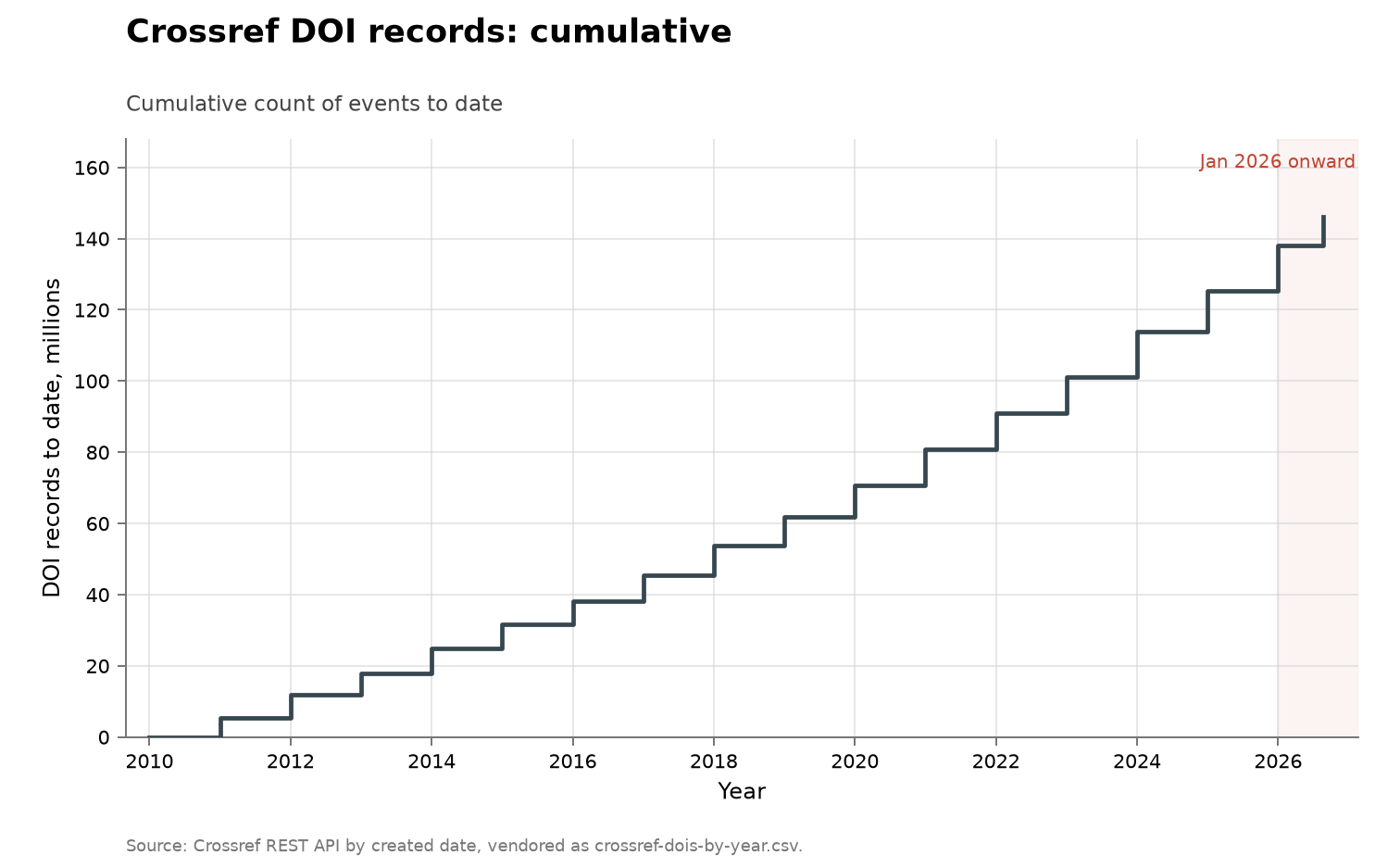
The collection-wide cumulative index redraws this
series as cumulative DOI records to date:
Method
fetch.py makes one Crossref REST API request per year from
2010, filtered to that year's created-date range and asking for rows=0 so
the response is a count rather than the records themselves. The row for the
current year is marked year-to-date with the date it was fetched. The
requests are sequential with a sleep between them, which is what keeps a
rebuild polite.
figure.py draws the series through
lib/families.py's shared volume shape: years on
the x-axis, the count on the y-axis, 2026 shaded, the part year outlined
rather than filled. The three volume folders draw through that one shape.
The series is drawn in slate rather than the blue used elsewhere for human
or uncredited finders because it has no authorship field.
check.py recomputes the fact lines from the CSV; the
annualization uses the shared day-count rule in
lib/prose.py.
Limitations
deposits are not publications. The count is by created date;
backfile deposits of old work land in whatever year they were registered,
so a year-on-year fall is not readable as a fall in publishing.
no authorship field. The CSV records years and counts only; whether a
human or a model wrote the work behind a record is not recorded.
volume, not discovery. The series counts artifacts registered; the
domain folders count results, and the two need not move together.
membership is not held fixed. A deposit exists because a publisher
that registers DOIs registered one, so more work being published cannot
be separated from more of publishing being registered with Crossref.
no denominator of effort. Nothing here measures how many researchers
were working, so output per unit of input cannot be separated from more
input.
the 2026 annualization is this repository's arithmetic, scaled from a
part year on an even-rate assumption.
AI attribution
The dataset carries no authorship field; no AI share can be computed from
it. crossref-dois-by-year.csv holds a year,
a count and a part-year note per row; no AI credit appears in it as of the
2026-09-28 fetch.
Sources
https://api.crossref.org/works — the REST API the yearly counts are
read from; this page carries no bibliography citekeys, and the counts
rest on the API alone.
output-arxiv and
output-github-pushes — the other two
volume series, drawn through the same shared shape; they count preprint
submissions and git pushes where this folder counts DOI registrations of
formal publications.