Metric: vulnerabilities disclosed per quarter, split by finder provenance: corroborated AI method, AI affiliation with method unverified, conventional or fuzzing credit, or no reporter credit
Verdict: accelerating — 39 CVEs by 2026-08-05 against 6 in all of 2025; the largest prior full years were 35 in 2016 and 32 in 2015
Disclosures per quarter by finder provenance
The final bar is a partial quarter.
Every disclosure, by severity
Click a point to open the OpenSSL metadata record.
Definition
OpenSSL is a widely deployed, security-critical cryptographic library. Its
official security metadata provides a publication date, project severity,
reporter and remediation credits, affected version ranges and references for
each CVE.
OpenSSL is a fixed project, not a fixed body of code. Code size, features,
supported versions and bug surface change, and new bugs continue to be
introduced: the January 2026 QUIC cipher-handling vulnerability
CVE-2025-15468 affected code added with QUIC support in OpenSSL 3.2. The
series therefore cannot assume that a fixed stock of findable bugs should
deplete, or rule out more software to search as an explanation for a rising
count.
A disclosure here is one CVE in the year of OpenSSL's datePublic. It is
not a discovery date, a count of bugs introduced or a measure of bugs
remaining. Finder provenance identifies who reported a CVE and, when
separately corroborated, the reported method; it does not measure search
effort. In this folder, "corroborated AI" means CVE-level evidence that an
AI system produced the finding, and 27 of 39, or 69%, of the 2026 CVEs
carry an AI-lab affiliation or an explicit AI method marker — a wider band
than the corroborated one, because affiliation alone is not counted as
method evidence.
Facts
2026 (through 2026-08-05): 39 CVEs; 18 corroborated AI, 9
AI-affiliated with method unverified, 12 with conventional or fuzzing
credits, 0 uncredited
prior full-year peaks: 35 in 2016 and 32 in 2015
same-period comparison (1 January to 5 August): 39 in 2026 versus 27
in 2015, 19 in 2016 and 16 in 2023, the three largest prior same-period
counts
2025: 6 CVEs; 3 corroborated AI
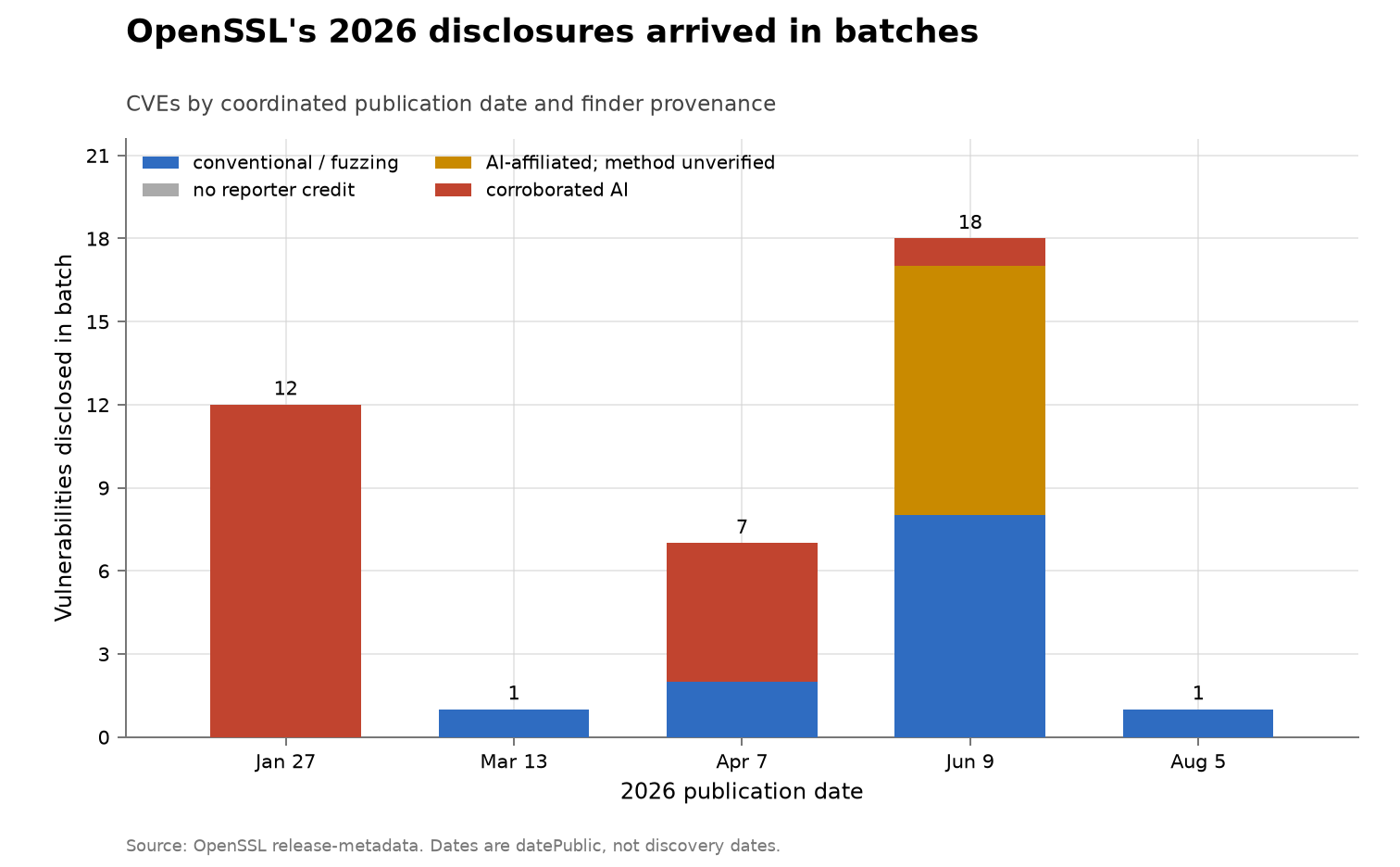
2026 publication batches: coordinated publications on 27 January, 13
March, 7 April, 9 June and 5 August contained 12, 1, 7, 18 and 1 CVEs
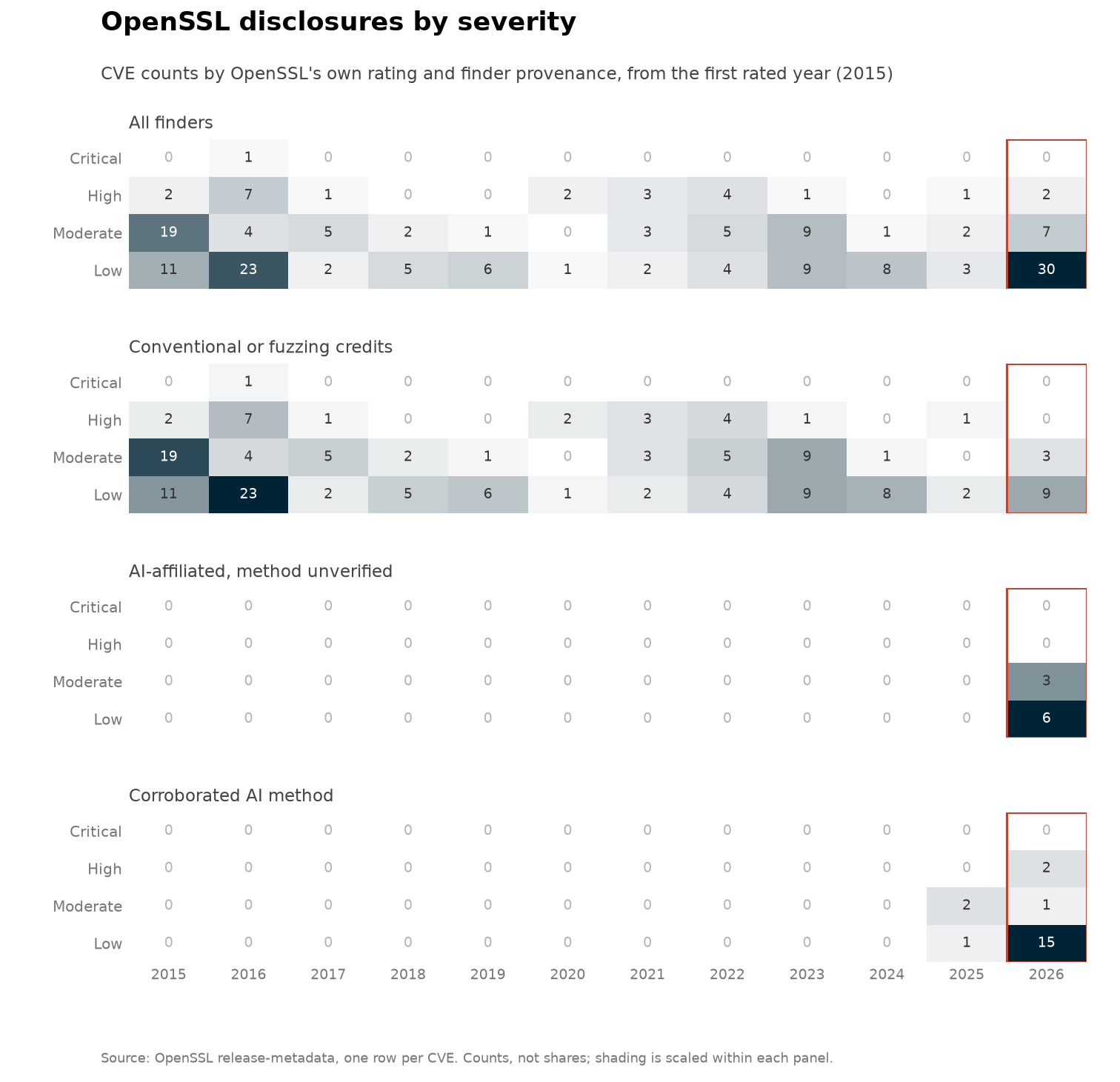
2026 severity by provenance (OpenSSL's own ratings):
Finder provenance
Critical
High
Moderate
Low
Corroborated AI
0
2
1
15
AI-affiliated, method unverified
0
0
3
6
Conventional/fuzzing
0
0
3
9
No reporter credit
0
0
0
0
baseline severity (2015–2025): half of all rated CVEs were Low and
15% were High or Critical
2026 Low shares by cohort: 75% for conventional or fuzzing credits,
67% for affiliation-only credits, and 83% for the corroborated-AI set,
which also holds both High-severity CVEs of 2026
The severity chart draws the table's cohorts in their multi-year trend: one
grid per finder-provenance cohort, years across, OpenSSL's ratings down,
every cell printing how many CVEs it holds. It starts in 2015 because the
structured metadata carries no severity before 2014, and an unrated record
is missing data rather than a low-severity one. Annual sizes run from three
to thirty-five CVEs, so the annual mix swings widely on small counts.
The batch chart shows the 2026 total arriving on five coordinated
publication dates rather than at a steady seven-month rate.
Publication-batch size can reflect release coordination and remediation
timing as well as the rate at which bugs were found.
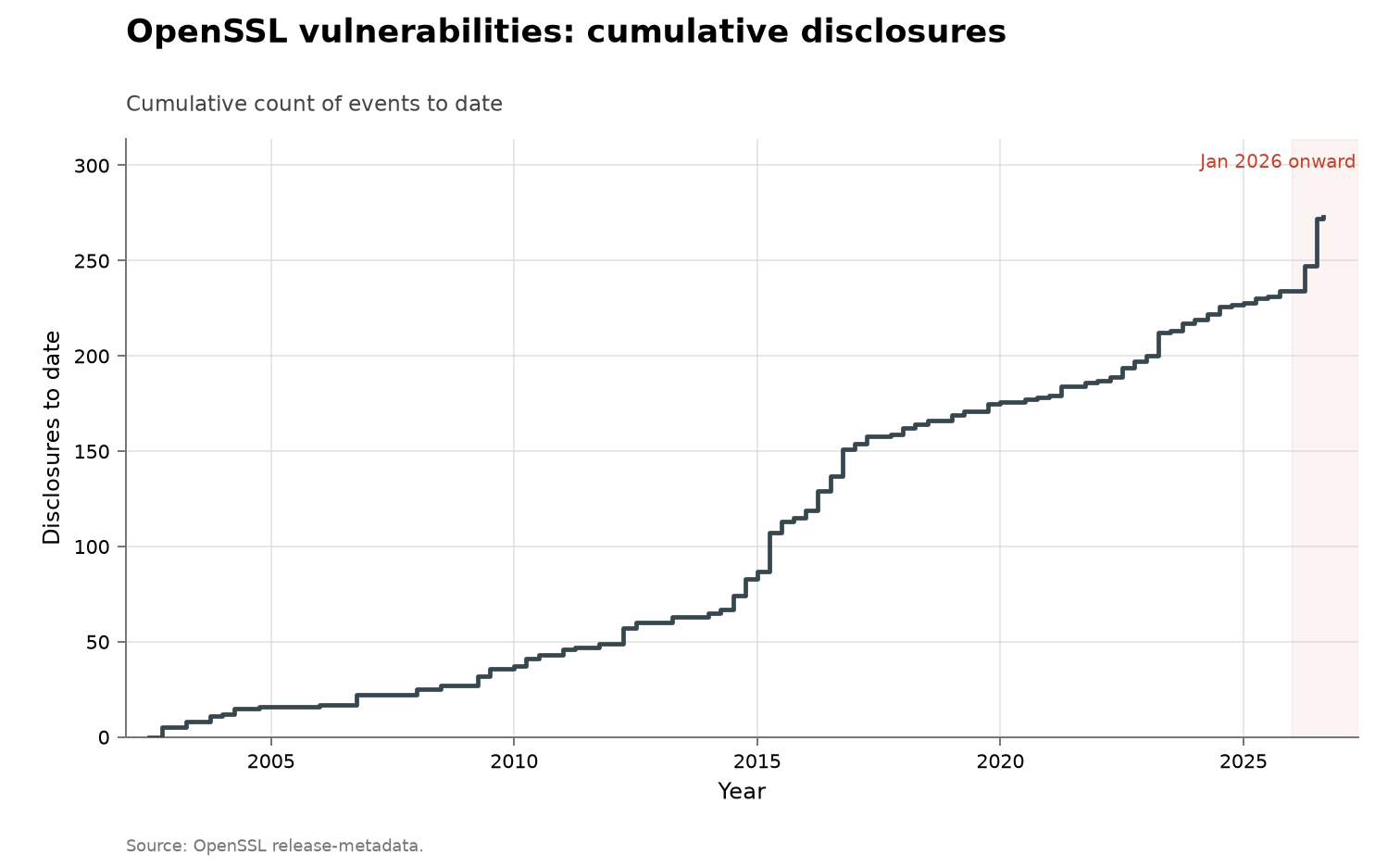
The collection-wide cumulative index redraws this
series as cumulative disclosures to date:
Method
fetch.py downloads one tarball for OpenSSL release-metadata
commit
597a9a75044f,
the final metadata correction on 5 August 2026. The pin makes the vendored
snapshot reproducible. It parses all 273 secjson/CVE-*.json records and
fails on a missing publication date or severity; coverage is 273 of 273
structured records, with no silent omissions. Reporter/finder credits are
kept separate from remediation developers.
openssl-cves.csv is the auditable, one-row-per-CVE
source for both aggregates. It records:
CVE, publication date, OpenSSL severity and reporter;
independent explicit_ai, ai_affiliated and fuzz booleans;
the finding-level AI evidence URL, affected version ranges and OpenSSL's
structured source.discovery value;
a pinned source URL, SHA-256 of the source JSON and metadata commit.
Here explicit_ai means corroborated AI method, not employment at an AI
company. It is yes only in these cases:
A separate source enumerates the CVE as produced by an AI system:
Aisle's three September 2025 findings, all 12 January 2026 findings, and
five April 2026 findings [@aisleopenssl2025; @aisleopenssljan2026;
@aisleopensslapr2026].
The official reporter text itself names the method, which applies to
CVE-2026-45447, quoted in AI attribution below.
The Aisle evidence is external to OpenSSL but is still the vendor's own
finding-level claim, not a neutral replication. OpenSSL independently
confirms the reporter identities but records source.discovery as
UNKNOWN; that field is not converted into AI attribution. Bare Aisle or
Anthropic affiliations without CVE-level method evidence remain
ai_affiliated=yes, explicit_ai=no.
AI and fuzz are independent booleans, so a future AI-guided fuzzing credit
can be true in both columns. The mutually exclusive chart bands are only a
display rule, applied in this order: corroborated AI; affiliation-only;
credited conventional/fuzzing; no reporter.
figure.py derives the four-band quarterly chart, the
event-level 2026 batch chart and the severity chart from the CSVs; quarters
come from each CVE's publication date, so the main chart and the CVE ledger
cannot disagree. The severity chart refuses to draw if any CVE from 2015 on
lacks a rating. check.py runs offline semantic checks: unique
CVEs, complete dates, category sums, CVE-to-annual and CVE-to-reporter
aggregation, evidence for every AI classification, pinned source hashes,
and the fact lines above. For a network-backed verification that every
vendored field still exactly matches the pinned OpenSSL snapshot, run:
python3 problems/cyber-openssl/fetch.py --check
Limitations
no causal estimate. The series has no denominator for researcher
time, compute, audit intensity or code added; AI capability and increased
attention cannot be separated.
changing target. Project identity is stable, but features, versions
and newly introduced bugs are not.
self-reported method evidence. Aisle's CVE-specific disclosures are
stronger evidence than inference from its name, but they remain
first-party claims.
unknown tools elsewhere. "Conventional/fuzzing" means no corroborated
AI method in the collected sources; it does not establish that every such
researcher used only manual methods.
publication is batched.datePublic tracks coordinated releases, not
when each issue was discovered.
partial year. The 2026 observation ends on 5 August. The same-period
comparison addresses exposure time, not seasonality or future releases.
small cohorts. A spread of 67% to 83% Low across 2026 cohorts of nine
to eighteen CVEs rests on small counts, as does any single year's
severity mix.
AI attribution
corroborated set: 21 CVEs. 20 are enumerated by Aisle's CVE-level
accounts — 3 published 2025-09-30 [@aisleopenssl2025], 12 on 2026-01-27
[@aisleopenssljan2026] and 5 on 2026-04-07 [@aisleopensslapr2026] — and 1
carries a reporter credit naming the method:
"Thai Duong (Calif.io in collaboration with Claude and Anthropic
Research)"
— OpenSSL reporter credit for CVE-2026-45447, published 2026-06-09, vendored in openssl-cves.csv, read 2026-08-14
published by year: 18 of the 21 corroborated CVEs were published in
2026, 3 in 2025.
affiliation-only: 9 further 2026 CVEs name Aisle or Anthropic
affiliations without finding-level method evidence in the sources
collected here; they are ai_affiliated=yes, explicit_ai=no.
Mythos: Anthropic's disclosure dashboard records vulnerabilities
attributed to Mythos and names Alex Gaynor on the project team; no
OpenSSL CVE was identified in the dashboard snapshot consulted
[@anthropicmythos2026; @anthropiccvd2026]. CVE-2026-28386 is in the
corroborated set because Aisle's CVE-specific account says its autonomous
system found it; the same account describes Gaynor's later co-report as
"likely using Mythos", which is not method evidence for his other OpenSSL
reports [@aisleopensslapr2026].
before 2025: no CVE row carries an AI marker of either kind, as of
the pinned 2026-08-05 snapshot.
Sources
[@openssl2026index] — the release-metadata repository; the authoritative
source for every count, severity and official credit here.
[@aisleopenssl2025] — Aisle's first-party, CVE-level claim to three of
the four OpenSSL vulnerabilities of 2025.
[@aisleopenssljan2026] — Aisle's first-party enumeration of the twelve
January 2026 CVEs.
[@aisleopensslapr2026] — Aisle's first-party enumeration of five April
2026 CVEs, and the source of the "likely using Mythos" description.
[@anthropiccvd2026] — Anthropic's coordinated-disclosure dashboard; no
OpenSSL CVE identified in the snapshot consulted.
[@bloomberg2026recordflaws] — press reporting on the 2026 surge; context
only, not a substitute for CVE-level provenance.
[@sherry2021fast] — measured heterogeneity of improvement rates across
algorithm families; the 2015–2016 disclosure burst here is a pre-LLM
record in the same spirit.