curl-by-year.csv (severity detail in the same file); quarterly curl-by-quarter.csv; per-finder curl-finders.csvThe final bar is a partial quarter.
curl is a widely deployed C library and command-line tool. The project publishes a machine-readable record of every vulnerability it has ever disclosed, with a severity rating set by the maintainers and a credit string naming who reported it.
A "discovery" in this series is one disclosed vulnerability, counted in the
quarter of its publication date. It is a disclosure count, not a count of
bugs introduced or bugs remaining. An "AI-marked" disclosure is one whose
credit string names an AI system or method, or names an AI-security
employer; the two signals are recorded separately in
curl-finders.csv and combined into the annual and
quarterly tables' ai_attributed column.
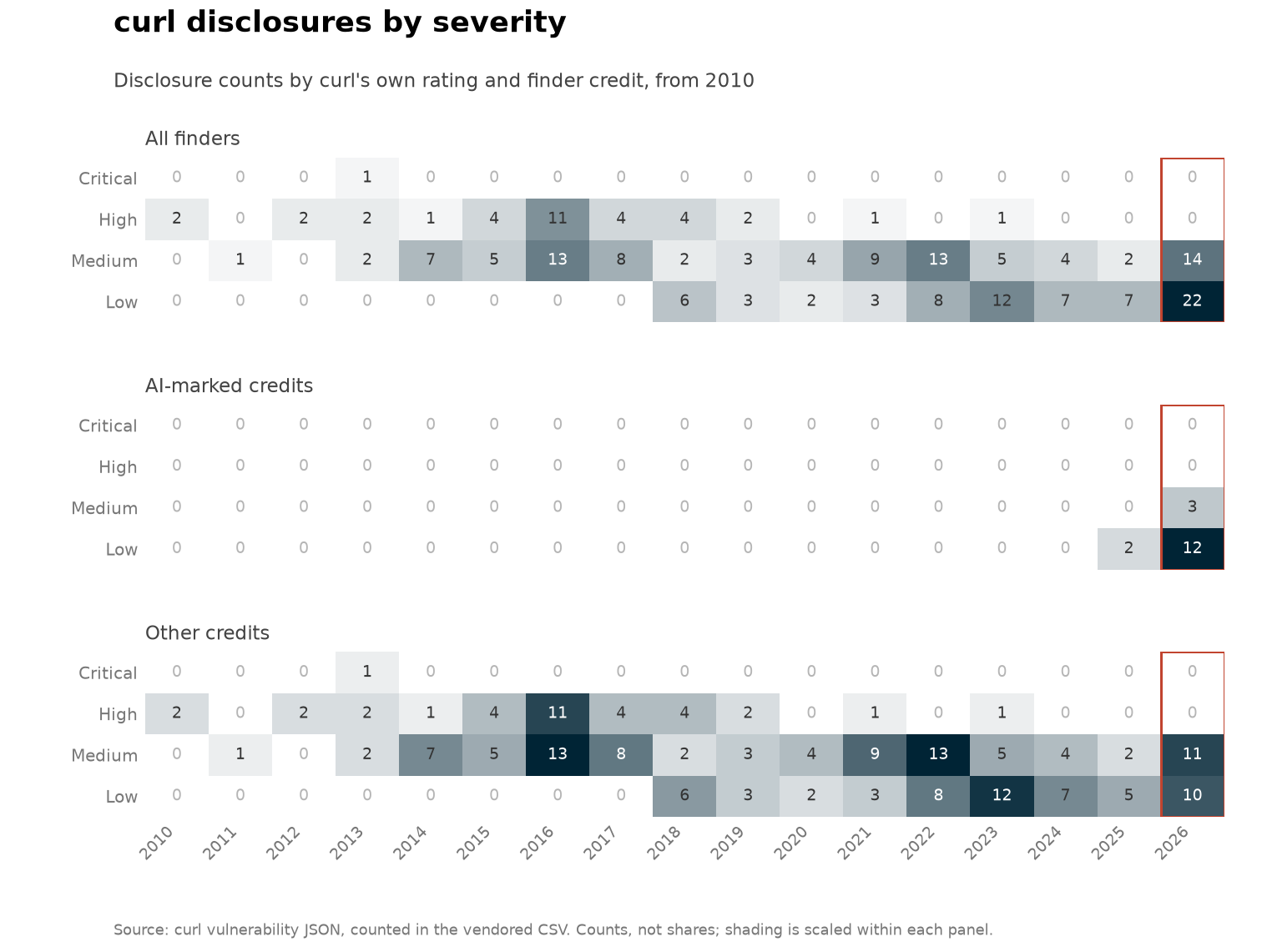
The severity figure cuts the same rows by curl's own rating: one grid per finder-credit cohort, years across, ratings down, every cell printing the number of disclosures it holds. Shading is scaled within each panel, as the note on the figure states.
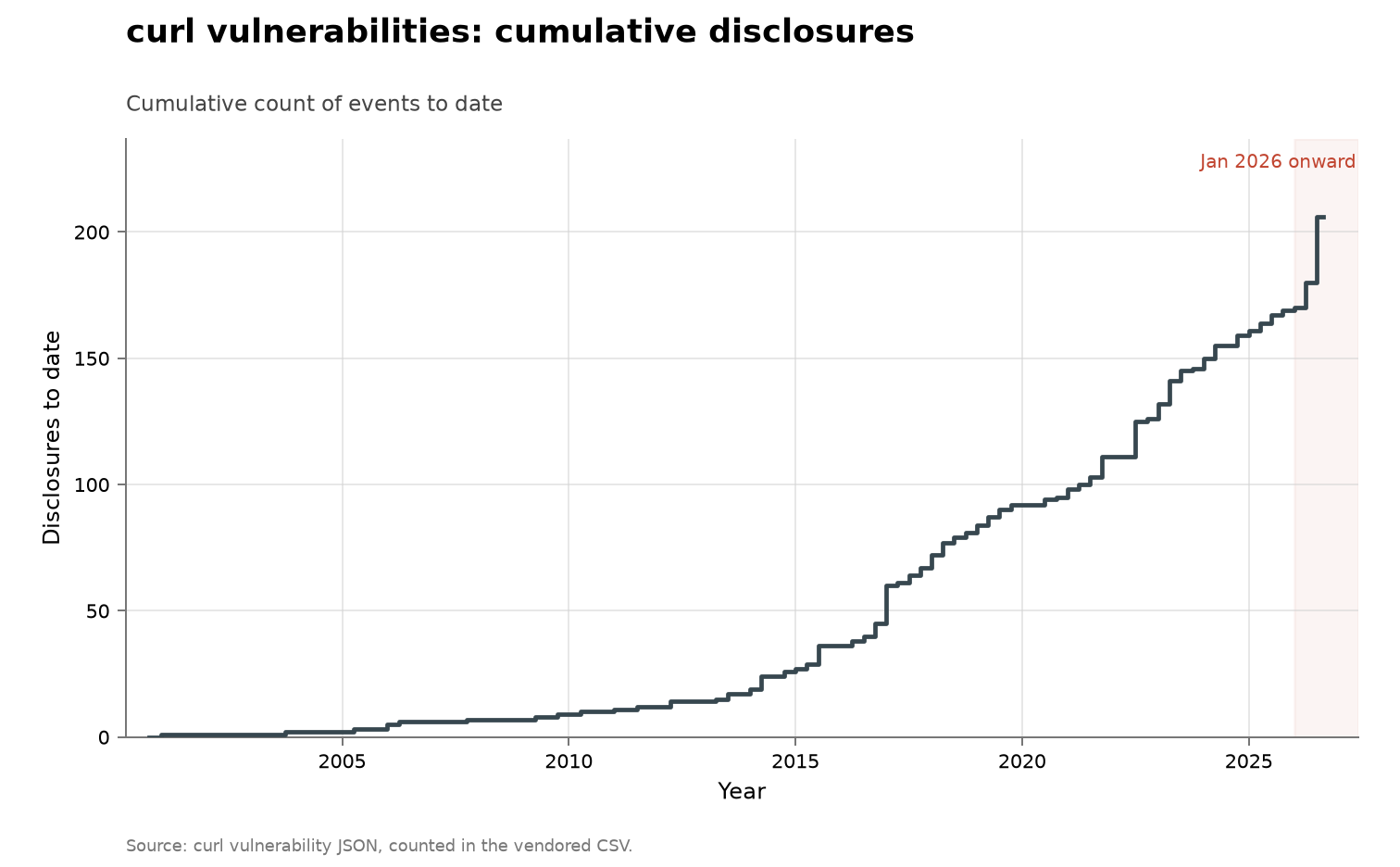
The collection-wide cumulative index redraws this series as cumulative disclosures to date:
The CSVs are built by fetch.py, which reads curl's JSON record
and buckets disclosures by publication year and quarter. The shared
classifier in ../../lib/credits.py reads three
independent signals off each FINDER string: whether it names an AI system
or method (Big Sleep, Mythos, Claude, "agent"), whether it names an
AI-security employer (Aisle Research, AntAISecurityLab, OpenAI, Anthropic),
and whether it names fuzzing. The per-finder table
curl-finders.csv records which band each credit falls
in. The annual and quarterly tables keep a single combined ai_attributed
column, true when a credit carries either AI signal; it describes the
credit's text, not the method used.
figure.py calls the shared periodic_stacked() shape in
../../lib/families.py, drawing stacked quarterly
bars from curl-by-quarter.csv: other_attributed in blue,
ai_attributed in red, the final quarter outlined rather than filled and
annotated with the annual table's data_through date. The axis is linear
and January 2026 onward is shaded, as in every figure here. The severity
figure comes from the same script through the shared severity_heatmap()
shape, built from the annual table's severity columns and normalized within
each panel. check.py recomputes the fact lines above from the
CSVs.
ai_attributed, so they describe
reports from AI-security researchers rather than reports with a
corroborated AI method.22 of the 45 disclosures of 2026 (through 2026-09-02) are AI-marked. One credit names a system:
"Andrew Nesbitt (powered by Mythos)" — curl credit string for one 2026 disclosure, vendored in
curl-finders.csv, read 2026-09-14
The other 21 name an AI-security employer without stating a method: 15
credit Aisle Research ("Stanislav Fort (Aisle Research)" on 9, "Joshua
Rogers (Aisle Research)" on 6), 3 credit AntAISecurityLab hackerone handles,
1 credits "Filipe Casal of Trail of Bits in collaboration with OpenAI",
and 2 credit "Eunsoo Kim (Autonomous Code Security team at Microsoft)",
all quoted from curl-finders.csv as read 2026-09-14.
2025 has 2 AI-marked disclosures: one system-naming credit,
"Google Big Sleep" — curl credit string for one 2025 disclosure, vendored in
curl-finders.csv, read 2026-09-14
and one affiliation-only credit, "Stanislav Fort (Aisle Research)". No
AI marker appears in any credit string before 2025, as of the 2026-09-02
snapshot. Stanislav Fort of Aisle Research appears in both curl and OpenSSL
finder tables (../cyber-openssl/)
[@googlebigsleep2024; @anthropicmythos2026; @aisle2026].