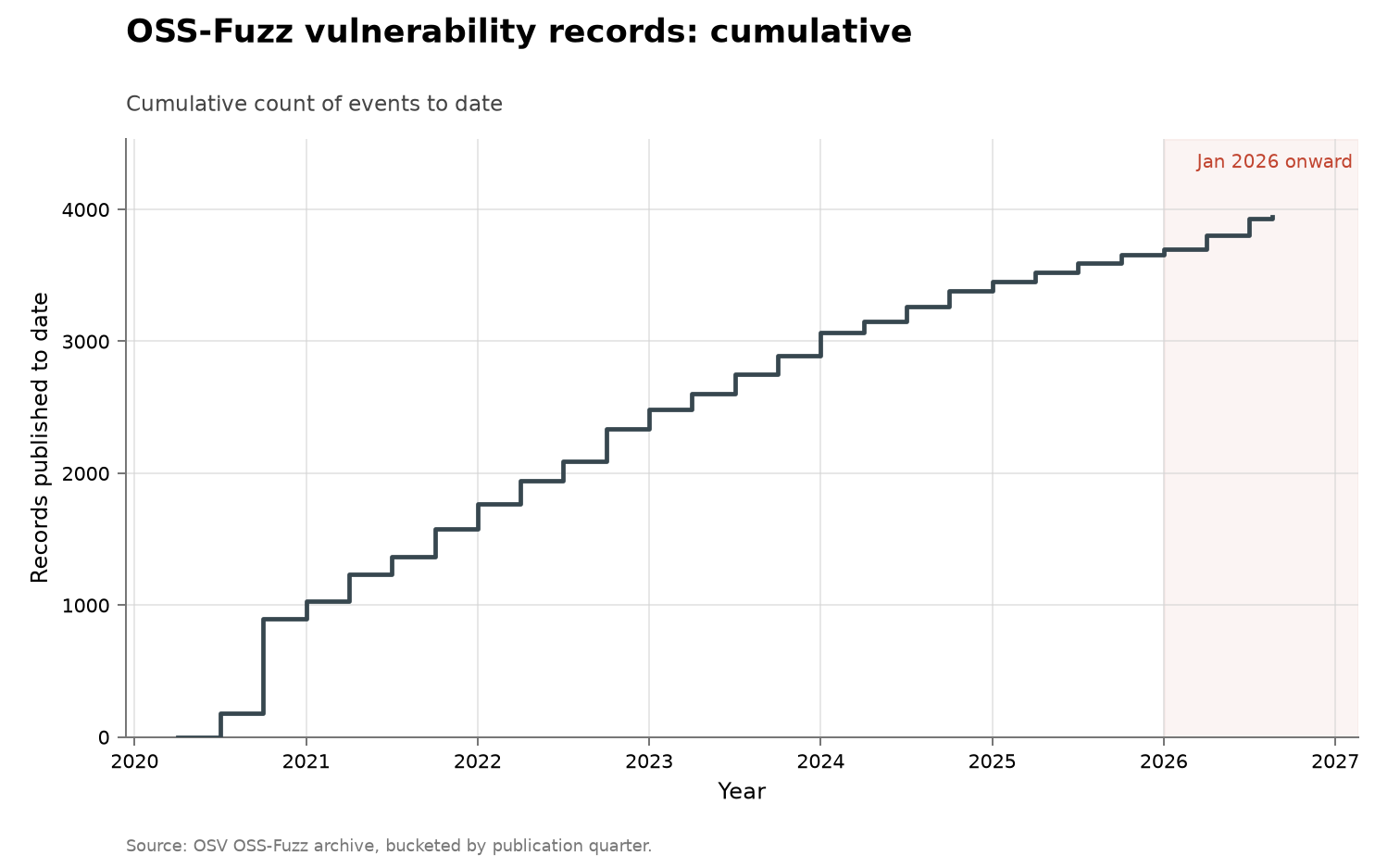
ossfuzz-by-quarter.csv; annual ossfuzz-by-year.csvThe final bar is a partial quarter; hover for the flag.
OSS-Fuzz is Google's continuous fuzzing service for open-source software. It runs automated search against the projects enrolled in it and publishes each finding as a dated record in the OSV database. The programme states its own scale:
"As of August 2023, OSS-Fuzz has helped identify and fix over 10,000 vulnerabilities and 36,000 bugs across 1,000 projects." — OSS-Fuzz documentation, google.github.io/oss-fuzz, read 2026-08-14 [@google2026ossfuzz]
A "discovery" in this series is one published OSV record in the OSS-Fuzz ecosystem. The count is not severity-weighted and is not restricted to any single codebase. Records carry an ecosystem and dates but no finder credit and no severity field.
The collection-wide cumulative index redraws this series as cumulative vulnerability records to date:
Both CSVs are built by fetch.py from the same OSV archive, on
two different clocks. The annual ossfuzz-by-year.csv counts records by
the year embedded in the record identifier (OSV-YYYY-N); the quarterly
ossfuzz-by-quarter.csv buckets the same records by their published date.
Records predating 2020 were backfilled into OSV during 2021, so their
publication dates all land in that year; counting by identifier year avoids
assigning those 267 pre-2020 records to 2021, and the series is reported from
2020, where the two clocks agree closely (1,041 against 1,031 for 2020, 710
against 716 for 2022). The clocks can still disagree at a year boundary; the
2026 gap is stated in the facts above. Records published after the
repository's snapshot date (AS_OF_DATE in
../../lib/dates.py) are dropped, so a refetch
reproduces the committed window; that snapshot is the data_through date the
partial rows carry.
figure.py calls the shared periodic_stacked() shape in
../../lib/families.py, drawing one amber bar per
quarter from the discoveries column — amber is the collection's fuzzer
colour. There is no AI/human split because the records carry no finder
credit. The partial quarter is outlined and annotated with the data_through
date. The axis is linear and January 2026 onward is shaded, as in every
figure here. check.py recomputes the fact lines from the
annual CSV.
No OSS-Fuzz record names a finder, so no record carries an AI credit, as of
the 2026-09-28 read of the archive. One adjacent fact: OSS-Fuzz-Gen, an
LLM-assisted generator of fuzzing harnesses, appears by name in OpenSSL
credit strings vendored in ../cyber-openssl/,
and this collection classifies those CVEs as fuzzing because the credit
names the fuzzer [@osv2026ossfuzz; @google2026ossfuzz].