Capability vs self-reported uplift
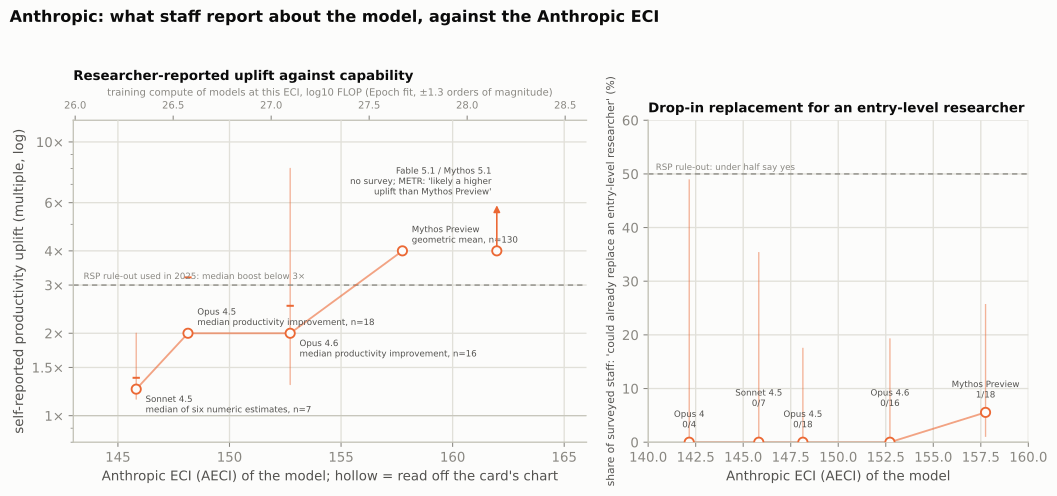
The closed labs’ cards give two kinds of evidence about AI acceleration of AI R&D: benchmark scores, and what their own researchers say the model does for their work. Anthropic is the only lab that publishes the second kind with numbers, as staff surveys in the Sonnet 4.5, Opus 4.5, Opus 4.6 and Mythos Preview cards, and it also publishes a capability index for its models, the Anthropic ECI (AECI), its fork of Epoch AI’s Epoch Capabilities Index. This page puts the two together, and then maps the capability index onto training compute using Epoch’s public data.
Uplift against the Anthropic ECI
Read across the four surveys, the reported median uplift roughly doubles for every 8 to 10 AECI points, from 1.25x at Sonnet 4.5 to 2x at Opus 4.5 and 4.6 and about 4x at Mythos Preview, while the share of staff who think the model could replace an entry-level researcher stays near zero until Mythos Preview, where 1 of 18 said so and 4 of 18 gave even odds within three months. Anthropic’s own reading is that uplift does not translate one for one into research progress: the Mythos Preview card puts the overall progress multiplier below 2x and says reaching 2x through this channel “would require uplift roughly an order of magnitude larger than what we observe”. After Mythos Preview the cards stop surveying staff and rely on internal usage data, the AECI trend and CoBench instead, so the series ends there. The surveys also differ in who was asked and how, so the slope is suggestive, not a measurement.
Mapping the capability index to compute
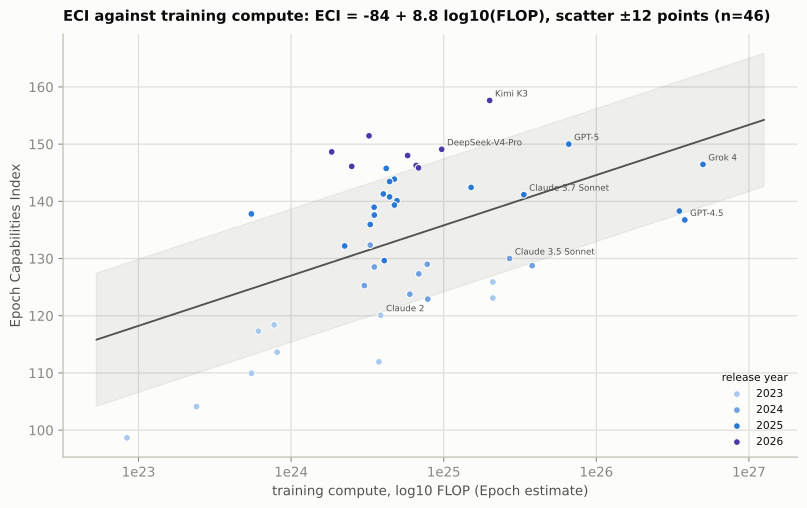
Two conversions follow from Epoch’s data, and they disagree by a factor of two, which is the honest width of the mapping:
- Pooled across years, ECI rises about 9 points per tenfold of training compute (the fit above). On that scale Anthropic’s frontier trend of 13.5 AECI per year corresponds to about 1.5 orders of magnitude of compute-equivalent per year, and the RSP’s “notably more capable” step of 4x effective compute to about 5 ECI points.
- Controlling for release date (adding a linear time term to the same fit), the compute slope falls to about 4.5 points per tenfold and the time term absorbs about 11 points per year. On that reading a tenfold of compute at fixed algorithms buys half as much ECI, and most of the year-on-year gain is algorithmic.
Epoch’s own analysis of the ECI trend finds frontier progress of about 8 points per year before April 2024 and about 15 points per year after, which brackets Anthropic’s 13.5 AECI per year. The AECI and the public ECI are on nearly the same scale for the Claude models that have both: the public ECI is higher by 1.5 points on average, with a spread of 1.2 (eleven Claude models have both), and that offset is applied before the compute conversion. Data: data/ai_rd_aeci.csv, data/ai_rd_uplift.csv, and Epoch’s files under data/external/ (CC-BY, fetched 2026-09-15).