frontiermath-open-problems.csv, frontiermath-open-solutions.csvRows are grouped by notability tier, most notable first. Unsolved problems sit at the right edge; click a point to open its page, hover for the system and notes.
FrontierMath: Open Problems is Epoch AI's pool of unsolved research mathematics, announced in late February 2026 [@epoch2026openproblems]. The site's front page states the selection:
"A collection of unsolved mathematics problems that have resisted serious attempts by professional mathematicians." — Epoch AI, FrontierMath: Open Problems front page, read 2026-08-14 [@epoch2026openproblems]
Computational verification is an admission criterion:
"Problems are only included if their solutions can be verified computationally. This lets us evaluate AI systems at scale without requiring humans to read AI-generated proofs each time." — Epoch AI, FrontierMath: Open Problems FAQ, read 2026-08-14 [@epoch2026openproblems]
Each problem carries an editorial notability tier — moderately interesting, solid result, major advance, breakthrough. The FAQ defines the lowest tier's floor:
"Moderately Interesting: The problem was posed at least 10 years ago and has been worked on by at least two independent teams of mathematicians. It has connections to broader questions, but is not a priority for any large research program." — Epoch AI, FrontierMath: Open Problems FAQ, read 2026-08-14 [@epoch2026openproblems]
A "discovery" in this series is a problem page moving to a solved status, solved by AI or solved by humans. Solve dates come from the pages' solution-update prose and Epoch's announcement posts: the ramsey-hypergraphs row is dated by the announcement post because its page states no solve date, the hadamard row by the day of the public report its page links, and the withdrawn explicit-deformations row and the genus-2-rational-points row carry no date. The pool is edited as events arrive: problems are added, retired after solves, and in one case withdrawn.
The front-page tally differs from the page-by-page sitemap read the CSVs vendor, consistent with recent additions, retirement of solved rows from the active pool, and the withdrawal. The Erdős catalogue records the same one-stock-several-counts pattern on its corpus.
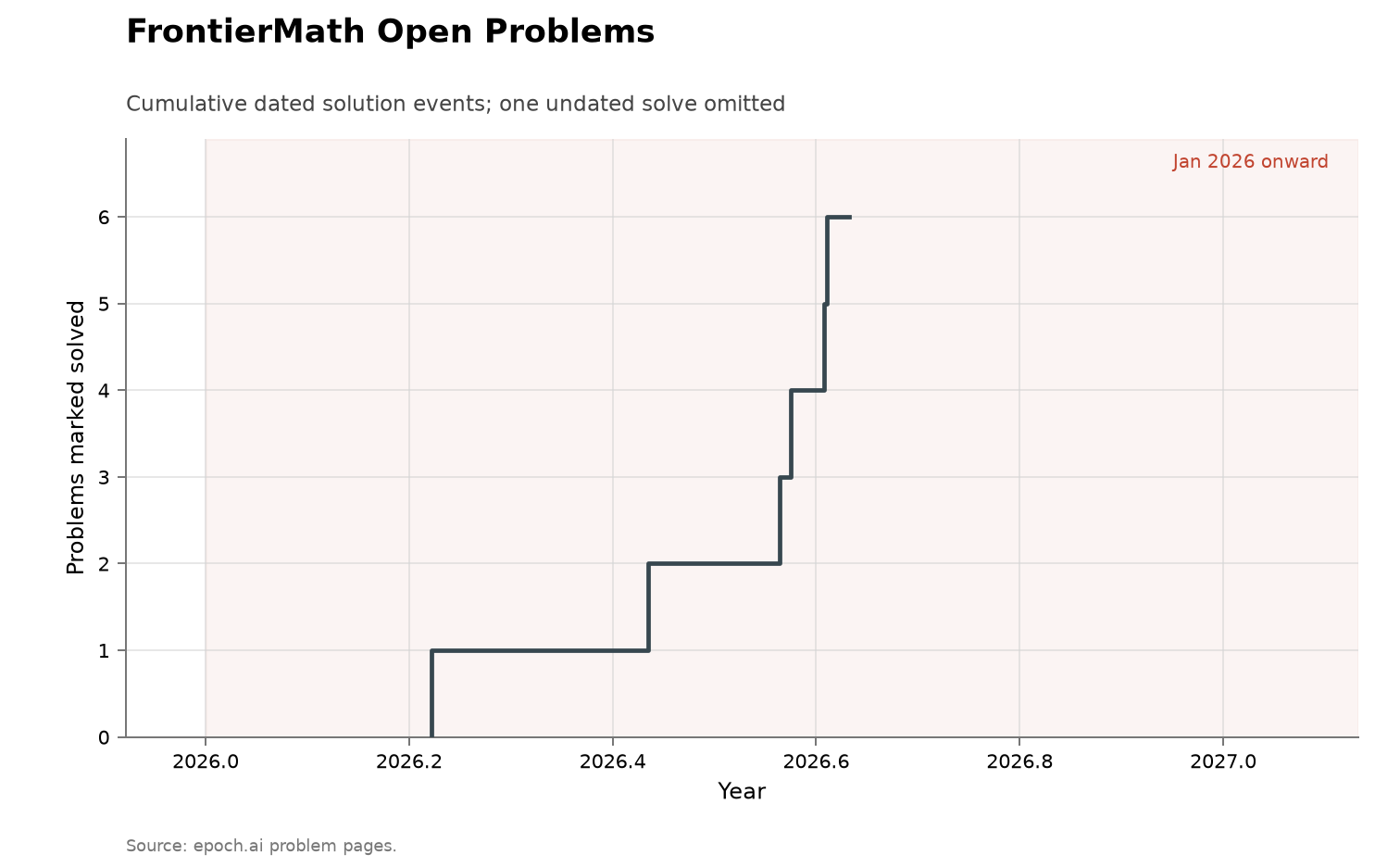
The collection-wide cumulative index redraws the seven dated events as a running count:
"This problem has been solved! A solution was first elicited by Kevin Barreto and Liam Price, using GPT-5.4 Pro. This solution was confirmed by problem contributor Will Brian, and will be written up for publication." — Epoch AI, ramsey-hypergraphs problem page, read 2026-08-14 [@epoch2026openproblems]
"The solution was generated by GPT-5.2 Pro running in a harness developed by David Turturean." — Epoch AI, explicit-deformations problem page, read 2026-08-14 [@epoch2026openproblems]
"Update (2026-03-12): We have determined that any solution to this problem would not meet our bar of being a publishable result in its own right. As a result, we have removed the problem from the benchmark." — Epoch AI, explicit-deformations problem page, read 2026-08-14 [@epoch2026openproblems]
"Progress Update (2026-07-06): Multiple AI systems have now generated solutions that are accepted by the verifier for this problem. The first solution we were made aware of was generated by Claude Fable 5, elicited by problem contributor David Roe on 2026-06-09." — Epoch AI, q2-absolute-galois problem page, read 2026-08-14 [@epoch2026openproblems]
"Since the superpermutations problem appears to have been solved by AI after we accepted the problem into the benchmark, we are recording this problem as solved on release." — Epoch AI, superpermutations problem page, read 2026-08-14 [@epoch2026openproblems]
"In this instance, the solution to the problem was latent in the existing literature: the curve, which is part of a substantial project to create a dataset of curves, is in a public database, and would have been recognized as a solution had someone checked its torsion subgroup." — Epoch AI, genus-2-jacobian-torsion problem page, read 2026-08-14 [@epoch2026openproblems]
"We hold a high bar for considering a problem “solved by AI”, in particular requiring that the core ideas of the solution be unambiguously contributed by AI." — Epoch AI, inverse-galois problem page, read 2026-08-14 [@epoch2026openproblems]
"The boundaries between the human- and AI-contributed reasoning are not clear. Probably, it would be practically impossible to draw a sharp line." — author of the (M_{23}) solution, quoted on Epoch AI's inverse-galois problem page, read 2026-08-14 [@epoch2026openproblems]
"We have provisionally marked the problem as being solved by AI, though will revise this if further reports from the team indicate that humans contributed significantly to the core mathematical ideas." — Epoch AI, hadamard problem page, read 2026-08-14 [@epoch2026openproblems]
The same event is this collection's elliptic-curve rank record, where the submission history, the leaderboard rows and the self-reported status of the credit are documented in full.
fetch.py reads the site's sitemap, fetches each problem page,
and rebuilds frontiermath-open-problems.csv
from the server-rendered status chip, field chip, task-type chips and
notability badge; an unrecognised status is a hard failure rather than a
guessed category.
frontiermath-open-solutions.csv is
hand-transcribed from the pages' solution-update prose and Epoch's
announcement posts, because the dates, systems and elicitors of each solve
are stated only in prose. check.py cross-checks the two
ledgers — every solved status in the page ledger must have an event row and
vice versa — and recomputes the fact lines and register entries, so a
refetch that flips a status without the event ledger being reviewed fails
the folder rather than passing silently.
figure.py places each dated event at its date and tier lane,
and beside the timeline draws the whole pool as one stacked bar per tier —
open, solved by AI, solved by humans — with each bar's label stating how
much of the tier remains unsolved. Undated solves — the withdrawn explicit-deformations page and the
genus-2-rational-points page — are stated in a corner note rather than
drawn.
It also draws the cumulative count of dated solves for
CUMULATIVE.md.
"Does the verifiability constraint introduce a bias to the kinds of math represented here? Yes. The problems have a constructive bent, asking for concrete mathematical objects or algorithms." — Epoch AI, FrontierMath: Open Problems FAQ, read 2026-08-14 [@epoch2026openproblems]
8 of the 9 recorded solves are credited to AI systems in the event ledger: GPT-5.4 Pro (ramsey-hypergraphs), Claude Fable 5 (q2-absolute-galois), GPT-5.6 Sol (superpermutations and genus-2-jacobian-torsion), Claude (hadamard and elliptic-curve-rank), one solve on the withdrawn explicit-deformations page for which the event ledger records no date and no system, and the genus-2-rational-points solve, marked Solved (AI) at the 2026-09-14 refetch with no public detail found yet [@epoch2026openproblems]. The ninth, inverse-galois, is scored solved-by-humans under the bar quoted in its register entry. The genus-2-jacobian-torsion solve is a literature-search result: the page states the solving curve was already in a public database (quoted above). No solve is recorded in the major-advance or breakthrough tiers as of the 2026-09-14 read.