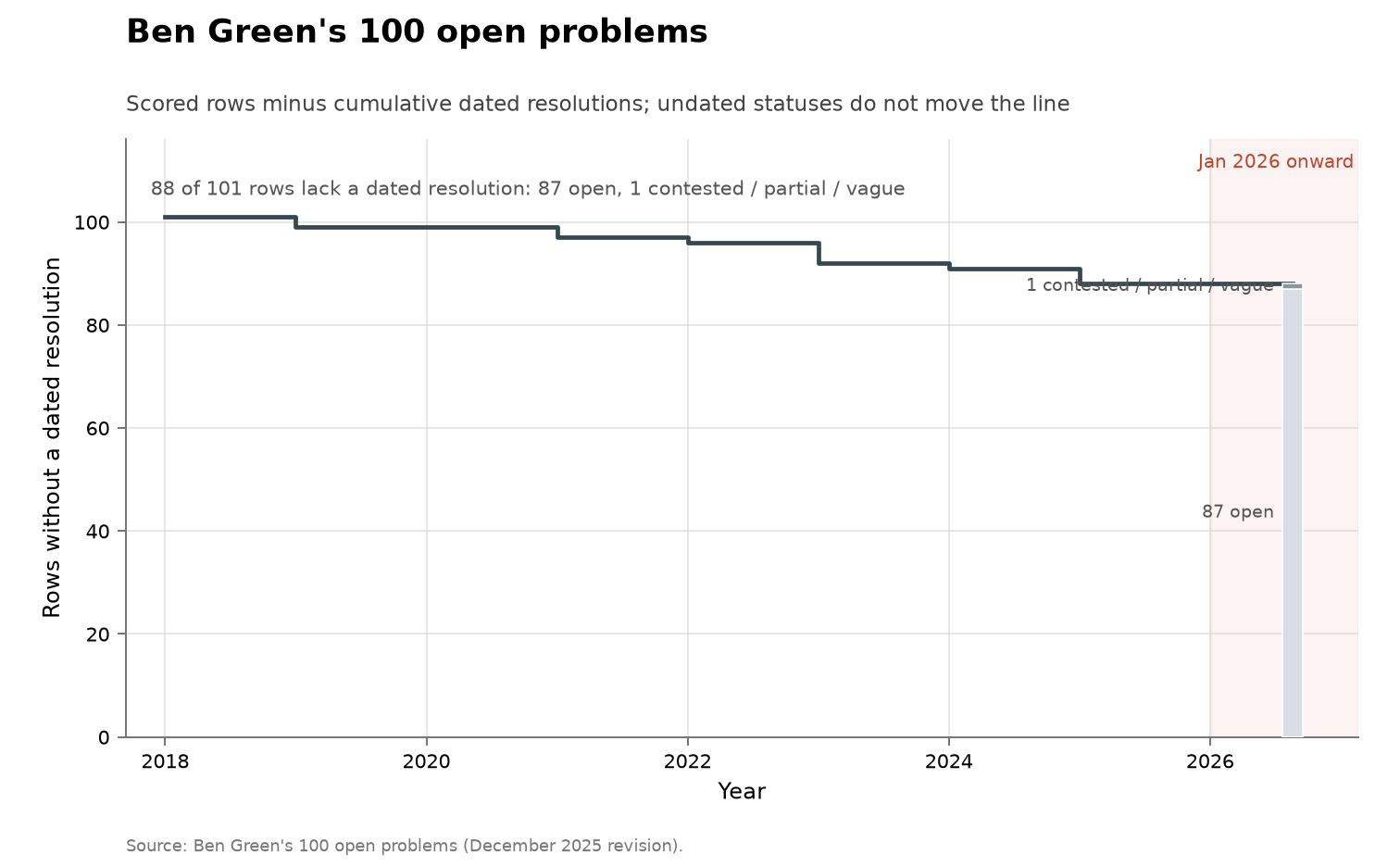
green-problems.csvOpen problems sit on the right edge. Hover a point for resolver and notes.
Ben Green's "100 open problems" is a list of one hundred questions in additive combinatorics, number theory, discrete geometry and harmonic analysis, circulated since 2018 and revised by its author, with statuses updated as problems fall [@green2025openproblems]. A problem's heading carries "(Solved)" when Green marks it solved, and a dated update note names what solved it. The document states its own revision cadence:
"Perhaps once a year or so. Most recent update: December 2025. Updates are generally in the form of additional remarks, with the original text unchanged." — Ben Green, 100 open problems (December 2025 revision), read 2026-08-13 [@green2025openproblems]
A "discovery" in this series is a row carrying Green's solved marker together with the year of the update note recording the solution. In every case but one that is also the year the resolving work first appeared; the exception is Problem 9(i), where the update note is dated a year after the Kelley–Meka preprint and the row carries the preprint's year. The ledger is a snapshot of the December 2025 revision, read on 2026-08-13.
There are 101 scored rows rather than 100 problems because Problem 9's part (i) carries its own solved marker while parts (ii) and (iii) stand open, so it is split into two rows — the same split rule the Smale ledger applies to its row 11. A heading marked "(Mostly solved)" is scored partial.
The collection-wide cumulative index redraws this ledger as rows remaining:
"Update 2025. Bedert [28] has solved the original question, showing that any set A ⊂ Z of size n contains a sum-free set of size at least n/3 + c log log n." — Ben Green, 100 open problems (December 2025 revision), read 2026-08-13 [@green2025openproblems]
"Update 2022. This question has been solved (together with a stability result characterising sets close to the extremum) by Keevash, Lifshitz and Minzer [192]." — Ben Green, 100 open problems (December 2025 revision), read 2026-08-13 [@green2025openproblems]
"Update 2024. In a remarkable breakthrough, Kelley and Meka [194] […]" — Ben Green, 100 open problems (December 2025 revision), read 2026-08-13 [@green2025openproblems]
"Update 2023. Depending on one’s definition of ‘reasonable’, problem (i) has been resolved by Peluse, Sah and Sawhney [241] […]" — Ben Green, 100 open problems (December 2025 revision), read 2026-08-13 [@green2025openproblems]
"Update 2021. I [150] resolved this question in the negative by proving a lower bound of shape […]" — Ben Green, 100 open problems (December 2025 revision), read 2026-08-13 [@green2025openproblems]
"Update 2019. This question has been resolved by Fox, Sah, Sawhney, Stoner, and Zhao [125], showing that C = 4." — Ben Green, 100 open problems (December 2025 revision), read 2026-08-13 [@green2025openproblems]
"Update 2023. This problem has now been resolved by Frantzikinakis, Klurman and Moreira [128]." — Ben Green, 100 open problems (December 2025 revision), read 2026-08-13 [@green2025openproblems]
"Update 2025. Yang Yu [308] has solved the original problem (with 100 replaced by 4)." — Ben Green, 100 open problems (December 2025 revision), read 2026-08-13 [@green2025openproblems]
"Update 2023. This has been solved by Gowers, Manners, Tao and me [135]." — Ben Green, 100 open problems (December 2025 revision), read 2026-08-13 [@green2025openproblems]
"Update 2025. Sawin [275] has used algebro-geometric methods to obtain an asymptotic formula with s = O(k), provided say p ⩾ 2k." — Ben Green, 100 open problems (December 2025 revision), read 2026-08-13 [@green2025openproblems]
"Update 2023. The original question has been resolved positively by Jing, Tran and Zhang [183]." — Ben Green, 100 open problems (December 2025 revision), read 2026-08-13 [@green2025openproblems]
"Update 2019. This problem, though not the further problems below, has now been solved in very nice work of Balister, Bollobás, Morris, Sahasrabudhe and Tiba [18]." — Ben Green, 100 open problems (December 2025 revision), read 2026-08-13 [@green2025openproblems]
"Update 2021. Ferber, Kwan, Narayanan, Sah and Sawhney [118] have shown that this is indeed true." — Ben Green, 100 open problems (December 2025 revision), read 2026-08-13 [@green2025openproblems]
"Update 2024. D. Zakharov [309] has shown that the answer to Problem 95 is negative […]" — Ben Green, 100 open problems (December 2025 revision), read 2026-08-13 [@green2025openproblems]
There is no fetch.py. The rows are hand-scored from the PDF itself: the
status column follows the "(Solved)" and "(Mostly solved)" markers Green
puts on problem headings, the year comes from his dated update notes, and
the resolver from the names those notes credit. A problem counts as resolved
exactly when the list's own author marks it so; the scoring is rebuildable
by reading the same PDF.
figure.py calls the shared problem_list_chart() shape in
../../lib/families.py, reading
green-problems.csv, keeping rows with status equal to resolved and a
non-empty resolved_year, and counting resolution events by year from the
2018 list_year to the present. The cumulative view is the shared
ledger_remaining_chart(). check.py recomputes the fact lines
and the register entries from the CSV.
No solved marker in the December 2025 revision credits an AI system: 0 of the 13 dated resolutions carry AI credit, and every resolver named in the ledger is a human mathematician or group of mathematicians, as of the 2026-08-13 read. Two AI-credited resolutions after that revision are known as of 2026-08-14; both rows keep the document's own open status per the scoring rule, with the events recorded here and in the rows' notes.
The problem is catalogued as erdosproblems.com problem 1202, citing the same Erdős 1980 survey Green cites; the catalogue's page states:
"This was resolved in the negative by Price and GPT-5.4 Pro." — erdosproblems.com, problem 1202, read 2026-08-14 [@erdosproblems2026catalogue]
The catalogue's AI-contribution wiki dates the solve 2026-04-01 and grades it a full solution [@erdosproblems2026wiki]. The December 2025 revision's own comment on the problem is:
"I must admit that I do not know anything about this problem other than what Erdős wrote nearly 40 years ago; this part of his paper does not appear to have been cited since." — Ben Green, 100 open problems (December 2025 revision), Problem 44, read 2026-08-13 [@green2025openproblems]
The document states the problem as two questions:
"There are really two questions here, namely is every group sofic? and is every group hyperlinear?" — Ben Green, 100 open problems (December 2025 revision), Problem 100, read 2026-08-13 [@green2025openproblems]
On 2026-08-01 OpenAI released ten claimed solutions by its Astra model, published with a 249-page manuscript and a public repository of Lean 4 certificates, headlined by the construction of a non-sofic group [@openai2026astra]. That construction answers the sofic question in the negative. It does not answer the hyperlinear question: the document notes that "all sofic groups are hyperlinear, but the reverse implication is not" known, so a non-sofic group leaves the hyperlinear half open. Peer review of the release is not complete as of 2026-08-14.
The one AI event the document itself records is not a resolution but a bound improvement, in the 2025 update to Problem 35:
"Update 2025. An AI-based approach [313] has slightly improved the upper bound of Matolcsi and Vinuesa to c∞ ⩽ 0.75026." — Ben Green, 100 open problems (December 2025 revision), read 2026-08-13 [@green2025openproblems]
The document's reference [313] is "Google DeepMind, AlphaEvolve: A coding agent for scientific and algorithmic discovery, white paper"; the system is documented in [@novikov2025alphaevolve]. The prior bound in the same problem's comments is c∞ ⩽ 0.75049. The autoconvolution constants are the family whose lower-bound ladder math-sums-autoconvolution tracks, and the bound-improvement contribution type is the one math-alphaevolve-records counts. Google DeepMind's formal-conjectures project maintains a milestone formalizing this list's statements in Lean (https://github.com/google-deepmind/formal-conjectures/milestone/2); that is statement formalization, not resolution, and no formalization changes any status in this ledger.