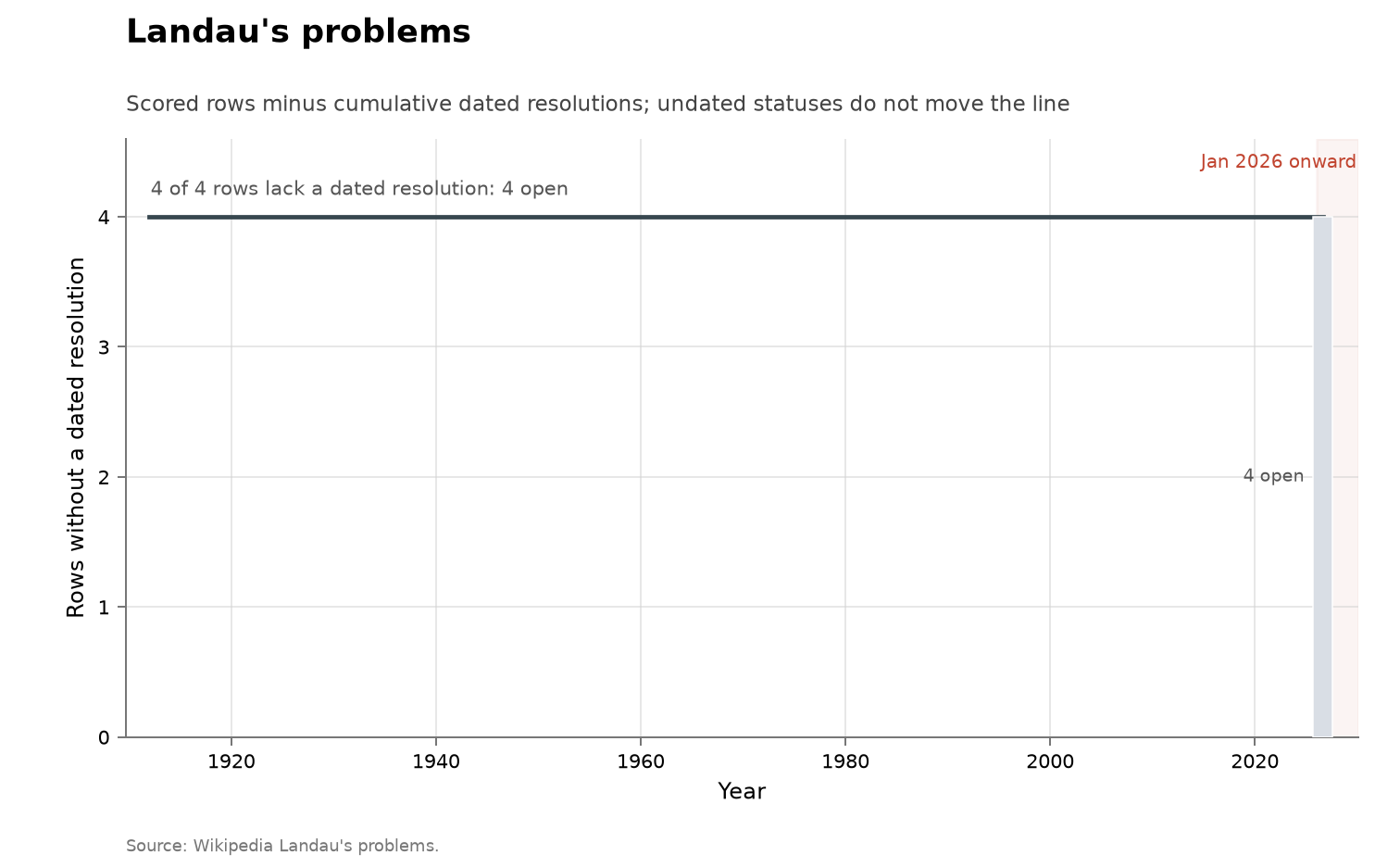
Verdict: no acceleration — 0 resolutions in 2026; 0 dated resolutions over 1912–2025
Per-problem resolution timeline
Open problems sit on the right edge. Hover a point for resolver and notes.
Definition
Edmund Landau named four problems about the primes at the 1912 International
Congress of Mathematicians: Goldbach's conjecture, the twin prime
conjecture, Legendre's conjecture that a prime lies between consecutive
squares, and the infinitude of primes of the form $n^2+1$. A "discovery" in
this series is a row moving to resolved, dated by the year a secondary
consensus account gives. The ledger has four rows, no subproblem splitting
and no contested classifications, and no row has ever moved. The upstream
page states the standing in one clause:
"all four problems are unresolved"
— Wikipedia, Landau's problems, "As of 2026" statement, read 2026-08-14
Facts
rows: 4 scored; 0 resolved with a dated year; 4 open
open rows: goldbach, twin_primes, legendre, n2_plus_1
ai-attributed: 0 of 4 scored rows
The collection-wide cumulative index redraws the
ledger as rows remaining:
The register of non-open rows is empty: every row's status is open.
Method
The rows are transcribed by hand from the consensus ledger named in the
source column, so there is no fetch.py in this folder. There is no
machine-readable upstream to rebuild from: the status of a famous conjecture
is a judgment in the literature rather than a feed.
figure.py calls the shared problem_list_chart() in
../../lib/families.py, which keeps the rows whose
status is resolved with a non-empty resolved_year and counts
resolution events by year from the 1912 list_year to the present. That
event set is empty here, so the chart states that no row has a dated
resolution. No ai_problem argument is passed, because there is no such
row. The cumulative view is the shared ledger_remaining_chart().
check.py recomputes the fact lines from the CSV.
Limitations
no events. A series with zero resolutions has no event rate to compare
across periods, in either direction.
four rows. The finest change the ledger can register is one quarter of
the list.
binary statuses. Partial progress moves no row: the upstream page as
read 2026-08-14 records Zhang's 2013 bound of 70 million on prime gaps,
since improved to 246, and Helfgott's 2013 proof of Goldbach's weak
conjecture, and both rows remain open here.
overlap. goldbach and twin_primes are jointly scored as row 8b of
Hilbert's list [@wikipedia2026hilbert], so
the two ledgers are not independent.
effort. Resolution landmarks are not effort-adjusted discovery rates,
and effort on the primes has risen over the century.
AI attribution
No row in landau-problems.csv carries a resolver or
an AI credit; all four rows are open. No AI credit appears on the Wikipedia
page the rows are scored from as of the 2026-08-14 read.
Sources
Wikipedia, Landau's problems
(https://en.wikipedia.org/wiki/Landau%27s_problems) — the consensus
ledger the four rows are transcribed from, quoted above for the four
statuses; it has no bibliography entry here. It also states the
bounded-gaps and weak-Goldbach facts in Limitations.
[@wikipedia2026hilbert] — the Hilbert ledger holding the overlapping row
8b.
[@arxiv2026horizonmath] — a 2026 benchmark of over 100 predominantly
unsolved problems chosen so that "verification is computationally
efficient and simple"; frontier models score near 0% on it.
[@sherry2021fast] — measured improvement rates across algorithm families,
including multi-decade stationary stretches, with no AI involved.