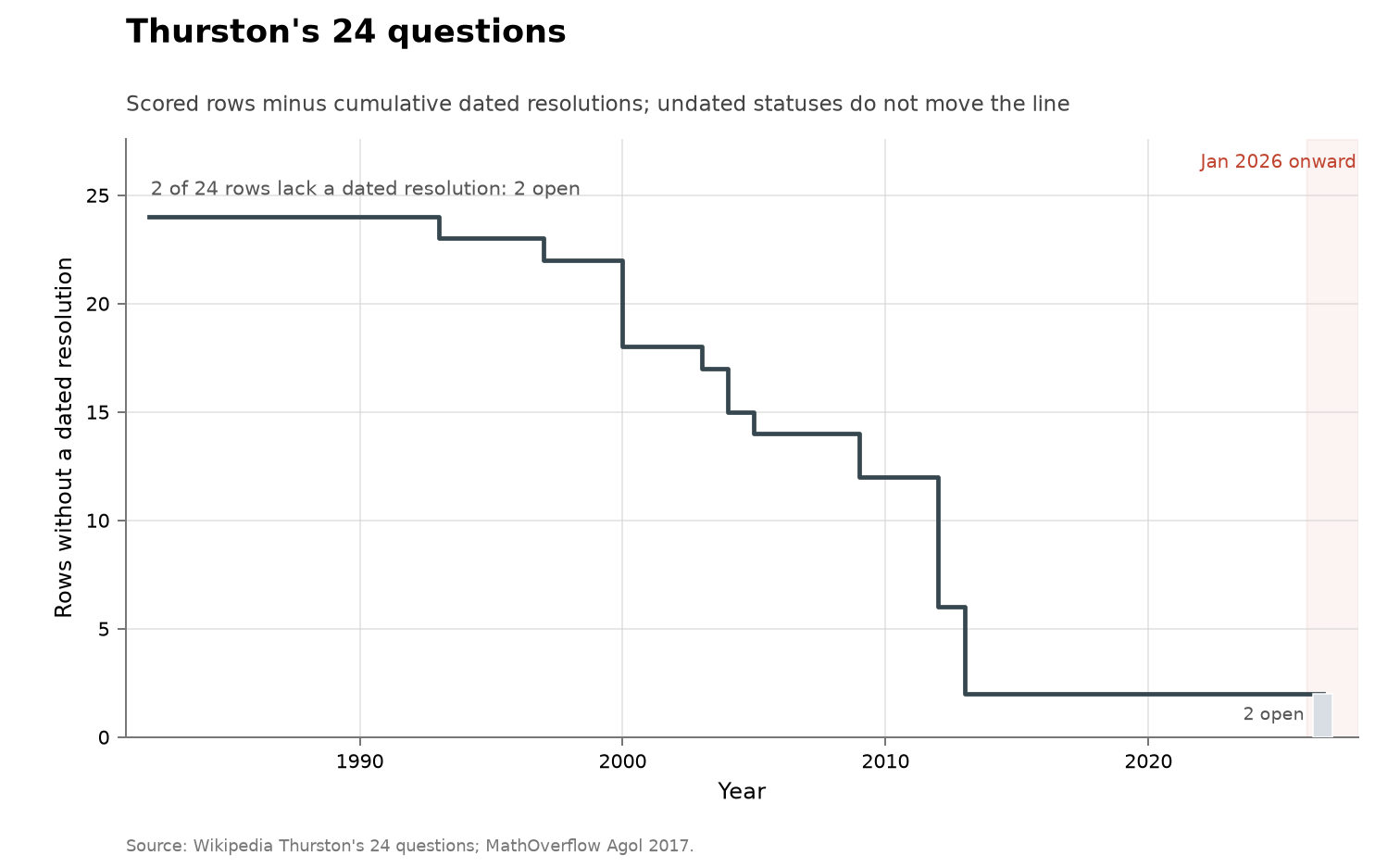
Verdict: no acceleration — 0 resolutions in 2026 and 0 since 2013; 22 dated resolutions over 1993–2013
Per-problem resolution timeline
Open problems sit on the right edge. Hover a point for resolver and notes.
Definition
William Thurston closed his 1982 survey of three-dimensional manifolds,
Kleinian groups and hyperbolic geometry with twenty-four questions. This
ledger scores each question as one row, with the status and year read from
the Wikipedia table named in the source column, cross-checked against
Agol's public status note. There is no subproblem splitting and no contested
classification: twenty-two rows are resolved and two are open (question
19, on arithmetic quotients of hyperbolic space, and question 23, on the
rational independence of hyperbolic volumes).
A "discovery" in this series is a row moving to resolved, dated by the
year the source account gives. Two dating conventions apply and are stated
in the rows' notes: where the source gives a span rather than a year, the
resolved_year is the end of the span (rows 4, 5 and 14), and the three
software questions (20–22) are dated at a conventional 2000 for work the
source places in the 1990s and 2000s.
Facts
rows: 24 scored; 22 resolved with a dated year; 2 open
15 — Residual separability of f.g. subgroups in f.g. Kleinian groups
status: resolved
resolved: 2013
resolver: Agol (building on Wise)
"Solved by Ian Agol, building on work of Wise."
— Wikipedia, Thurston's 24 questions, question 15, read 2026-08-14
16 — Virtually Haken conjecture
status: resolved
resolved: 2012
resolver: Agol
"Solved by Ian Agol."
— Wikipedia, Thurston's 24 questions, question 16, read 2026-08-14
17 — Finite cover with positive first Betti number
status: resolved
resolved: 2013
resolver: Agol
"Solved by Ian Agol."
— Wikipedia, Thurston's 24 questions, question 17, read 2026-08-14
18 — Virtually fibered conjecture
status: resolved
resolved: 2013
resolver: Agol
"Solved by Ian Agol."
— Wikipedia, Thurston's 24 questions, question 18, read 2026-08-14
20 — Software for surface diffeomorphisms / laminations
status: resolved
resolved: 2000
resolver: SnapPea and successors
notes: Software ask; Wikipedia counts as addressed (1990s–2000s)
"Addressed through development of SnapPea and other software."
— Wikipedia, Thurston's 24 questions, question 20, read 2026-08-14
21 — Software to compute hyperbolic structures
status: resolved
resolved: 2000
resolver: SnapPea and successors
notes: Software ask; Wikipedia counts as addressed (1990s–2000s)
"Addressed through development of SnapPea and other software."
— Wikipedia, Thurston's 24 questions, question 21, read 2026-08-14
22 — Software tabulating 3-manifold invariants
status: resolved
resolved: 2000
resolver: SnapPea and successors
notes: Software ask; Wikipedia counts as addressed (1990s–2000s)
"Addressed through development of SnapPea and other software."
— Wikipedia, Thurston's 24 questions, question 22, read 2026-08-14
24 — Hyperbolic structures at given Heegaard genus
status: resolved
resolved: 2009
resolver: Namazi–Souto
"Solved by Namazi and Souto."
— Wikipedia, Thurston's 24 questions, question 24, read 2026-08-14
Method
The rows are transcribed by hand from the consensus ledger named in the
source column, cross-checked against Agol's public status note, so there
is no fetch.py in this folder. There is no machine-readable upstream: the
status of a question in geometric topology is a judgment in the literature
rather than a feed. The two dating conventions — span ends for rows 4, 5 and
14, a conventional 2000 for the software rows 20–22 — are stated in the
Definition and carried in the rows' notes.
figure.py calls the shared problem_list_chart() in
../../lib/families.py, which keeps the rows whose
status is resolved with a non-empty resolved_year and counts
resolution events by year from the 1982 list_year to the present. No
ai_problem argument is passed, because no row carries an AI credit. The
cumulative view is the shared ledger_remaining_chart().
check.py recomputes the fact lines and the register entries
from the CSV.
Limitations
effort. Resolution landmarks are not effort-adjusted discovery rates;
the 2012–2013 events rest on years of prior work the dates do not show.
span-end dates. Rows 4, 5 and 14 compress a multi-year completion into
its final year, which shifts those events later.
software rows. Rows 20–22 are counted resolved against software rather
than theorems, at a conventional year of 2000 for work spanning the 1990s
and 2000s.
little room to move. With 22 of 24 rows resolved, the series can
register at most two further events.
one secondary ledger. Every row is transcribed from a consensus
account, cross-checked against one expert's public status note, rather
than from independent review of the literature.
overlap. Question 1 contains the Poincaré conjecture, the resolved row
of the Millennium ledger and Smale row 2,
so these series are not independent.
AI attribution
No row in thurston-questions.csv names an AI
system in its resolver or notes columns; the most recent dated
resolution is 2013. No AI credit appears in the Wikipedia table the rows are
scored from as of the 2026-08-14 read.
Sources
Wikipedia, Thurston's 24 questions
(https://en.wikipedia.org/wiki/Thurston%27s_24_questions) — the
consensus ledger every row is transcribed from; the register quotes its
per-question status wording as read 2026-08-14. It has no bibliography
entry here.
[@sherry2021fast] — measured improvement rates across algorithm families,
including clustered gains and multi-decade stationary stretches, with no
AI involved.
[@arxiv2026horizonmath] — a 2026 benchmark of over 100 predominantly
unsolved problems chosen so that "verification is computationally
efficient and simple"; frontier models score near 0% on it.
[@deepmind2026nexus] — formal proof search over open problems, reporting 9
of 353 open Erdős problems resolved.