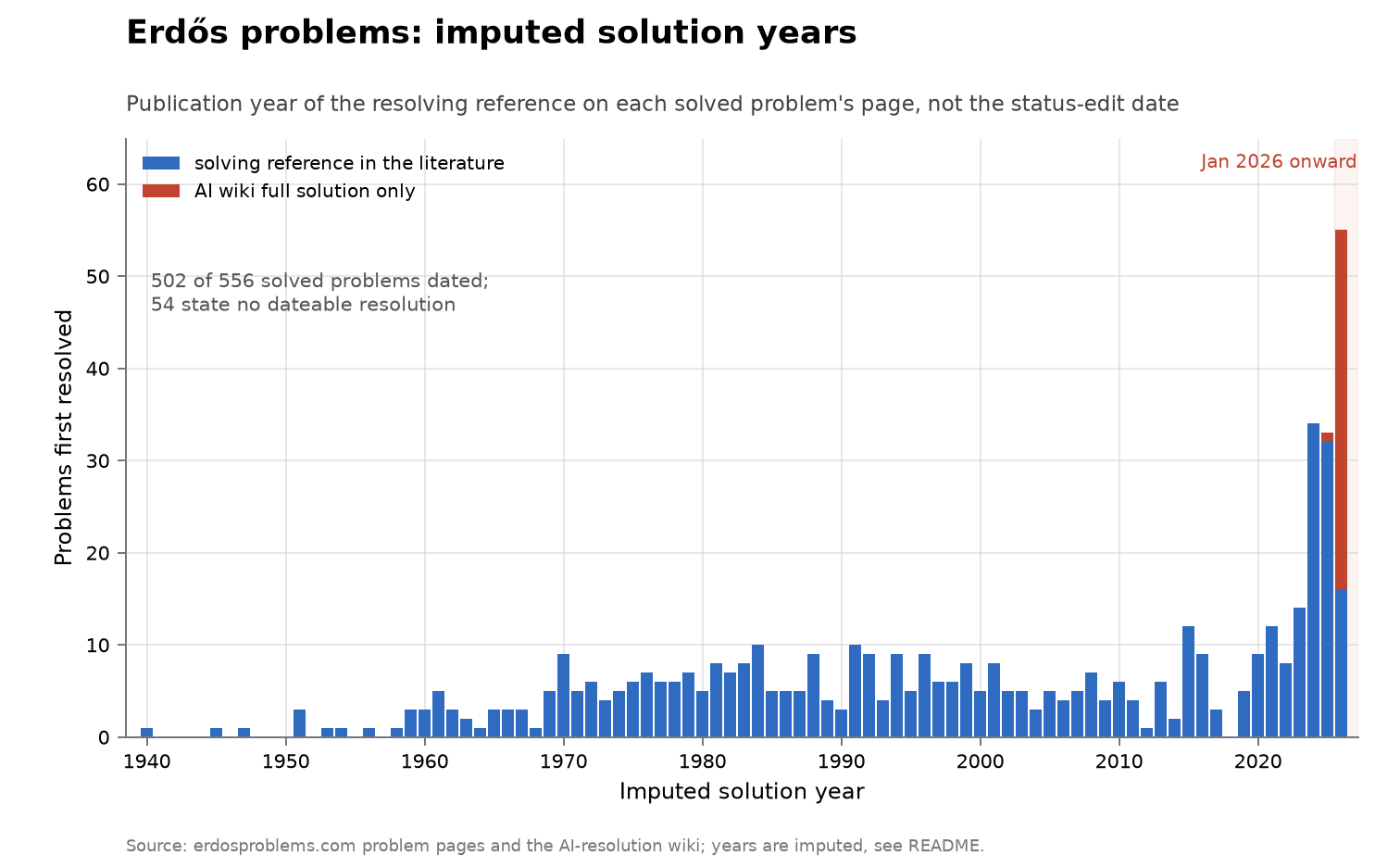
erdos-database-history.csv, erdos-solution-years.csv, erdos-solution-year-overrides.csvBars count solved problems by the year of their resolving reference; see the folder README for the imputation rules.
Each point is one solved problem; clicking opens its page on erdosproblems.com.
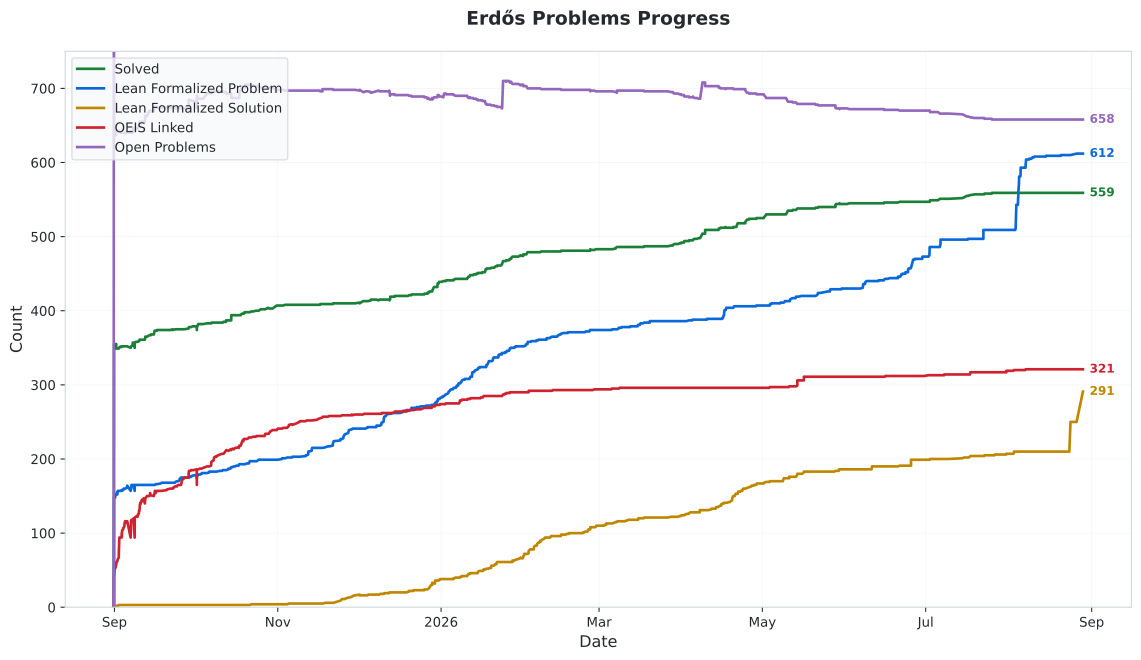
Monthly stocks from the project's statistics history.
The Erdős problems catalogue is a community register of the problems Erdős posed, one page per problem, each carrying a status and increasingly a Lean formalization of its statement [@erdosproblems2026catalogue]. The project publishes a per-commit statistics history of three stocks — problems catalogued, statuses marked solved, statements formalized in Lean — and a separate wiki attributing contributions to AI systems, which stopped updating on 2026-06-30 [@erdosproblems2026wiki]. The catalogue itself, including problem statuses, is still edited past that date.
This folder holds two instruments over that corpus.
The snapshot series counts the three stocks at one snapshot per month. A "discovery" at this level is a status edit from open to solved — a bookkeeping event, and the site itself warns that the edit can follow the underlying solution by weeks, months, or decades [@erdosproblems2026catalogue]. The series shows how many problems carry a solved status at each date, not how many were solved in a given month.
The imputed series assigns each solved problem a solution year. A solved problem's page usually states what resolved it — "Solved by Maynard [Ma16]" — and the page's bibliography dates that reference; the imputed year is the publication year of the resolving reference, or, where the page cites no dateable resolution, the date in the AI wiki's primary-contribution tables. That turns the 556-row stock of solved problems into a per-year series running back to 1940. Every date in it is the publication year of the resolving work, not the day the mathematics happened, and the rules and review ledger behind it are stated under Method.
Snapshot series, from
erdos-database-history.csv:
The project publishes its own running chart of the same statistics history this folder's fetcher reads. Unlike the PNG above, the image below is upstream's and live: it keeps moving after this document's snapshot date, and its counts are the project's own.
Imputed series, from
erdos-solution-years.csv:
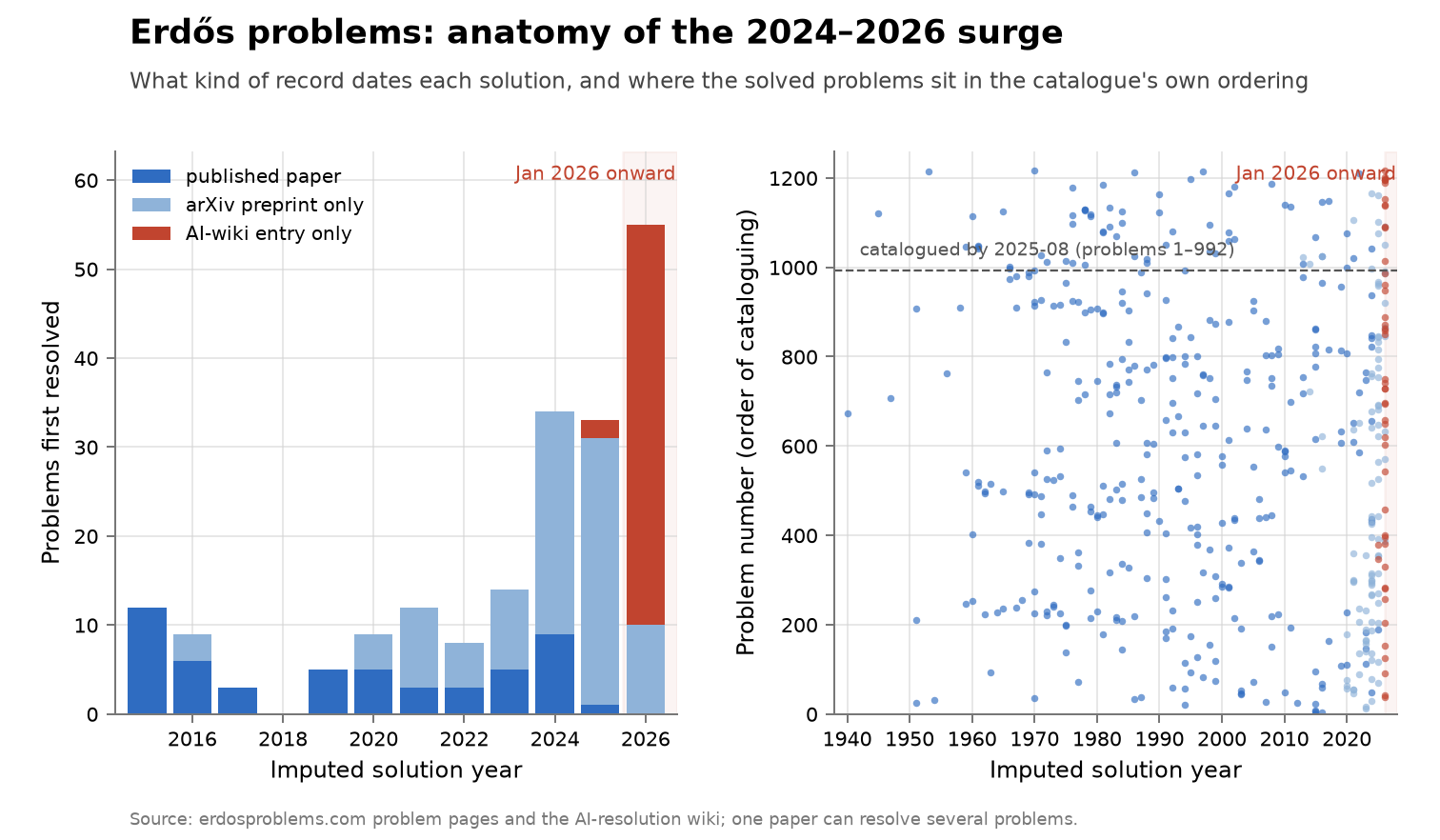
Pre-2024 dated solutions sit at every problem number: problems entered the catalogue with their resolutions already attached, so old solution years record literature archaeology rather than events observed by the site. For 2024–2025 the first snapshot is too late to order cataloguing against solution. For 2026, 41 of the 55 dated rows sat at numbers the 2025-08-31 snapshot had already catalogued.
The collection-wide cumulative index redraws the snapshot series as open problems remaining — a line that can rise, because new problems are catalogued faster than problems fall:
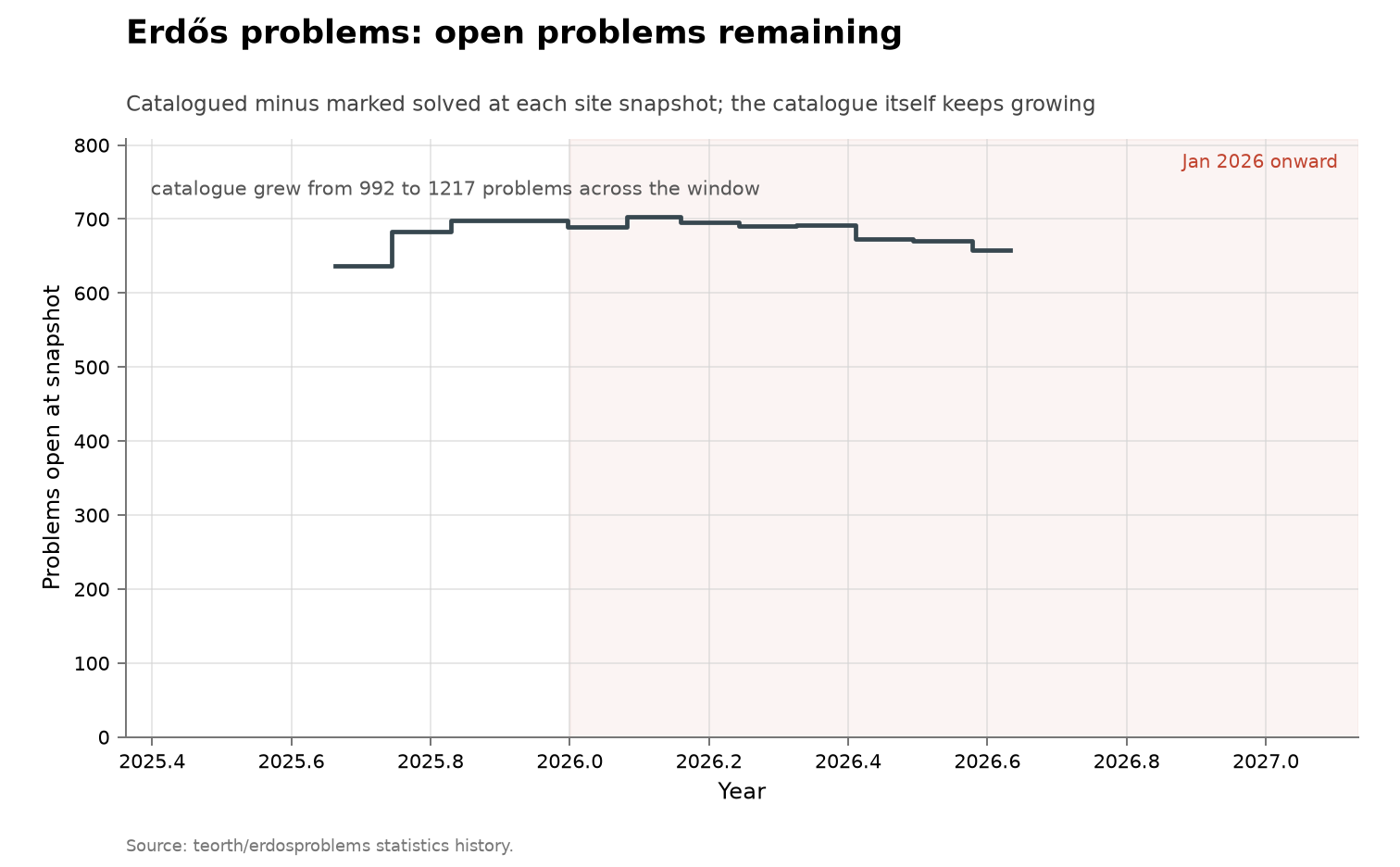
Every point in the snapshot series comes from one source, the project's
GitHub statistics history, which is what fetch.py rebuilds the
whole file from: one row per calendar month, the last snapshot in that
month. The catalogue_count_unchanged column flags snapshots where the
catalogue count holds steady from the previous one; the catalogue count
moved again at this month's snapshot (to 1,221), so the flagged run resets
to that single snapshot, 2026-09-28, and the fixed-cohort comparison below
has no elapsed window yet — once the count holds flat across snapshots
again, a rise in solved statuses over that run cannot be caused by adding an
already-solved problem. An earlier version of this series set its last point by hand from
the live website's solved-status headline; the two sources disagree — on 8
August the headline read 565 where the statistics history recorded 559 — and
a hand-set endpoint the folder's own fetcher overwrites cannot be rebuilt,
so the fetcher's value stands and the disagreement is recorded in the
three counts fact line.
The imputed years come from fetch_solutions.py,
which is run by hand rather than by make fetch because it downloads the
LaTeX source of every solved problem's page — about 560 throttled requests.
It enumerates the problems whose problems.yaml status read proved,
disproved or solved on the day it ran (556 rows, against 579 in the same
week's statistics snapshot), and imputes each a year by three rules, in
order. First, review overrides:
erdos-solution-year-overrides.csv
carries 175 hand-checkable rows, each with its reference and reason, for
pages where the mechanical rule misfires. Second, the solving citation: the
page's discussion usually attributes the resolution in a sentence like
"Solved by Maynard [Ma16]", and the imputed year is the publication year of
the newest reference cited in the first such sentence, taken from the page's
own bibliography. Third, the AI wiki: problems whose only recorded
resolution is an AI system's take the date in the wiki's
primary-contribution tables. Where a citation and a wiki date both exist the
earlier wins.
The overrides file is the review record. The sentence rule and the wiki overlay together dated 418 of the 556 pages, and every one of the 556 was then re-read against that output — a model-assisted review of each page's discussion text, spot-checked by hand — which supplied a year for 94 pages the rule had missed, corrected 71, and withdrew 10, leaving 54 problems with no dateable resolution stated anywhere on their page. Rerunning the fetcher reapplies the overrides, so the review survives a refetch until the underlying page text changes.
figure.py draws the four charts. The first plots three step
series from erdos-database-history.csv against date: total_problems as
a dashed grey line, total_solved in blue with markers, and
lean_formalized as a purple dotted line; January 2026 onward is shaded, as
in every figure here. The AI-standalone stock is drawn as a boxed callout
rather than a fourth line: it comes from a different source, frozen on a
different date, under its own definition of standalone contribution, and at
about 13 against stocks of 579 and 1,221 it would not resolve on the linear
axis. The second chart bars the solution_year column of
erdos-solution-years.csv by year, blue where the year comes from a
reference on the problem's page and red where the only dated resolution is
the AI wiki's. The third chart reads the same file's reference_kind column
— published when a dating reference carries a venue in the page's
bibliography, preprint when every dating reference is arXiv-only,
ai_wiki when the date is a wiki entry — and plots each dated solution
against its problem number, with the catalogue's size at the first snapshot
marked. The two splits are not the same rule: the second chart keys on
basis, what dated the problem after review, while the third keys on
reference_kind, what kind of reference did the dating; 7 problems whose
dates rest on the wiki but were confirmed in review are blue in the second
chart and red in the third. The cumulative view is the shared
open-problems-remaining shape.
The catalogue's AI-contribution record is the project's wiki, which states its own freeze:
"The wiki is no longer updated. The latest data is as of Jun 30, 2026." — AI contributions to Erdős problems, teorth/erdosproblems wiki, read 2026-08-14 [@erdosproblems2026wiki]
At that freeze it records roughly 47 AI-standalone contributions — about 13 full resolutions, about 25 partial, and about 9 incorrect — under disclaimers that include:
"This page is not a benchmark […] Absence of past progress may reflect obscurity rather than difficulty" — AI contributions to Erdős problems, wiki disclaimers, read 2026-08-14 [@erdosproblems2026wiki]
The one AI result with a stated denominator on this corpus is AlphaProof Nexus [@deepmind2026nexus]:
"Our most capable agent autonomously resolved 9 of 353 open Erdős problems at the per-problem cost of a few hundred dollars, proved 44/492 OEIS conjectures […]" — AlphaProof Nexus paper abstract, arXiv 2605.22763, v2 of 2026-06-08, read 2026-08-14 [@deepmind2026nexus]
Dated single events:
"Model disproves discrete geometry conjecture" — OpenAI, announcement title, 2026-05-20 [@openai2026discretegeometry]
and the argument was digested by nine mathematicians into a human-verified account (arXiv 2605.20695), with the explicit exponent, greater than 1.014, stated by Sawin (arXiv 2605.20579). The wiki's table carries the same event as "OpenAI internal model", dated "20 May, 2026", which is the date the imputed series records for problem 90. - OpenAI's 2026-08-01 Astra release — ten claimed solutions published with a 249-page manuscript and public Lean 4 certificates — includes, per the press account cited, "three problems from Paul Erdős's famous catalogue, including problem 183 on multicolored Ramsey numbers" [@openai2026astra]. The claims post-date the wiki freeze and were awaiting peer review as of 2026-08-14; the catalogue's pages for problems 146, 180 and 183 all still read open with no mention of the claims, read 2026-08-14, and none of the three appears in the wiki's tables.
On scale, Tao's statement in the 2026-03-20 interview:
"Fifty-odd problems have been solved with AI assistance, which is great, but there's like six hundred to go" — Terence Tao, interview with Dwarkesh Patel, 2026-03-20 [@tao2026interview]
The snapshot CSVs themselves carry no finder attribution; the AI/human split
in the imputed series is the basis and reference_kind columns' record of
whether a row's date rests on the wiki, as stated in Method.