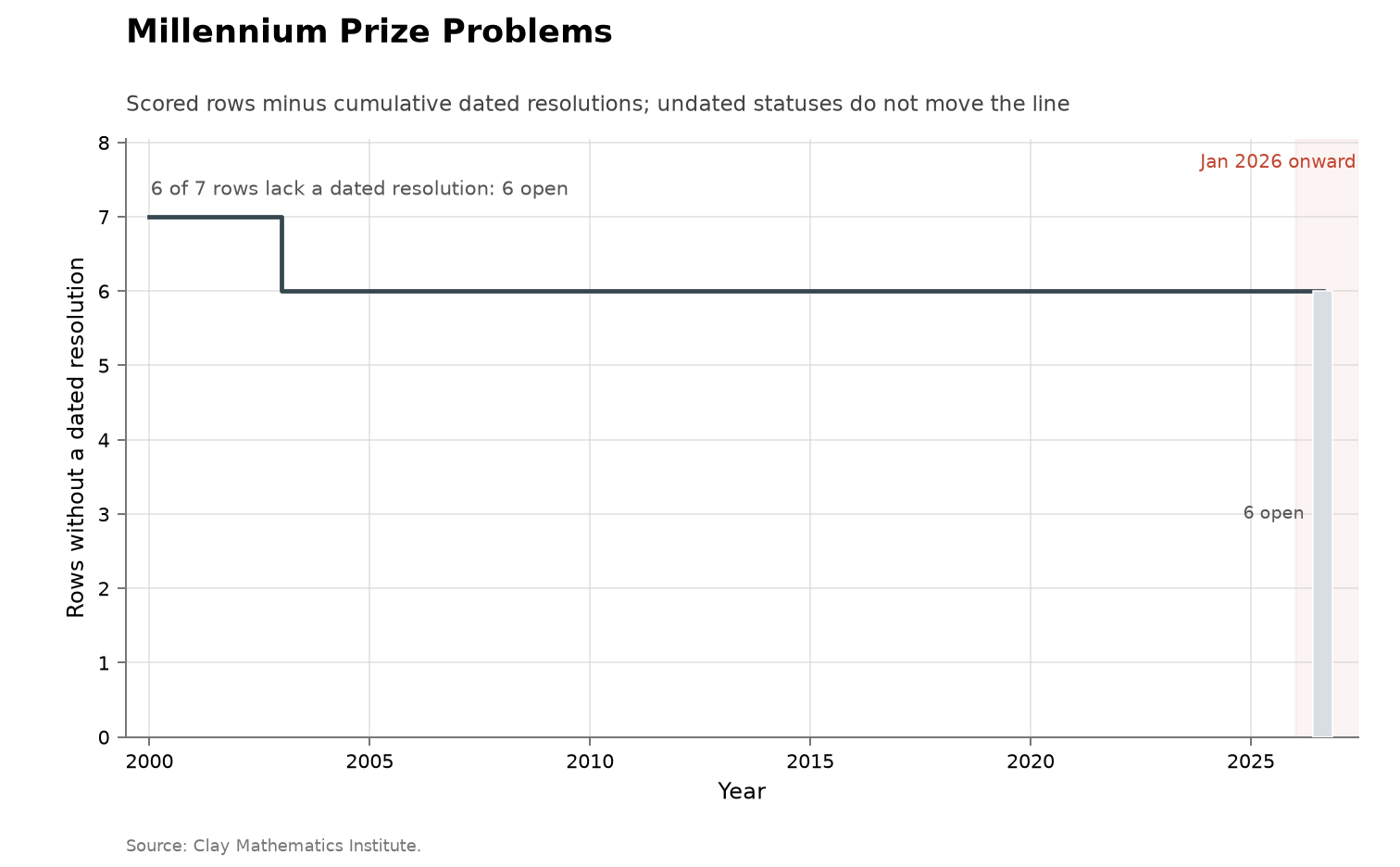
millennium-problems.csvOpen problems sit on the right edge. Hover a point for resolver and notes.
The Clay Mathematics Institute named seven problems in 2000 and attached a
US$1 million prize to each [@clay2000millennium]. A "discovery" in this
series is a row moving to resolved, dated by the year of the resolving
work. The list needs no subproblem splitting: seven problems, one resolved,
one claimed, five open. A claimed row is a resolution its authors have
announced that the Institute has not accepted and no journal has refereed;
it carries the announcement year and contributes nothing to the series.
The one resolved row is the Poincaré conjecture. The ledger dates it 2003,
the year of the last of Perelman's arXiv preprints; the row's notes column
records that the preprints ran 2002 to 2003 and that the prize was announced
in 2010.
The collection-wide cumulative index redraws the ledger as rows remaining:
"Nearly a century passed between its formulation in 1904 by Henri Poincaré and its solution by Grigoriy Perelman, announced in preprints posted on ArXiv.org in 2002 and 2003." — Clay Mathematics Institute, Poincaré Conjecture page, read 2026-08-14 [@clay2000millennium]
"For every positive viscosity, we prove two results: Whole space ℝ³: There exist smooth initial data and forcing for which no global smooth solution with uniformly bounded kinetic energy exists. Periodic torus ℝ³/ℤ³: There exist smooth periodic initial data and forcing for which no global smooth solution exists." — OpenAI, NavierStokesAndEuler repository README, read 2026-09-13 [@openai2026navierstokes]
"These are alternatives (C) 'Breakdown of Navier–Stokes solutions on ℝ³' and (D) 'Breakdown of Navier–Stokes Solutions on ℝ³/ℤ³' in the Clay Mathematics Institute's official problem description of the Navier–Stokes existence and smoothness Millennium Prize Problem." — OpenAI, NavierStokesAndEuler repository README, read 2026-09-13 [@openai2026navierstokes]
The seven rows are hand-scored; the source column names the page each
row's status rests on, the Clay Mathematics Institute's own pages for six of
them and, for the claimed row, the repository OpenAI published its proof
certificates in; there is no fetch.py. The Institute's site lists the
Poincaré conjecture under solved problems and the other six as open. Of the
three candidate dates for the one resolution — preprints 2002–2003, prize
announced 2010 — the resolved_year takes 2003, the end of the preprint
span. The claimed row's resolved_year is the announcement year, 2026; the
status moves to resolved or contested when the Institute's own listing
does, and the row is re-read each time the ledger is.
figure.py calls the shared problem_list_chart() in
../../lib/families.py, which keeps the rows whose
status is resolved with a non-empty resolved_year and counts
resolution events by year from the 2000 list_year to the present. No
ai_problem argument is passed, because no dated resolution carries an AI
credit. The cumulative view is the shared ledger_remaining_chart(), whose
drawn line ignores the claimed row; the data file it writes beside the PNG
also carries a tentative line that steps down at 2026 as if the claim held,
which the collection's comparison page shows on request.
check.py recomputes the fact lines and the register entries
from the CSV.
The one dated resolution is Perelman's, dated 2003, with no AI credit. The
claimed row names an AI system: its resolver column reads "OpenAI internal
multi-agent system; Lean-checked; announced 2026-09-08", and the register
entry above quotes the result as the repository's README states it
[@openai2026navierstokes]. The claim is not a dated resolution in this
series and the ai-attributed fact line counts 0 of 1. No AI credit
appears on the Clay Mathematics Institute's problem pages as of the
2026-08-14 read.