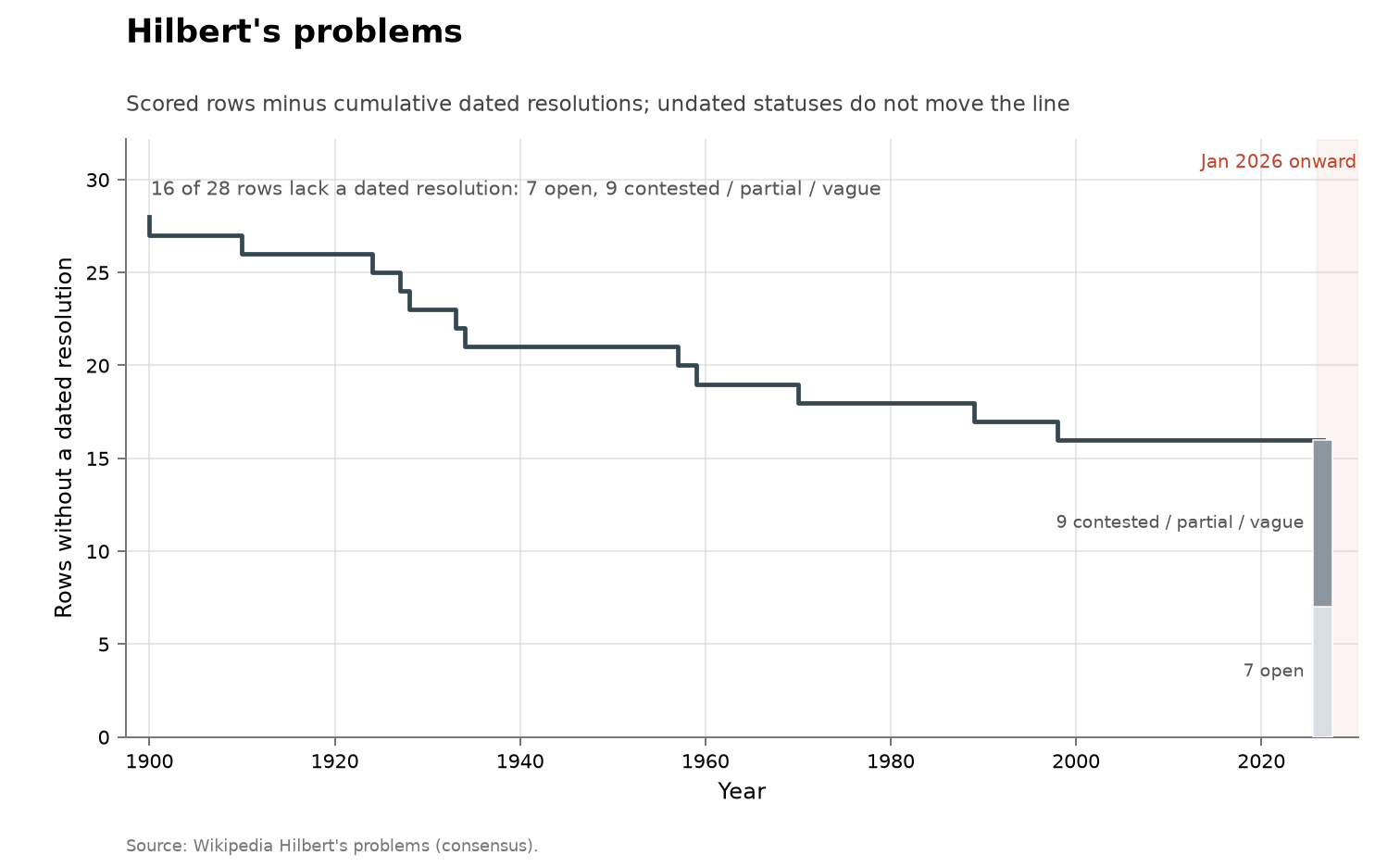
hilbert-problems.csvOpen problems sit on the right edge. Hover a point for resolver and notes.
David Hilbert stated his list of mathematical problems in 1900. The ledger here scores the standing of each problem as recorded in the Wikipedia problem table [@wikipedia2026hilbert], with 28 rows rather than 23 problems: problems 6, 8 and 18 are split into parts tracked separately (6a/6b, 8a/8b/8c, 18a/18b/18c), and the unpublished 24th problem is not scored.
Each row carries one of four statuses. A resolved row has a
resolved_year, the year the consensus account gives for the resolving
work, and is one event in the series. An open row has no resolution claim.
A contested row has a claimed or partial resolution without consensus that
it settles what Hilbert asked; the continuum hypothesis (row 1) is scored
contested because the Gödel–Cohen independence results are not agreed to
answer Hilbert's statement. A vague row (4 and 23) is not stated precisely
enough to score either way. Only resolved rows with a dated year count as
events; contested and vague rows contribute nothing to the series.
The collection-wide cumulative index redraws the ledger as rows remaining:
"Resolved. Result: No, proven by Max Dehn using Dehn invariants." — Wikipedia, Hilbert's problems, problem 3, read 2026-08-14 [@wikipedia2026hilbert]
"Resolved. Result: Yes (by Ludwig Bieberbach)" — Wikipedia, Hilbert's problems, problem 18, read 2026-08-14 [@wikipedia2026hilbert]
"Resolved. Helmut Hasse in 1924 created a general theory of classification and deciding solvability of quadratic forms over number fields using the local-global principle." — Wikipedia, Hilbert's problems, problem 11, read 2026-08-14 [@wikipedia2026hilbert]
"Resolved. Result: Yes, due to Emil Artin." — Wikipedia, Hilbert's problems, problem 17, read 2026-08-14 [@wikipedia2026hilbert]
"Resolved. Result: Yes (by Karl Reinhardt)." — Wikipedia, Hilbert's problems, problem 18, read 2026-08-14 [@wikipedia2026hilbert]
"(a) Resolved. Kolmogorov's axiomatics is accepted as the foundation of probability theory." — Wikipedia, Hilbert's problems, problem 6, read 2026-08-14 [@wikipedia2026hilbert]
"Resolved. Result: Yes, illustrated by the Gelfond–Schneider theorem." — Wikipedia, Hilbert's problems, problem 7, read 2026-08-14 [@wikipedia2026hilbert]
"Resolved. Result: Yes, proven by Ennio De Giorgi and, independently and using different methods, by John Forbes Nash." — Wikipedia, Hilbert's problems, problem 19, read 2026-08-14 [@wikipedia2026hilbert]
"Resolved. Result: No, a counterexample was constructed by Masayoshi Nagata." — Wikipedia, Hilbert's problems, problem 14, read 2026-08-14 [@wikipedia2026hilbert]
"Resolved. Result: Impossible; Matiyasevich's theorem implies that there is no such algorithm." — Wikipedia, Hilbert's problems, problem 10, read 2026-08-14 [@wikipedia2026hilbert]
"Resolved. Result: No, a counterexample was shown by Andrei Bolibrukh." — Wikipedia, Hilbert's problems, problem 21, read 2026-08-14 [@wikipedia2026hilbert]
"Resolved, by computer-assisted proof (by Thomas Callister Hales) and later with a machine-verified proof in project flyspeck." — Wikipedia, Hilbert's problems, problem 18, read 2026-08-14 [@wikipedia2026hilbert]
"There is no consensus on whether this is a solution to the problem." — Wikipedia, Hilbert's problems, problem 1, read 2026-08-14 [@wikipedia2026hilbert]
"There is no consensus on whether the results of Gödel and Gentzen give a solution to the problem as stated by Hilbert." — Wikipedia, Hilbert's problems, problem 2, read 2026-08-14 [@wikipedia2026hilbert]
"Too vague to be stated resolved or not." — Wikipedia, Hilbert's problems, problem 4, read 2026-08-14 [@wikipedia2026hilbert]
"Depends on the interpretation of "continuous group". If the term is understood as a topological group that is also a topological manifold: yes, proven by Andrew Gleason. If "continuous group" is understood as a topological group acting on a manifold, the problem becomes the Hilbert–Smith conjecture, which is still unresolved." — Wikipedia, Hilbert's problems, problem 5, read 2026-08-14 [@wikipedia2026hilbert]
"Depends on the interpretation of the problem." — Wikipedia, Hilbert's problems, problem 6 part (b), read 2026-08-14 [@wikipedia2026hilbert]
"Depends on the interpretation of expected results. In 1917, Erich Hecke constructed an analytic continuation for Dedekind zeta functions and proved functional equation, which allowed for obtaining results similar to that currently accessible using Riemann zeta function." — Wikipedia, Hilbert's problems, problem 8 part (c), read 2026-08-14 [@wikipedia2026hilbert]
"Depends on the variant of the problem. For the continuous variant: No; the Kolmogorov–Arnold representation theorem shows that every multivariate continuous function can be obtained through such composition." — Wikipedia, Hilbert's problems, problem 13, read 2026-08-14 [@wikipedia2026hilbert]
"Significant developments for resolving this problem have been made since the publication of the list …" — Wikipedia, Hilbert's problems, problem 15, read 2026-08-14 [@wikipedia2026hilbert]
"Too vague to be stated resolved or not. Since the list was proposed, Hilbert and many other mathematicians have made numerous contributions to the calculus of variations." — Wikipedia, Hilbert's problems, problem 23, read 2026-08-14 [@wikipedia2026hilbert]
The ledger is hand-scored from the Wikipedia problem table named in the
source column: one row per problem or subproblem, with the status and the
resolution year read off that account. There is no fetch.py; nothing
upstream publishes the table in a form a script could take, so a correction
means editing the CSV. The scoring rule is strict: contested and vague
rows carry no resolved_year and contribute no event, so rows with a
defensible claim to being settled under some reading (1, 2, 5, 6b, 8c, 13,
15) do not appear in the event count.
figure.py calls the shared problem_list_chart() in
../../lib/families.py, which keeps the rows whose
status is resolved with a non-empty resolved_year and draws one event
bar per year from the 1900 list_year to the present; a corner note states
how many of the 28 rows have dated resolutions. No ai_problem argument is
passed, because no row carries an AI credit. The cumulative view is the
shared ledger_remaining_chart(). check.py recomputes the
fact lines and the register entries from the CSV.
No row in hilbert-problems.csv names an AI system
in its resolver or notes columns; the most recent dated resolution is
problem 18c in 1998 (Hales). No AI credit appears in the Wikipedia ledger
the rows are scored from as of the 2026-08-14 read.