osv-cves-by-quarter.csv; annual osv-cves-by-year.csv; severity labels in osv-severity-by-year.csv; finder credits in osv-credits-by-year.csv; every AI-marked CVE with its credit strings in osv-ai-cves.csvThe final bar is a partial quarter; hover for the flag.
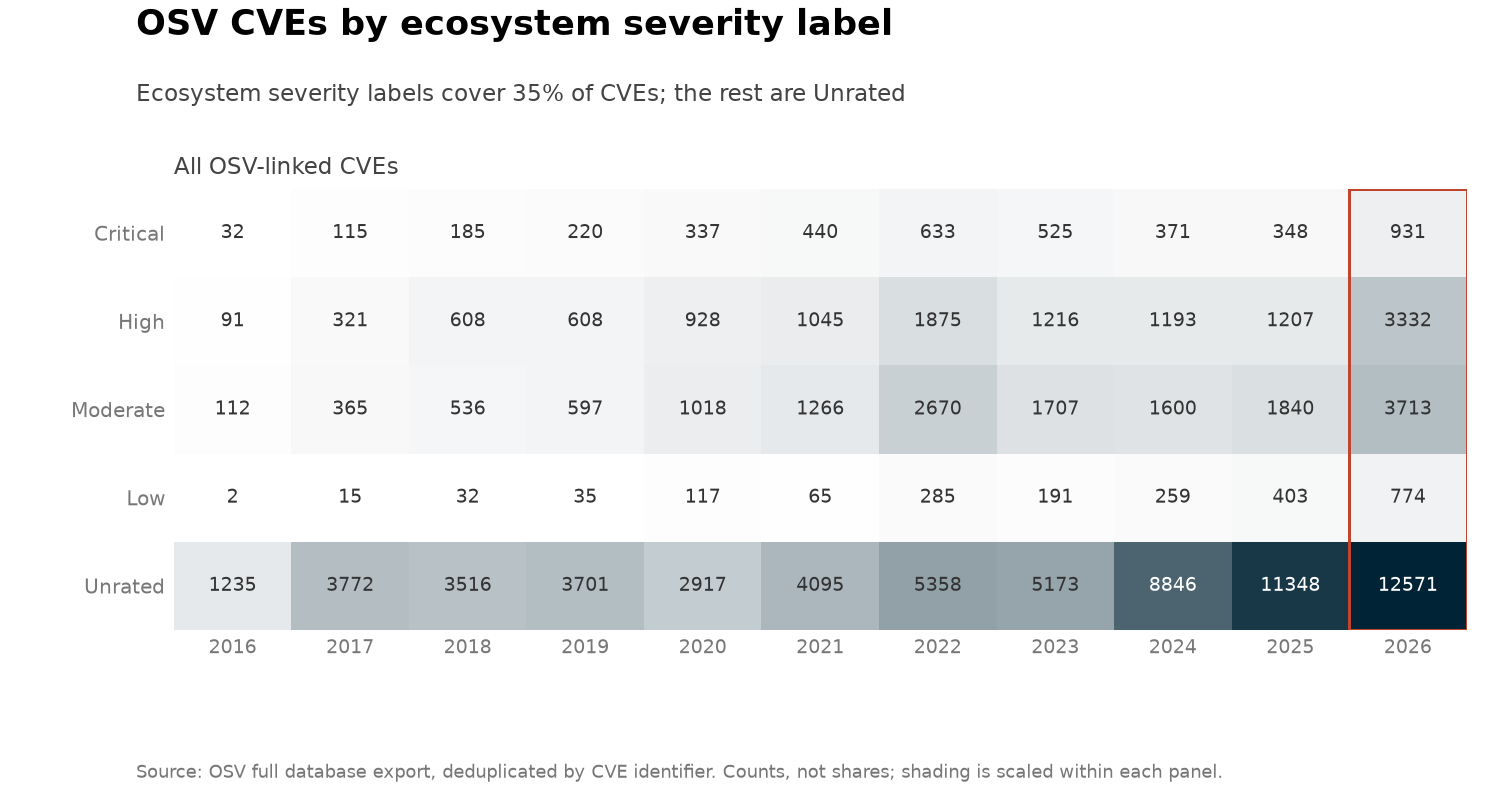
Labels cover about a third of CVEs; Unrated is missing data, not a rating.
About 1% of CVEs carry any credit; the uncredited majority is not drawn.
OSV aggregates machine-readable vulnerability records from open-source package ecosystems, project databases, Linux distributions, GitHub advisories and a converted subset of NVD [@osv2026data]. It is an all-open-source aggregate beside the all-software NVD count, and its headline series requires no finder credit.
A counted event is one distinct CVE identifier linked by at least one
non-withdrawn OSV record to an affected package. It is dated to the
earliest published date among all such records for that CVE. Multiple
distribution and ecosystem advisories pointing to the same flaw collapse to
one event; an advisory naming several CVEs contributes one event per CVE.
osv-ai-cves.csv
The severity heatmap draws the Unrated majority as its own row rather than silently dropping it. The rated mix is not a random sample: labels come from whichever upstream databases choose to assign them — GitHub's advisory database does, the converted NVD subset and several distributions do not — and that composition shifts over time, so a drift in the rated mix can be a drift in which sources publish labels rather than in the vulnerabilities themselves.
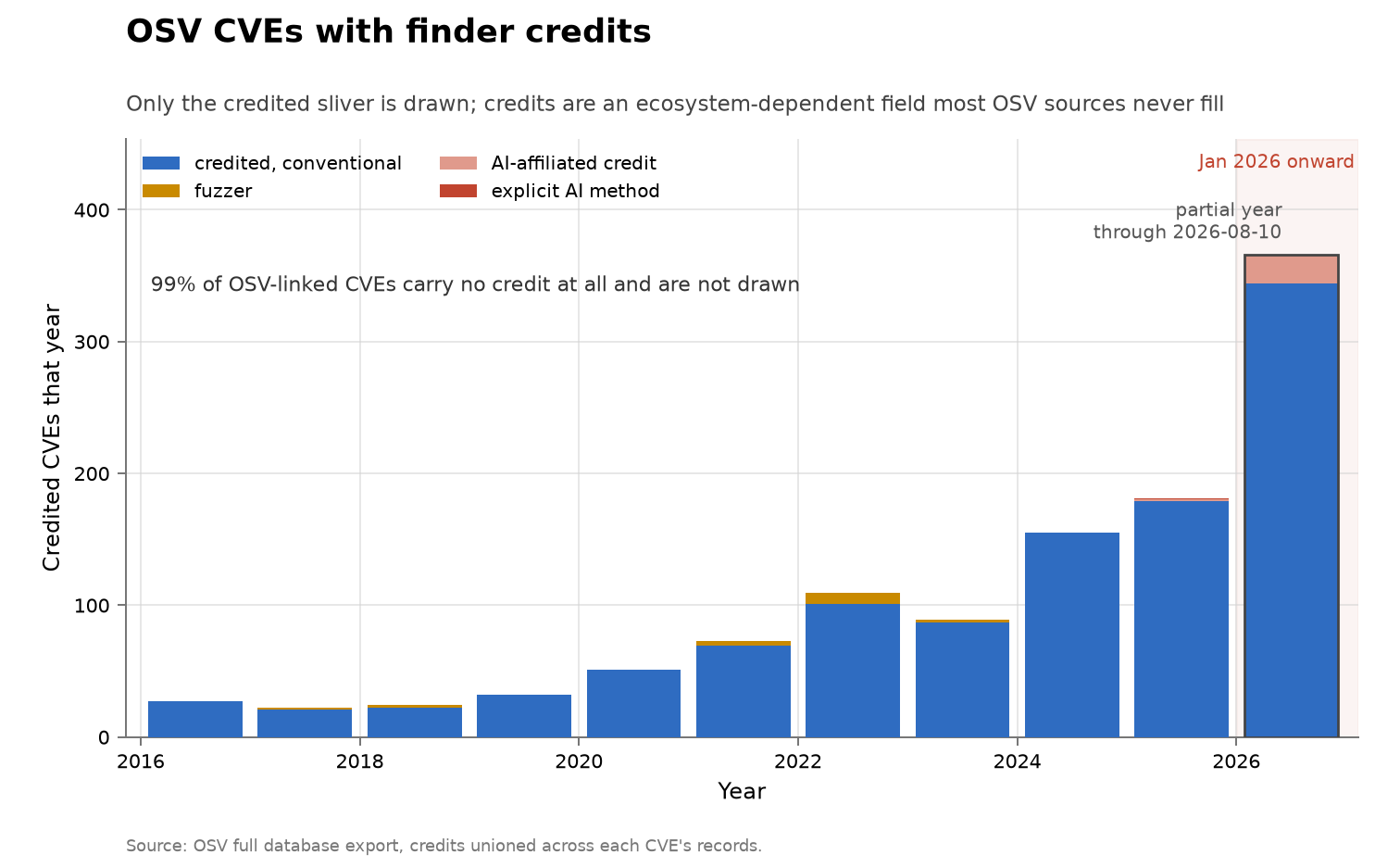
The credits chart draws the credited sliver alone, and its note states that the uncredited majority is not drawn. These counts are a floor set by which ecosystems publish credits, not a measurement of AI's share of discovery.
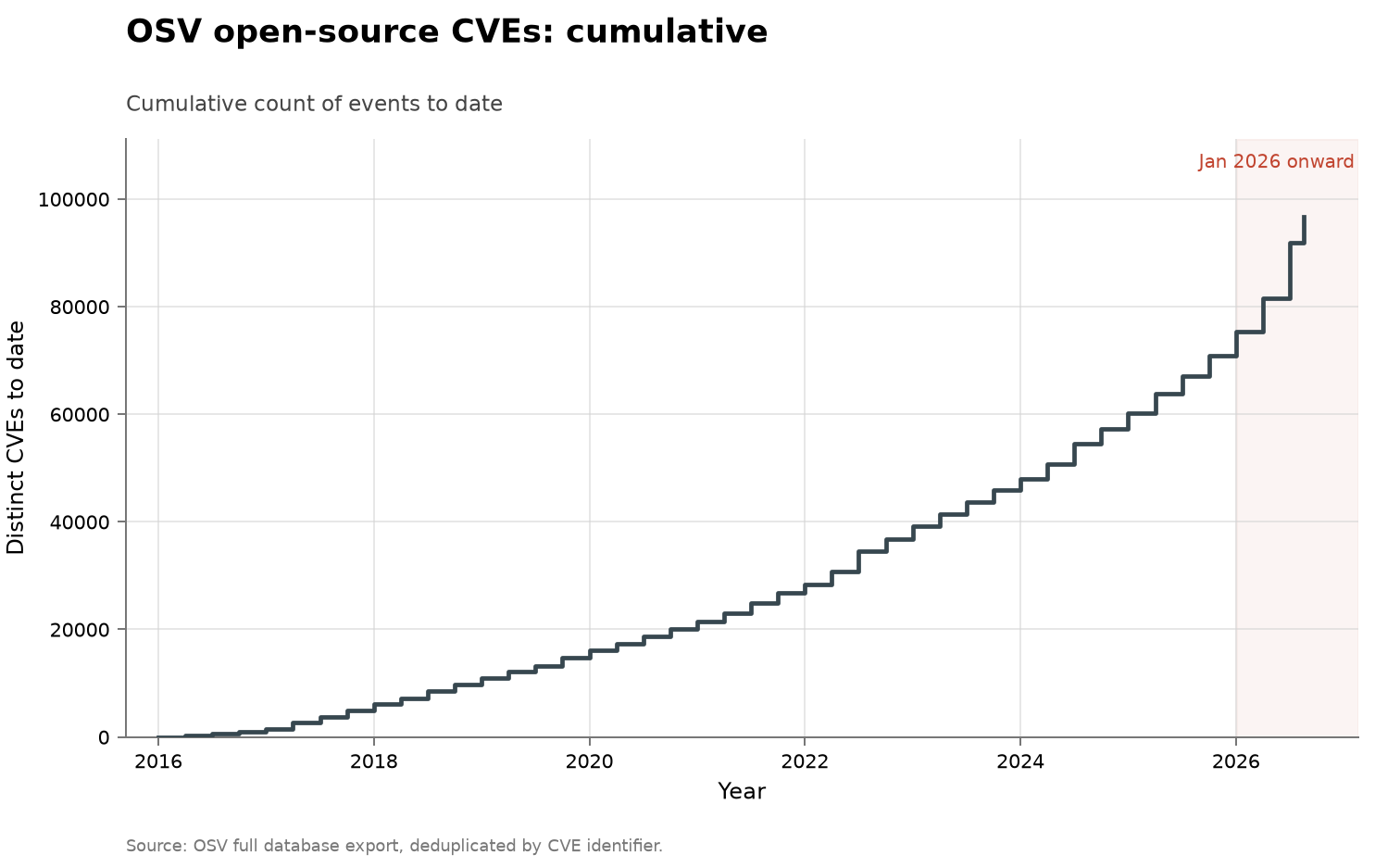
The collection-wide cumulative index redraws this series as cumulative distinct CVEs to date:
fetch.py downloads OSV's official full-database archive, then
applies the same inclusion rule to every JSON record:
published date.The second step deliberately excludes OSV's malicious-package reports,
non-security distribution updates, and advisories that have no CVE. CVEs
first published after the repository's snapshot date (AS_OF_DATE in
../../lib/dates.py) are dropped, so a refetch
reproduces the committed window.
The merged per-CVE entries feed five CSVs: quarterly and annual counts, the
severity and credits cuts, and the AI-marked ledger. Severity is the
database_specific.severity label an ecosystem database assigns
(GHSA-style LOW/MODERATE/HIGH/CRITICAL, with MEDIUM folded into Moderate),
taken at the highest label across a CVE's records; records carrying only a
CVSS vector stay Unrated rather than being scored by a calculator this
repository would then have to defend. Credits are OSV credits names
unioned across a CVE's records and classified with the shared
../../lib/credits.py rules; a CVE with no credit
on any record is uncredited, which is the majority and is its own column.
The plotted series starts in 2016. Earlier years in the present export
contain only tens or low hundreds of matching CVEs, a coverage
discontinuity rather than a measure of open-source disclosure volume.
figure.py draws the main chart from the quarterly CSV in the
shared periodic-bar shape, in the unattributed colour because the headline
count carries no finder split, with the current quarter outlined and
labelled partial; the severity heatmap and the credits chart come from
their annual CSVs, with the coverage percentages in their subtitles and
notes computed from the data at draw time. check.py
recomputes the fact lines above from the vendored CSVs.
The AI-marked ledger holds 33 CVEs. 2 carry credits stating an AI method:
"Google Big Sleep | Daniel Stenberg" — OSV credit strings for CVE-2025-9086, vendored in
osv-ai-cves.csv, read 2026-08-14"Andrew Nesbitt (powered by Mythos) | Stefan Eissing" — OSV credit strings for CVE-2026-8286, vendored in
osv-ai-cves.csv, read 2026-08-14
The other 31 carry an AI-lab affiliation with no method stated: 23 name
Aisle Research, 3 name AntAISecurityLab hackerone handles, 1 names "Filipe
Casal of Trail of Bits in collaboration with OpenAI", 2 name "Eunsoo
Kim (Autonomous Code Security team at Microsoft)" and 2 list "Anthropic"
among its credits, all quoted from
osv-ai-cves.csv as read 2026-09-28. Several of the
same credit strings appear in the curl series' finder table
(curl), which counts the same projects'
disclosures at the project level. No other CVE in the export carries any AI
marker in its credits, as of the 2026-09-28 read.