Metric: CVEs issued by Microsoft's own CNA per month, dated by first publication in the Security Update Guide, split by whether an acknowledgment credit names an AI method, an AI-security employer, a fuzzer, or none of these
Coverage: 2016–2026, partial through 2026-09-23; no February or March 2016 document exists upstream, so the first year is ten months
Verdict: accelerating — 2,961 CVEs through 2026-09-23 against 1,243 in 2025; the part year annualizes to about 3.3 times 2025
CVEs issued
The final bar is a partial month.
Definition
Microsoft ships security fixes in one coordinated monthly release — Patch
Tuesday, running since October 2003 [@arcticwolf2026june] — and publishes
each month since January 2016 as a machine-readable CVRF document in the
Security Update Guide, with acknowledgments naming who reported most
entries. A Windows vulnerability is found against shipped binaries and a bug
bounty rather than a public repository; curl, OpenSSL and Firefox, the other
finder-named codebases in this collection, are all open source.
Trackers count a given Patch Tuesday differently: Arctic Wolf counts the
June 2026 release at 206 vulnerabilities [@arcticwolf2026june], and Tenable
counts the July 2026 release at 569 CVEs while other trackers put the same
release at up to 622 [@tenable2026july]. The spread arises because the
monthly documents also republish CVEs Microsoft did not author — Chromium
fixes shipped through Edge, and from 2023 the Linux CVEs of Azure Linux —
and every tracker folds those in differently. This folder pins one rule to
the primary source: an entry counts when the CNA note in its document says
Microsoft, or when it has no CNA note at all, which is the pre-2018 document
format. Everything that rule excludes is verifiably third-party — the
excluded entries carry Chrome, Linux distribution, curl or similar CNA
notes. Each CVE is dated by the earliest revision in its history across
every document that mentions it, so an out-of-band fix lands in the month it
shipped.
A "discovery" here is one Microsoft-issued CVE first published that month.
It is a patch-and-disclosure count, not a count of bugs found or bugs
remaining.
plateau and growth: between 863 and 961 a year from 2019 through
2023; 14% growth in each of 2024 and 2025
2026 (through 2026-09-23): 2,961 CVEs, 2.38 times the 2025 full year;
annualizes to about 3.3 times 2025
record months: 220 CVEs dated June 2026, then 662 CVEs dated July
2026, 3.0 times the June figure
ai-marked: 0 before 2025; 17 in 2025; 30 in 2026, or 1.0% of the part
year — 22 name an AI system or method and 8 name only an AI-security
employer
fuzz band: never exceeds 2 CVEs in any year
acknowledgments: 87% of 2016's CVEs carry at least one named credit,
rising to 97% in the 2026 part year
no-customer-action CVEs: 23 in 2024, 68 in 2025 and 176 in the 2026
part year
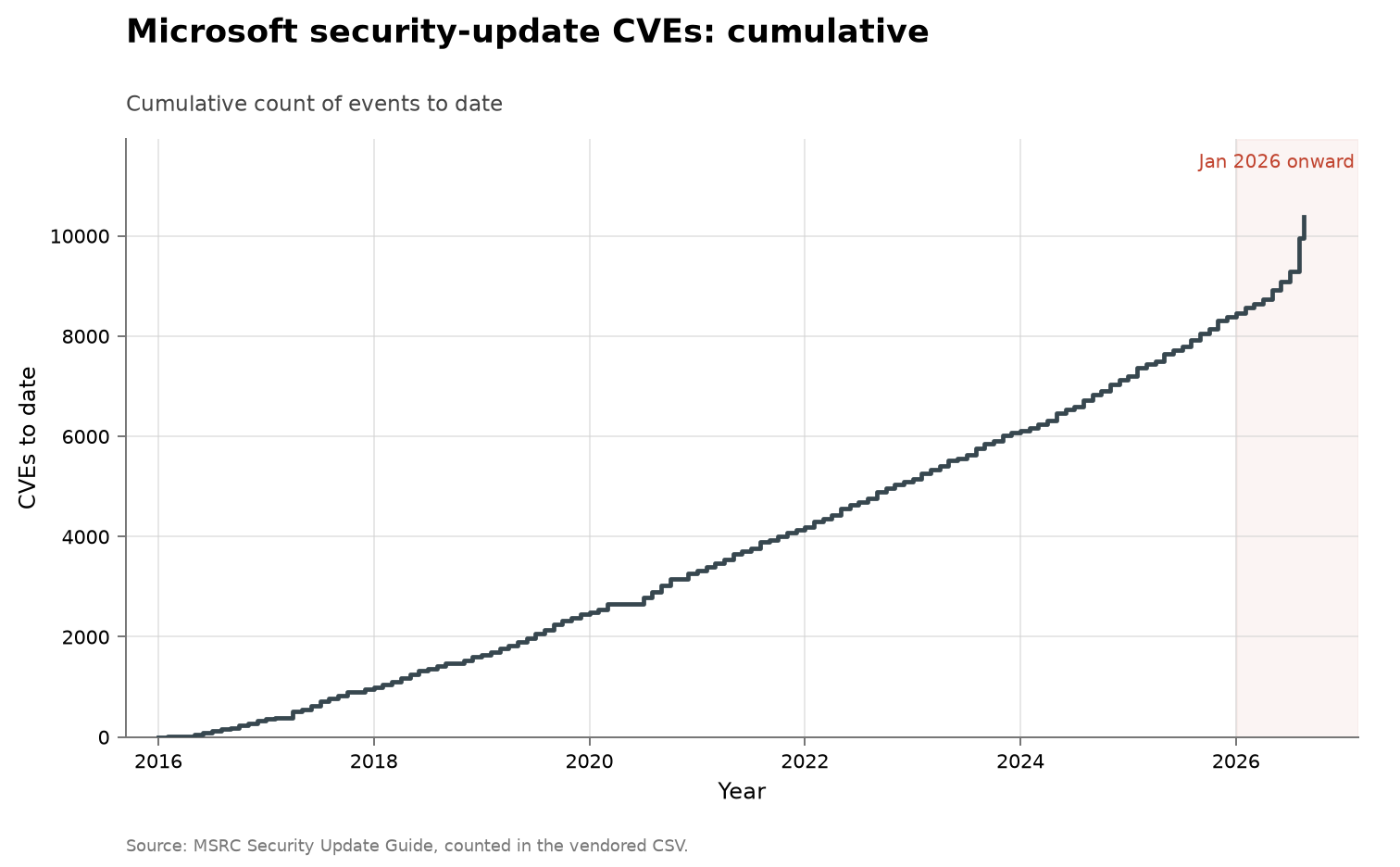
The collection-wide cumulative index redraws this
series as cumulative CVEs to date:
Method
The CSVs are built by fetch.py, which walks every monthly
security-update document in the CVRF API — matched on document title,
because the IDs are irregular — and applies the CNA rule above. Documents
released after lib/dates.py's snapshot date are skipped, so a refetch
reproduces the committed window; the vendored window ends 2026-09-23, just
after the September 2026 Patch Tuesday, released 2026-09-08. Acknowledgment strings are stripped of
HTML and classified with the shared markers in
../../lib/credits.py: EXPLICIT_AI_METHOD for a
named system or method, AI_AFFILIATION for an employer, FUZZ for
fuzzing, with one CVE's signals unioned across all its credit strings before
the display precedence — method, then affiliation, then fuzz, then none —
picks its band. Anonymized hex handles count as credits, since an anonymous
credit is still a credit. msrc-by-month.csv carries the same four bands at
the monthly grain, banded per CVE by the same rule, so the months of a year
sum to that year's row in msrc-cves.csv. The annual CSV keeps an
acknowledged column beside the bands, and a no_customer_action column
counting the cloud-service CVEs Microsoft patches itself, so both facts stay
auditable.
figure.py draws stacked monthly bars from msrc-by-month.csv:
other in blue, fuzz in amber, ai_affiliated in pale red and
explicit_ai in full red, in the same bands and colours as the
Firefox series. No bar is drawn partial —
Microsoft ships one coordinated release per month, and the final month's
release is in the data — and the on-chart note states where the data stop.
January 2026 onward is shaded, as in every figure here. The axis is linear
and nothing is normalized. check.py recomputes the fact lines
above and fails when the monthly, annual and per-CVE files stop agreeing.
Limitations
a disclosure is not a discovery, and here it is not dated like one.
CVEs are batched to a monthly release cadence and published when fixed,
not when found or reported; the 662 CVEs of July 2026 are a release
event, and the gap between report and patch can be months. The count
moves with Microsoft's triage and engineering throughput as well as with
anyone's rate of finding.
vendor policy moves the count. In mid-2024 Microsoft began issuing
CVEs for cloud-service flaws it patches itself, with no customer action
required: 23 CVEs in 2024, 68 in 2025 and 176 in the 2026 part year.
Removing that column entirely leaves the 2026 rise in place; other policy
shifts would not be so visible.
the AI share has error in both directions. Acknowledgments are free
text; a researcher who used a model silently counts as human, an
affiliation-only credit may not have used one, and the SEC-agent team's
marker is the word "agent" in its own name. Only the method-naming
credits are evidence about how a bug was found, and even those are the
finder's own account.
no severity or depth comparison. The documents rate severity, but
this folder has not extracted it, so a 2026 CVE cannot be compared in
consequence with a 2019 one here.
the codebase is fixed but the surface and the effort are not.
Microsoft added cloud services, acquired products and an expanded bounty
over the period, and nothing here gives a denominator of code or search
effort.
edges of coverage. The first year is ten months; a month with no
bar — February 2017, for one — is a month in which no CVE has its
earliest publication; 2026 is a part year through 2026-09-23, ending just
after the September Patch Tuesday rather than on a complete calendar
month. The rare
Microsoft-product CVE issued by another CNA — a 2022 Windows SMB flaw
issued by Rapid7's CNA, for instance — is excluded by the counting rule.
AI attribution
Every AI-marked CVE is itemized with its full credit strings in
msrc-ai-cves.csv; the quotes below are read from that
file as vendored, 2026-09-14. No AI marker appears in any acknowledgment
before 2025, as of the 2026-09-23 snapshot.
SEC-agent team. All 17 AI-marked CVEs of 2025 carry a SEC-agent
credit, 14 of them jointly with ENKI WhiteHat, and 15 of 2026's 30
AI-marked CVEs carry one. The team's SLYP pipeline runs LLM agents
against Windows COTS binaries [@secagent2026slyp].
"Hwiwon Lee (hwiwonl), SEC-agent team | Jongseong Kim (nevul37),
SEC-agent team with ENKI WhiteHat"
— MSRC acknowledgment strings for CVE-2025-53802, vendored in msrc-ai-cves.csv, read 2026-09-14
Claude and Anthropic. 7 of 2026's AI-marked CVEs credit Claude or
Anthropic [@anthropicmythos2026]. One of them, CVE-2026-33096, is
co-credited to "WARP & MORSE teams at Microsoft".
"Calif.io in collaboration with Claude and Anthropic Research"
— MSRC acknowledgment for CVE-2026-40380, vendored in msrc-ai-cves.csv, read 2026-09-14
XBOW. 3 CVEs credit "XBOW", an affiliation with no method stated.
OpenAI. The remaining 5 CVEs each carry a credit naming OpenAI, all
affiliations with no method stated. Two, dated 2026-08-11, are credited
solely to "Thomas Neil James Shadwell (zemnmez) with OpenAI"; the other
three, dated 2026-09-08, name OpenAI in differing strings — that same
Shadwell credit among six credits on one CVE, "Khai Tran with OpenAI"
among three on another, and "Hung Nguyen (mov) of Calif.io in
collaboration with OpenAI Codex Security" on the third.
Sources
[@msrc2026sug] — the CVRF API; the primary source every vendored count
here aggregates.
[@arcticwolf2026june] — Arctic Wolf's June 2026 recap: 206
vulnerabilities, called the largest single security update since the
program began in October 2003.
[@tenable2026july] — Tenable's July 2026 recap: 569 CVEs, with other
trackers putting the same release at up to 622.
[@secagent2026slyp] — the SLYP pipeline behind the SEC-agent credits:
LLM agents over binary-exploration and debugging MCP servers.
[@anthropicmythos2026] — Anthropic's Mythos preview, background on the
vendor named in the Claude credits.
[@bloomberg2026recordflaws] — press reporting connecting 2026 disclosure
records to AI systems; on this vendor the AI-marked share of the part
year is 1.0%.
[@hackerone2025autonomy] — HackerOne's platform statistics, the only
public figures on how many reports autonomous systems file.