7 Marin
This section applies the RSI-tracking template (“Tracing the Path of RSI”, the one-page prioritised list from Cunningham et al. 2026) to Marin as if Marin were a frontier lab being asked to report: internal capabilities, efficiency gains, and the inputs behind the gains. For each item it records what Marin actually publishes, a best-guess estimate where the record allows one, and how much to trust it. The data behind every number is in the Marin chapter and data/. Marin is a useful test case precisely because nothing is hidden: whatever is missing here is missing because the lab never produced the number, not because it withheld it.
| area | item | what Marin publishes | best guess | confidence |
|---|---|---|---|---|
| Capabilities | ECI of latest model | Not listed on ECI (not checked directly; epoch.ai unreachable from this environment) | 8B is at Llama 3.1 8B level (beats it on 14 of 19 tasks); 32B at Gemma 3 27B PT / OLMo 2 32B level. Read the peer's ECI as a proxy. | guess |
| Capabilities | Internal capability index | 19-task base average, MMLU, Paloma losses, for released bases only | 19-task: 66.6 (8B, May 2025) to 65.2 (32B, Oct 2025); MMLU 67.6 to 74.7. No post-trained series. Snowball and 535B: no evals yet. | reported |
| Capabilities | Unsaturated benchmarks | 19-task suite is base-model and largely saturated (the 32B scores below the 8B on it) | Only the 2026 SFT sweep uses unsaturated targets (AIME, HMMT); no frontier-difficulty evals of released models. | reported |
| Efficiency | Overall efficiency gain, pretraining | Not stated by the lab; derivable from finished-run endpoints | About 7x less compute for c4_en 2.35 from the 2025 recipe to Delphi (Mar 2026), plus about 2x from MoE on active-parameter compute: roughly 10x per year, of which perhaps half is compute-optimal allocation rather than algorithm. | derived |
| Efficiency | Efficiency gain, post-training | One SFT data-scaling sweep (2026); no time series, no RL | Cannot be estimated: a single point in time. | none |
| Efficiency | Small-scale validation before big runs (leading indicator) | Published, pre-registered, with errors: Delphi 1e23 within 0.2% at 300x; MoE 1e21 within 0.3%; 1e23 MoE within 1%; 535B forecast pending | Marin's 2026 practice matches the template exactly; the 2025 runs had no such step. | reported |
| Inputs | Labour headcount and compensation | 1 FTE (2025) to about 10 FTE (2026, Open Athena), stated; no compensation, function or seniority data | Fully loaded US research staff at $300k to $500k: about $0.4M (2025) and $3M to $5M a year (2026). Plus unpaid Stanford students and community contributors, uncounted. | guess |
| Inputs | Experimental compute, quantity | Per run from public logs; no total stated | 2025: about 1.4e24 FLOPs in abandoned trials and discarded cooldowns (around 1M H100-hours equivalent), about half of that year's logged compute. 2026: about 1.1e23 in Delphi and ladders plus under 1e22 in the 80 agent-run MoE cells and the SFT sweep, about 4% of 2026 logged compute. | derived |
| Inputs | Experimental compute, expenditure | Zero cash: TPUs from Google TRC, GB200 from the Huang Foundation via CoreWeave | List-price value about $2M (2025) and $0.3M (2026) for experiments; the foundation's total CoreWeave purchase is about $108M across all grantees. | derived |
| Inputs | Inference compute, quantity and expenditure | Not stated; no RL rollouts published | Evaluation only: the 6,153 evalchemy runs of the SFT sweep at up to 32k tokens per answer are of order 1e10 tokens, negligible against training. Would change if Snowball RL ships. | guess |
| Inputs | How AI generates efficiency gains | 80 agent-run MoE experiments (Mar to Aug 2026): 16 worked, 9 promising, 13 mixed, 32 did not work, 6 not evaluated, 4 in progress | About 20% of autonomous small-scale experiments produced a usable improvement, screened by an effective-speedup metric against the scaling-law baseline; researcher-uplift is not measured. | reported |
7.1 Capabilities
Marin’s models are not, to our knowledge, on Epoch’s Capabilities Index, and Marin runs no frontier-difficulty evaluation of its released bases. The lab’s own index is the 19-task base-model average, which is saturated enough that the 32B scores below the 8B on it while gaining seven points of MMLU. A proxy ECI is readable from peers: Marin 8B matches Llama 3.1 8B on Marin’s harness, and the 32B roughly ties Gemma 3 27B PT. Two data points a year apart do not support a growth-rate estimate, and there is no post-trained series at all. What the template asks for and Marin lacks is a fixed, unsaturated internal suite scored on every candidate checkpoint; the closest thing Marin has is the per-checkpoint Paloma loss, which is a loss, not a capability.
7.2 Efficiency gains
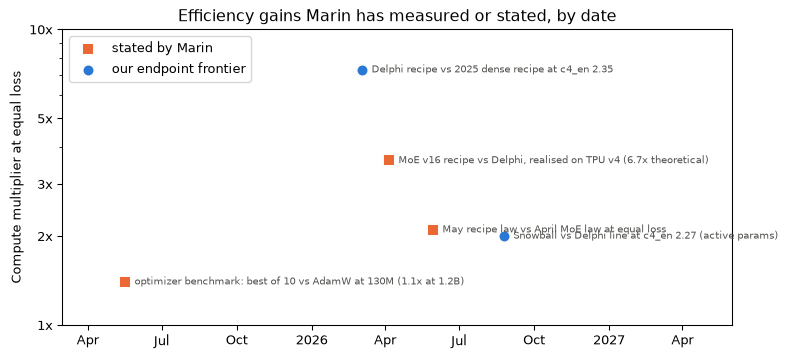
Marin does not state an efficiency-gain figure, but its record supports one, worked out in the Marin chapter’s recipe-generation section: at a fixed c4_en loss the compute needed fell about 7x between the 2025 dense recipe and Delphi (March 2026), and MoE bought about 2x more on active-parameter compute. Annualised that is of order 10x per year, well above the 2.5x to 3x per year that Epoch’s Ho et al. (2024) estimate for algorithmic progress in pretraining across the field. The gap is expected: a small lab adopting known techniques (compute-optimal allocation, a modern optimizer, MoE) catches up faster than the frontier moves, and part of the 7x is allocation rather than algorithm. Marin’s own multipliers, on its Paloma macro loss, are drawn below with ours.
Post-training efficiency cannot be tracked at all: the 2026 SFT sweep is a single time point, and there is no RL. The leading-indicator half of the template, small experiments that reveal a big run’s efficiency before it is cashed in, is where Marin is strongest. Since March 2026 every large run has been preceded by a published, pre-registered forecast, and the forecast errors are public: 0.2 percent for Delphi’s 1e23 model at a 300x extrapolation, 0.3 percent for the MoE law at 1e21, within 1 percent for the 1e23 MoE hero run, and a live forecast for the 535B. Anyone tracking Marin can therefore read the efficiency of the 535B recipe from its ladder months before the run finishes, which is exactly the property the template wants.
7.3 Inputs to efficiency gains
Labour. Headcount is stated in outline: one core FTE through 2025, about ten under Open Athena by 2026, plus Stanford students and community contributors who are not counted. No compensation, function or seniority breakdown exists. At a fully loaded $300k to $500k per research FTE, Marin’s labour bill went from under half a million dollars in 2025 to $3M to $5M a year in 2026, a roughly tenfold rise that coincides with the 7x efficiency gain. That coincidence is the template’s central warning: on Marin’s record the gain cannot be separated from the labour increase, so it is not evidence of AI-driven acceleration.
Experimental compute. The logged non-final compute is about 1.4e24 FLOPs in 2025 (the 13B/24B/70B trials and the discarded 32B cooldown, roughly a million H100-hours equivalent or $2M at list price, about half of that year’s total) and about 1.1e23 in 2026 (Delphi and the ladders, plus under 1e22 for the 80 agent-run MoE cells and the SFT sweep), about 4 percent of 2026’s total. The 2025 figure is a different kind of spend: failed scale-ups rather than experiments designed to inform. Marin paid nothing in cash for any of it. The 446-issue long tail of small ablations has no compute attached and is a floor on both years.
Inference compute. Nothing is stated. The only inference-heavy activity in the record is evaluation: the SFT sweep’s 6,153 evalchemy runs at up to 32k tokens per answer are of order 1e10 tokens in total, negligible against training. If Snowball’s RL ships, rollout compute will be the first inference line item that matters, and it is not yet public.
How AI contributes. Marin is one of the few labs with a public number here. Between March and August 2026 it ran 80 “Agent MoE” experiments, small-scale A/B tests of attention, routing, expert, optimizer and normalisation changes proposed and executed by AI agents and gated by an effective-speedup metric against the fitted scaling law. The digest scores them 16 worked, 9 promising, 13 mixed, 32 did not work, 6 not evaluated and 4 in progress: about a 20 percent hit rate on autonomous small-scale research, feeding the May 2026 recipe. What is not measured is researcher uplift on the human side, and there is no statement of how much of the 2.1x April-to-May gain came from the agent-run cells rather than from the ten people. The survey question the template leaves blank would, for Marin, be: of the changes that made it into the May recipe, how many were first proposed by an agent, and what fraction of the team’s experiment throughput in 2026 was agent-executed?
Bottom line. Marin’s 2026 record shows a fast efficiency gain (order 10x a year at fixed loss), a working leading-indicator practice (pre-registered forecasts on every big run), and a documented AI contribution (80 agent-run experiments at a 20 percent hit rate). It also shows a tenfold labour increase over the same period, no capability index that would register the gain, and no post-training series. On the template’s own logic, Marin is a lab where the inputs grew as fast as the outputs, which is the case the template says should not be read as RSI.